The Circle charter is the set of rules that protect the room, including from us. A club is only as useful as the things people are willing to say in it. These rules exist so that a head of data platform can say what a migration really cost, and a site leader can say what HQ really thinks, without either sentence ever being used against them.
6
rules in the Circle charter, binding the convener as tightly as every member
1
strike under Chatham House; no warning stage
0
sponsors, data sales or sales conversations, ever
5
elected council members decide breaches; fsyncDATA has no seat
01
Why the Circle charter exists
Most professional communities have a code of conduct. Few have a charter that the organiser can lose by. The difference matters because the Circle is convened by a company, and every member is entitled to ask what stops that company from turning the room into a pipeline. The Circle charter is the answer, and it is written so that the answer does not depend on anyone’s good intentions.
The rules are short. There are six of them. They cover selling, attribution, whose seat it is, what a member owes the room, where the money comes from, and how the room grows. Each is explained below in the form founding members will be asked to adopt or amend at the founding session in Bengaluru in November 2026.
If you are reading the Circle charter before deciding whether to accept a seat, the companion pages on who is in the room and who governs it will help. The charter is deliberately the page we ask people to read first.
02
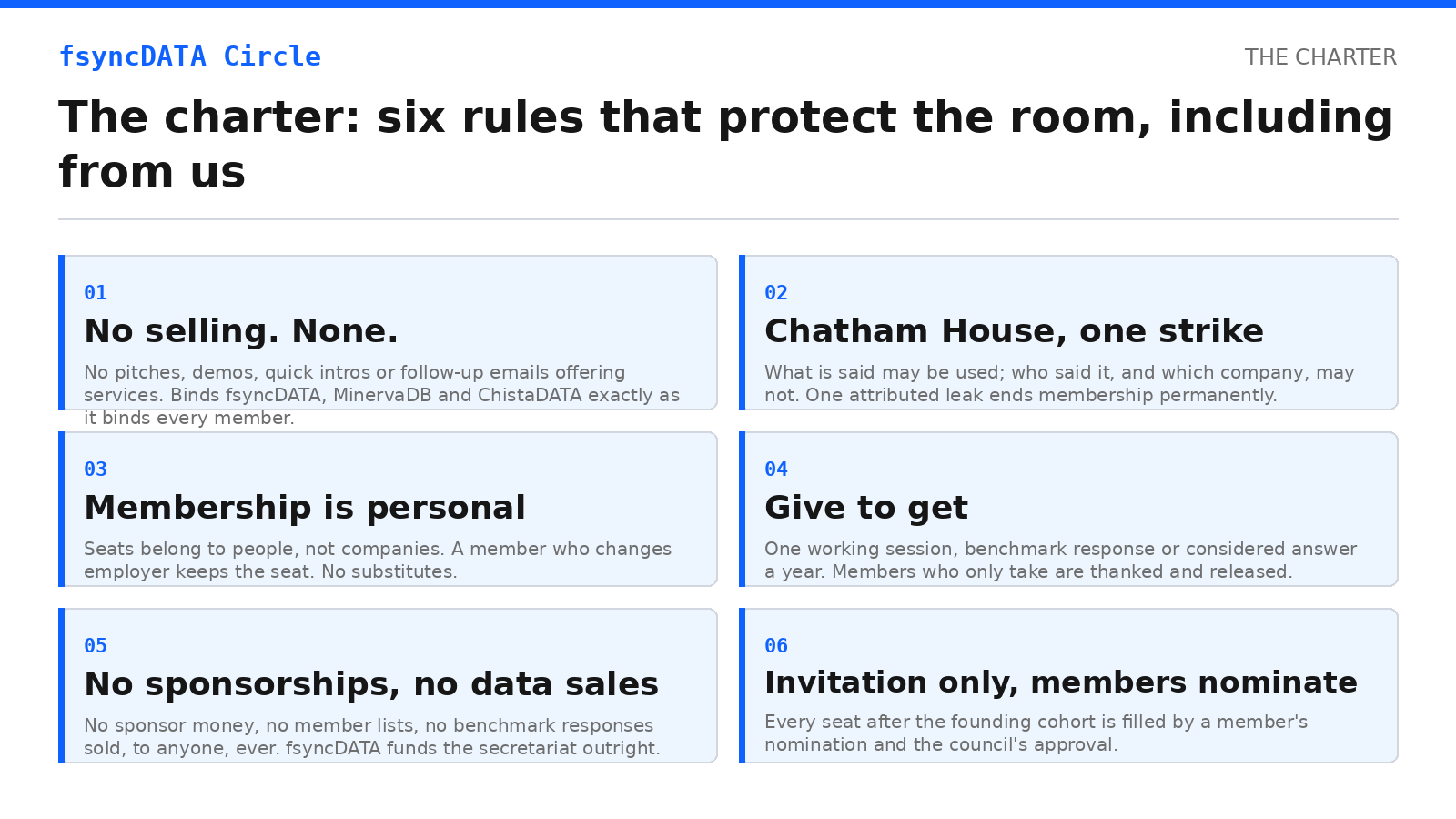
Rule 1 of the Circle charter: no selling, none
No pitches, no product demonstrations, no “quick intro to what we do”, no follow-up emails offering services to people met in the Circle. This binds fsyncDATA, MinervaDB and ChistaDATA exactly as it binds every member. A member who wants fsyncDATA’s help asks outside the Circle, and the Circle is never mentioned in that conversation.
Rule 1 of the Circle charter is the one most often tested, so it is worth being precise about what it forbids. It forbids a sales conversation started by anyone with anyone inside a Circle format: a working session, a deep dive, office hours, ask-the-network, a city dinner, a cohort mixer, or a message sent through the secretariat. It forbids the softer forms too: a case study that happens to feature a vendor’s product, a “we solved this at a client” story told by a consultant, a slide with a logo in the corner.
It also forbids what happens after. A member who meets another member in the Circle and later sends them an offer of services, referencing the Circle or not, has broken Rule 1. This applies to fsyncDATA’s staff without exception. Our principal engineers who run office hours answer technical questions; they do not scope, quote or follow up. If a member wants to engage fsyncDATA commercially, the member starts that conversation, outside the Circle, and nobody on our side will bring the Circle into it.
What Rule 1 does not forbid: members telling each other, factually, which vendors they use and what they paid. That is precisely the kind of information the Circle exists to exchange. The distinction is between a member describing their own estate and anyone describing what they could sell you.
03
Rule 2: Chatham House, one strike
What is said may be used; who said it, and which company, may not. One attributed leak, however small, ends membership permanently. There is no warning stage.
The Circle charter adopts the Chatham House Rule as Chatham House itself defines it: participants are free to use the information received, but neither the identity nor the affiliation of the speaker, nor that of any other participant, may be revealed. The Circle adds one thing the original does not have: a single sanction, applied once, without appeal to intent or scale.
Why does the Circle charter have no warning stage? Because the value of the room is the confidence that a number said in it will not travel with a name attached. A warning stage tells every member that the first leak is survivable, which means the first leak is priced in, which means the numbers come out of the room. One strike keeps the numbers in. Members who find this harsh should consider that they are also the beneficiaries.
What counts as attribution: naming a member, naming their company, or describing them so specifically that a reasonable reader in the Indian GCC ecosystem could identify them. “A BFSI captive in Hyderabad with a large Oracle estate” is attribution when there are two such members. The council decides, and its decision is final.
04
Rule 3: membership is personal
Seats belong to people, not companies. A member who changes employer keeps the seat. A company cannot send a substitute.
Rule 3 of the Circle charter is what makes Rule 2 enforceable and what makes the peer network real. If seats belonged to companies, the person in the room would be a representative, and representatives say what their employer would want said. If seats belong to people, the person in the room speaks for their own experience, and can carry it to their next role.
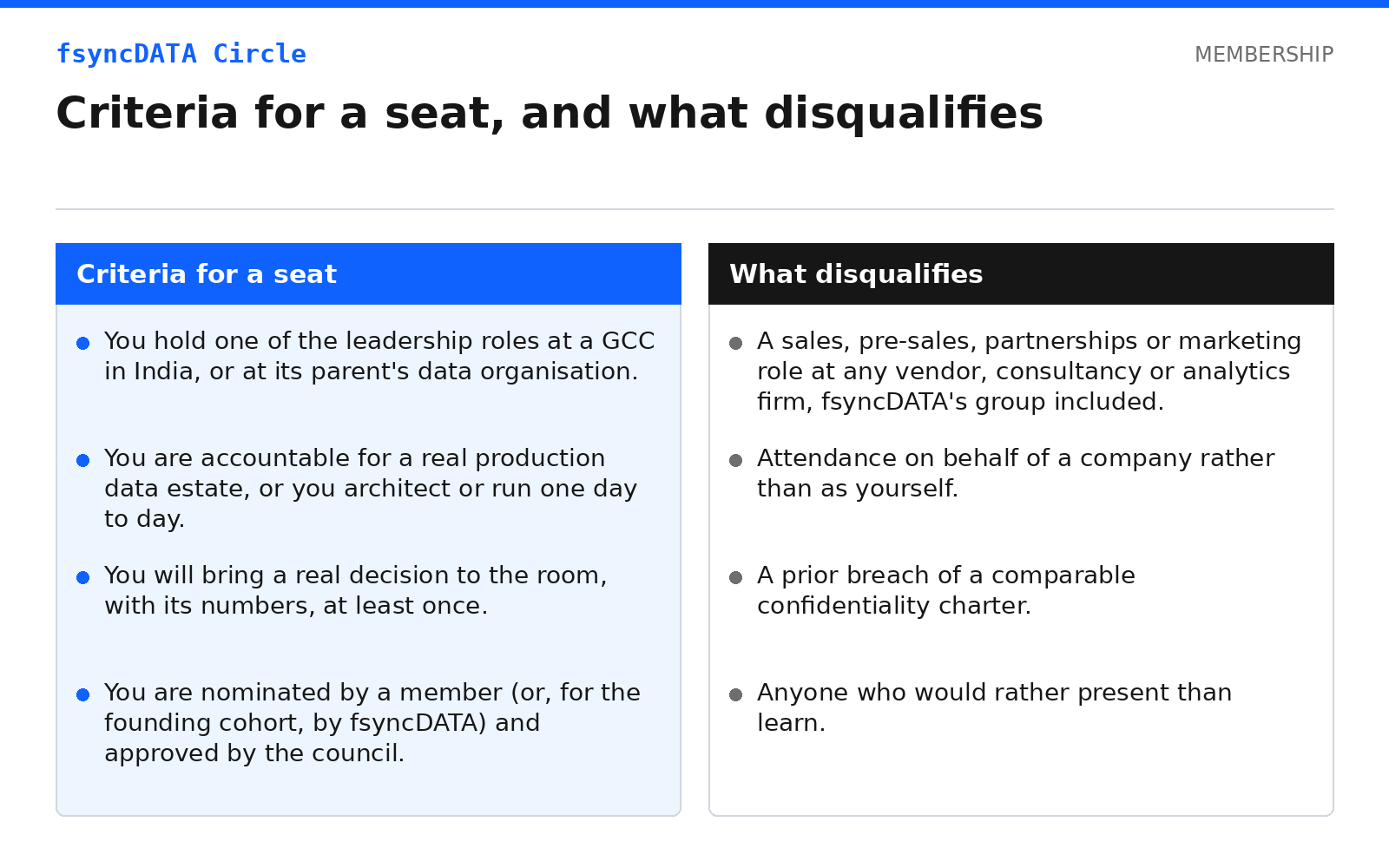
There are consequences of the Circle charter members should understand before accepting. A member who moves to a disqualifying role, for example into a sales, pre-sales, partnerships or marketing position at a vendor or consultancy, is thanked and released. A member who moves from one GCC to another keeps the seat with no re-nomination. A member who moves from a GCC to its parent’s data organisation keeps the seat too, because the parent-side view is one the room wants.
Companies sometimes ask whether a colleague can attend a session in a member’s place. The answer under the Circle charter is no, always. If the colleague belongs in the room, the member nominates them under Rule 6.
05
Rule 4: give to get
Each year every member contributes at least one of: a working session, a benchmark response, or a considered answer to a peer’s question. Members who only take are thanked and released at renewal.
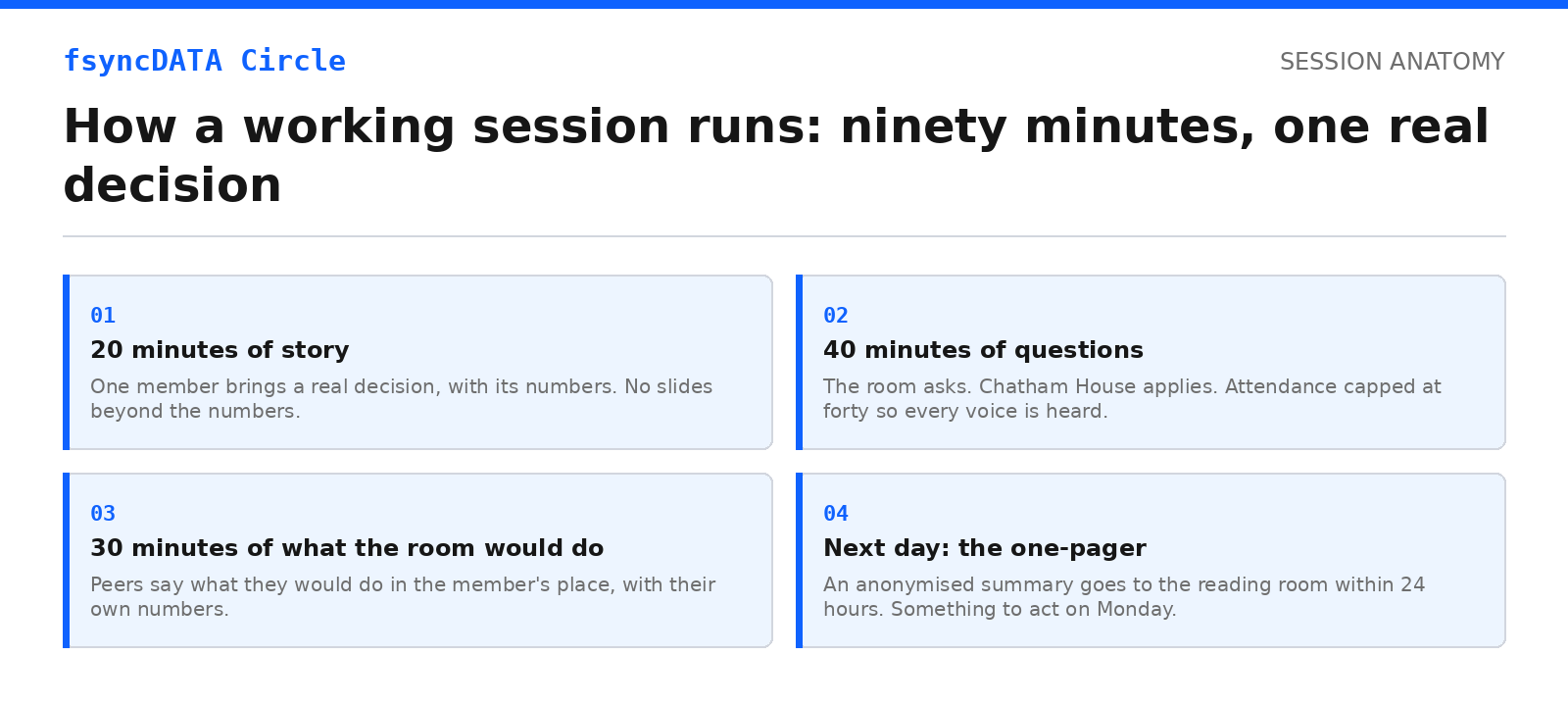
The Circle has no membership fee. Rule 4 is the price of a seat, and it is set low on purpose. One working session means bringing a real decision, with its numbers, for ninety minutes. One benchmark response means answering the annual survey honestly. One considered answer means replying, with care, to a question the secretariat routes to you through ask-the-network. Any of the three satisfies the rule.
Under the Circle charter the secretariat keeps a value ledger for every member: sessions attended, questions asked and answered, introductions made, contributions given. At renewal you see yours. The council sees the aggregate. A member who has received much and given nothing is asked, kindly, to give or to step aside for someone who will. Nobody is embarrassed; the ledger is private to the member and the council.
Why the Circle charter needs this rule at all: rooms of senior people drift toward spectatorship. The people with the most to share are the busiest, and without a stated expectation the room fills with listeners. Rule 4 keeps the ratio honest.
06
Rule 5: no sponsorships, no data sales
The Circle takes no sponsorship money and sells no member data, lists or benchmark responses, to anyone, ever. fsyncDATA funds the secretariat outright and receives nothing in return but the right to listen.
Rule 5 closes the two doors through which every other professional community has eventually let vendors in. Sponsorship buys an agenda slot, a logo, a “presented by”, and eventually the room. Data sales convert a member directory into a prospect list. The Circle charter closes both, permanently, and the council may audit compliance at any time at fsyncDATA’s cost.
What Rule 5 of the Circle charter means in practice: deep-dive venues and dinners are paid for by fsyncDATA with no hospitality partner named; the reading room runs on infrastructure fsyncDATA pays for with no vendor’s product placed in it; the benchmark is collected and processed by the secretariat with raw responses deleted after aggregation; and the member directory is opt-in by field, members-only, and never exported.
- No sponsor slot, in any format, at any price
- No product demonstration, including of fsyncDATA’s or MinervaDB’s tooling
- No case study “presented by” anyone
- No attendee list shared with anyone outside the Circle
- No recording that leaves the reading room
- No benchmark raw data seen by anyone, fsyncDATA included
07
Rule 6: invitation only, members nominate
Every seat after the founding cohort is filled by a member’s nomination and the council’s approval. fsyncDATA proposes founding members and thereafter has one vote among many.
Rule 6 of the Circle charter is how the room stays small enough that every member can know every other member. Growth is by nomination only, at a pace the council sets. If that means the Circle stops growing, it stops growing. There is no waiting list that money or seniority can shorten, and no membership tier.
The founding cohort is the one exception, and it is a bounded one: sixty seats, proposed by fsyncDATA across the leadership roles, four cities and six sectors, between October and November 2026. Each founding invitee receives the prospectus and a personal note explaining why they were proposed. Declined seats are re-offered from a reserve list; no seat is filled by a company’s substitute. After that, fsyncDATA nominates like any member and votes like any member.
Members are asked to nominate one person a year who belongs in the room. The council treats a nomination of someone the nominator believes belongs there more than they do as the highest recommendation a seat can receive. The nomination form is on the request an invitation page.
08
Enforcement: who decides a breach of the Circle charter
The members’ council, not fsyncDATA, decides breaches. Five elected members, rotating annually, hear any complaint and their decision is final. fsyncDATA has no veto and no seat on the council.
If the council ever finds fsyncDATA in breach of Rule 1, the council may dissolve the Circle and take its member directory with it. This is the clause that makes the Circle charter more than a statement of good intent. The convener funds the room and can be expelled from it by the people it invited. We wrote it that way because a rule you cannot lose by is not a rule.
How a complaint under the Circle charter works: any member may raise one with the council, in writing, through the secretariat or directly to any council member. The council hears the member complained of. It decides by simple majority. It may find no breach, find a breach of Rule 2 and remove the member, find a breach of Rule 1 by a member and remove the member, or find a breach of Rule 1 by the convener and publish that finding to all members with or without dissolution. There is no appeal.
The council also audits the benchmark process annually and may commission an independent audit of the data and confidentiality controls at any time, at fsyncDATA’s cost. The structure, election and rotation of the council are described on the members council page.
09
The code of conduct
The Circle charter is the law of the room; the code of conduct is its manners. It is short, and it is the part members most often quote back to each other.
- Speak for your own estate, not for your vendor’s.
- Ask before you advise; the room is for questions first.
- Credit peers for what you learned from them, inside the Circle only.
- Disagree with numbers, never with people.
- What you would not say with your CEO listening, do not say here either. Chatham House protects attribution, not indiscretion.
The last line is the one worth reading twice. Rule 2 guarantees that your name will not travel with your words. It does not make the words wise. Members are expected to bring their real numbers and their real decisions, and to bring the judgement they would exercise anywhere else about what is theirs to share.
10
The test the convener accepts under the Circle charter
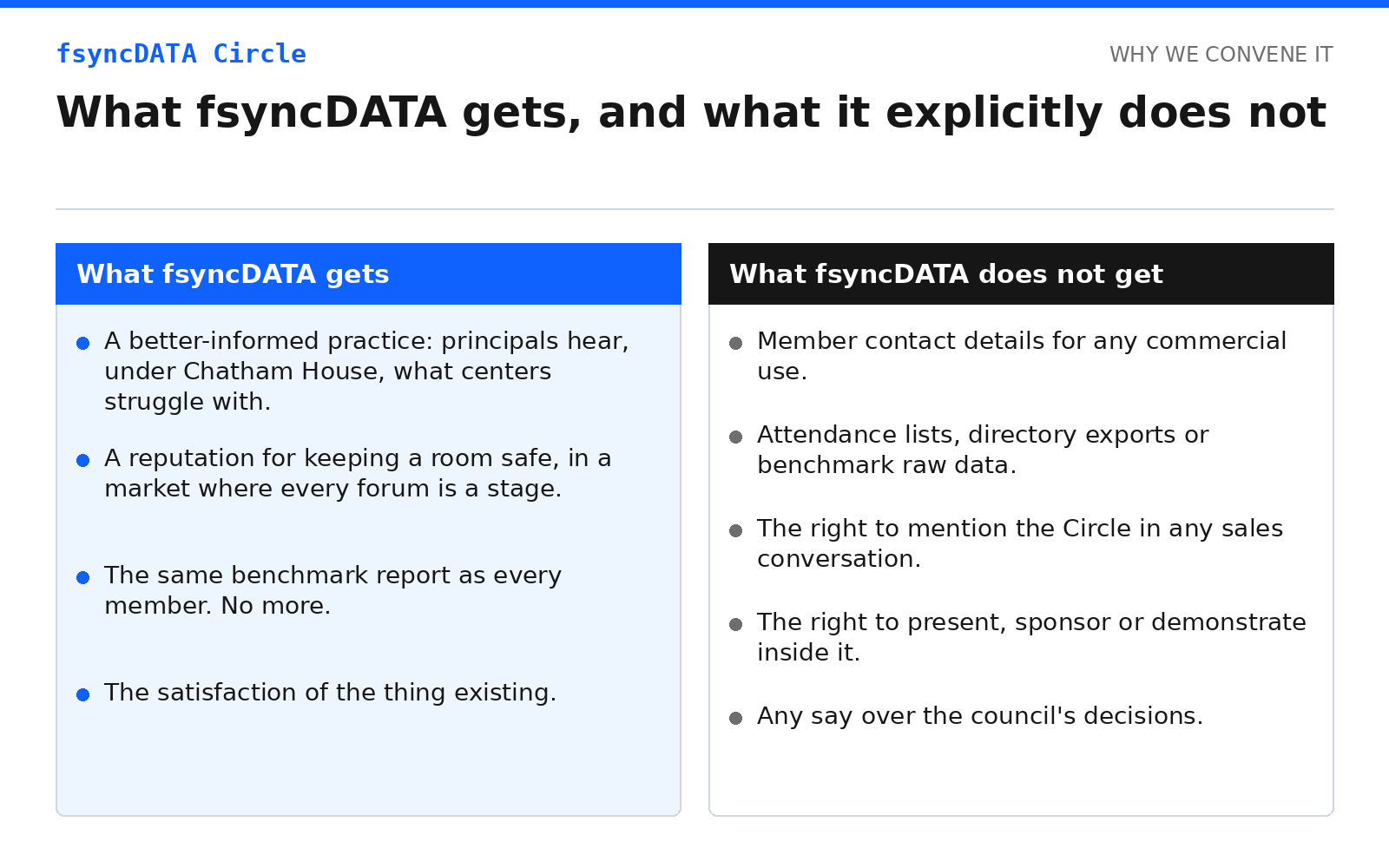
A club convened by a company invites one question first: what is in it for them? The answer should be written down before anyone joins, so that anything beyond it is a breach. What fsyncDATA gets is a better-informed practice, a reputation for keeping a room safe, the same benchmark report as every member, and the satisfaction of the thing existing.
The test we accept under the Circle charter: if any member ever receives a services approach from fsyncDATA, MinervaDB or ChistaDATA that references the Circle, a session, or something learned in one, the member reports it to the council, the council publishes the breach to all members, and the council may dissolve the Circle.
What fsyncDATA explicitly does not get: member contact details for any commercial use; attendance lists, directory exports or benchmark raw data; the right to mention the Circle in any sales conversation; the right to present, sponsor or demonstrate inside it; any say over the council’s decisions. The full reasoning is on the page about why fsyncDATA convenes the Circle.
11
What founding members may change
The Circle charter as published here is the version proposed to the founding cohort. Founding members decide, at the November 2026 founding session in Bengaluru, whether it stands as written or is amended. They also elect the first council, set the size and pace of the second cohort, approve the benchmark’s questions before it is issued, and choose which city hosts the annual assembly.
Two things founding members cannot amend, because they are the conditions under which fsyncDATA convenes the room: Rule 1, and the council’s power to find the convener in breach of it. Everything else, including the one-strike sanction in Rule 2, the contribution expectation in Rule 4 and the nomination mechanics in Rule 6, is theirs to shape.
The charter is reviewed at every annual assembly. Founding members hold a standing seat at that review. Amendments pass by a simple majority of members present, in person or online, and take effect at the next session.
Members may leave at any time with no explanation. Members who change roles to a disqualifying one are thanked and released. Members who breach Rule 2 are removed by the council. Nothing in the Circle charter creates an obligation that survives leaving, except the obligation every member already has under Chatham House for what they heard while they were in the room.
This page describes the Circle charter as proposed to its founding cohort, who may amend it at the founding session. Nothing on this site is an offer of services. © 2026 MinervaDB Inc.