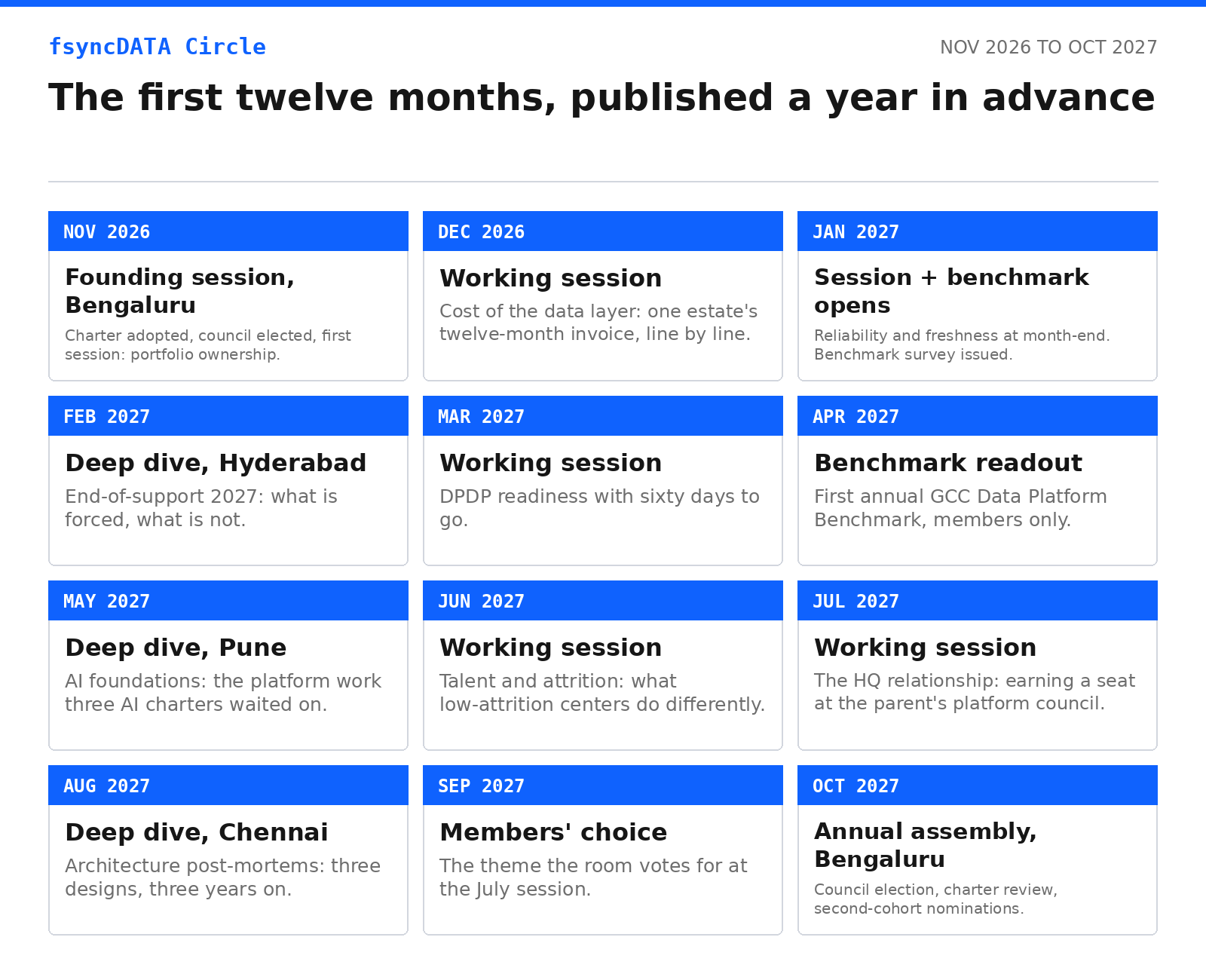
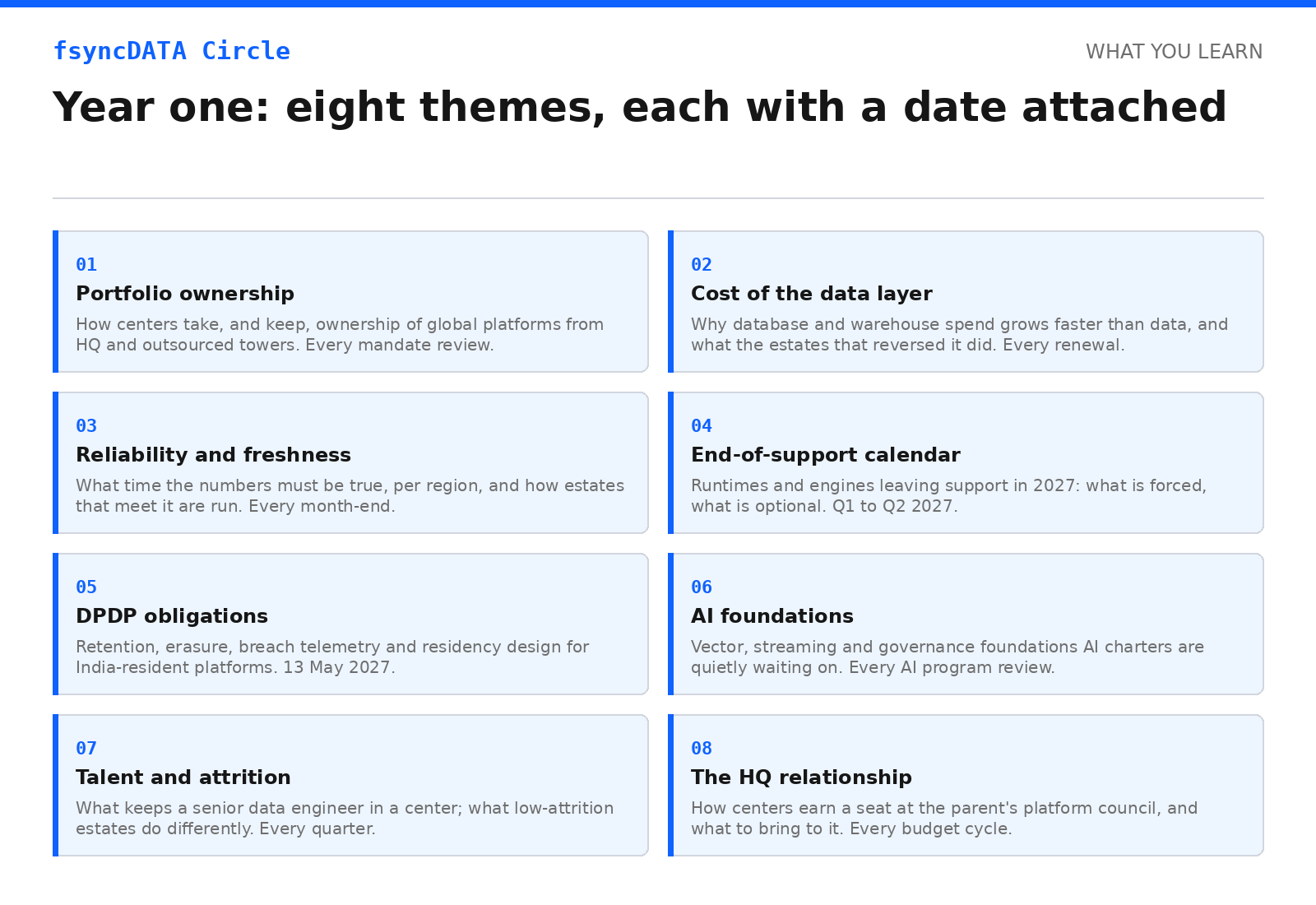
The GCC data platform curriculum is not a syllabus. It is the set of decisions members will face in the next eighteen months, worked through with people who face them too. Eight themes, each with a date attached, delivered through six working formats that add up to roughly thirty hours a year.
8
themes in the GCC data platform curriculum, each with a date attached
6
working formats, one membership
90
minutes per monthly session, capped at forty people
30
hours a year, most of them online
01
What the GCC data platform curriculum is, and is not
Conference agendas are set by sponsors. Training courses are set by whoever wrote the slides last year. The GCC data platform curriculum is set by the decisions the members of the Circle actually have in front of them: the ones with a renewal date, a compliance date, a mandate review or a budget cycle attached. That is why every theme below has a date column.
It is a curriculum in the sense that it is sequenced and complete: by the end of year one, a member who attended six of the twelve sessions and one deep dive will have heard, under Chatham House, how at least a dozen other Indian capability centers made the decisions they are about to make, and with what numbers.
It is not a course. Nobody teaches. One member brings a real decision; the room works it. It is not a vendor program: no product, no case study “presented by”, no recommendation that ends in a quote. And it is not about dashboards or models. Everything in the GCC data platform curriculum is about the platforms those things run on, because that is what the members run.
Two design rules shape the GCC data platform curriculum. First, the member who brings the decision must be able to speak for a real production estate; no theme is worked from a slide deck or a whitepaper. Second, every session ends with what the room would do, not what a speaker recommends, so the output is a range of peers’ judgements with their numbers rather than a single answer with a logo on it. Both rules are enforced by the secretariat when sessions are scheduled.
| Theme | The decision | The date |
|---|---|---|
| Portfolio ownership | How centers take, and keep, ownership of global platforms from HQ and from outsourced towers | Every mandate review |
| Cost of the data layer | Why database and warehouse spend grows faster than data, and what the estates that reversed it did | Every renewal and commit |
| Reliability and freshness | What time the numbers must be true, per region, and how estates that meet it are run | Every month-end |
| End-of-support calendar | Runtimes and engines leaving support in 2027: what is actually forced, what is optional | Q1 to Q2 2027 |
| DPDP obligations | Retention, erasure, breach telemetry and residency design for India-resident platforms | 13 May 2027 |
| AI foundations | Vector, streaming and governance foundations AI charters are quietly waiting on | Every AI program review |
| Talent and attrition | What keeps a senior data engineer in a center; what the estates with low attrition do differently | Every quarter |
| The HQ relationship | How centers earn a seat at the parent’s platform council, and what to bring to it | Every budget cycle |
02
Theme 1: portfolio ownership
India’s capability centers have moved from tickets to portfolio ownership. Platform reliability, data engineering, cloud architecture and AI pipelines for some of the world’s largest enterprises are now decided in Bengaluru, Hyderabad, Pune and Chennai and ratified at HQ. But ownership is won, not granted, and it is won differently in every parent.
The first theme in the GCC data platform curriculum is told by a center that won it. What did the parent’s platform council need to see before it let the India center own a production estate end to end? Which runbooks, which evidence, which incident record? What did the outsourced tower do when the work started moving? What did the center’s site leader trade for the mandate, and would they trade it again? This is the founding session in Bengaluru in November 2026.
What members leave the first session of the GCC data platform curriculum with: a list of the artefacts a parent’s platform owner actually asks for, in the order they ask for them, and the name of a peer who has produced them.
03
Theme 2: cost of the data layer
Database and warehouse spend grows faster than data in most estates, and the reasons are rarely on the invoice. Committed-spend utilisation, warehouse credits burned by unbounded BI queries, DBaaS instances sized for a peak that never recurred, extended-support surcharges on engines that auto-enrolled at end of life. Database and warehouse lines are the hardest part of a cloud bill to cut safely, which is why they are usually the part nobody cuts.
The December 2026 working session in the GCC data platform curriculum takes one estate’s twelve-month invoice and explains it line by line. Not a vendor’s cost model; a member’s actual bill, anonymised, with what changed, what it cost to change, and what did not improve. The annual benchmark then puts every member’s cloud data spend, as a share of the center’s cloud bill and against data growth, alongside it.
What members leave this part of the GCC data platform curriculum with: a number to check in their own estate on Monday, and the question to put to their cloud account team.
04
Theme 3: reliability and freshness
“The numbers are true by 6 a.m.” is a sentence every center has said to a parent and few have costed. Freshness SLAs by region, month-end close windows, the replication lag that is fine on the 14th and catastrophic on the 31st, the on-call load that keeps them true: this is the reliability picture behind the uptime slide.
The January 2027 session of the GCC data platform curriculum works the honest version of month-end. Which estates meet their freshness SLA, how they are run, what they pay in on-call load and incident count to do it, and what they gave up. The benchmark measures freshness SLAs by region and how often they are missed, and on-call load and incident counts per platform, so the room’s anecdotes get numbers behind them in April.
05
Theme 4: the end-of-support calendar
Upgrade demand in this market is not cyclical; it is scheduled. Each end-of-support date forces a funded program into every center that owns the affected engine, with a fixed deadline and an auditable compliance driver. The 2027 wave touches commercial and open-source engines alike, and cloud DBaaS fleets that auto-enrol end-of-life engines into paid extended support.
The February 2027 deep dive in Hyderabad is the GCC data platform curriculum’s half-day on what is actually forced and what is optional. Two member war stories: one center that ran a major-version wave across an OLTP estate, one that chose to pay extended support and why. One open working session on the calendar itself. Dinner after, for those in the room.
A standing caveat in the GCC data platform curriculum, one the Circle’s convener applies in its own practice and that members will hear repeated: end-of-support dates are version-pinned as of the day they are stated and must be re-verified against the current release calendar before any decision rests on them. They are the most-quoted numbers in this business and the ones that go stale fastest.
06
Theme 5: DPDP obligations
India’s Digital Personal Data Protection Act, 2023 and its rules bring dated obligations for India-resident platforms: retention limits, erasure on request, breach notification, and the telemetry needed to prove all three. For a center that processes a parent’s data on Indian infrastructure, the design questions are concrete: where does erasure propagate, what does the breach clock start on, which replicas and backups are in scope.
The March 2027 working session in the GCC data platform curriculum is DPDP readiness with sixty days to go: retention, erasure and breach-telemetry designs compared across members’ estates. The benchmark measures DPDP readiness, self-assessed, so the room knows where it stands in aggregate. The Act itself is published by the Ministry of Electronics and Information Technology; the Circle discusses design, not legal advice, and members are expected to take their own counsel.
07
Theme 6: AI foundations
Nearly every new center has an AI charter, which is why the GCC data platform curriculum gives it a deep dive. The unglamorous prerequisite is governed, performant, cost-controlled data platforms with vector and streaming capability, and it is exactly the work that arrives after the charter has been announced. Chief AI officers and chief data scientists in the Circle carry that gap; principal architects and platform heads close it.
The May 2027 deep dive in Pune covers AI foundations: the platform work three AI charters were waiting on, and how long it actually took. Vector capability, streaming freshness, governance and residency posture, told by the members who built them, with the elapsed time and the cost left in. Nothing in the GCC data platform curriculum touches models; everything in this theme is about what models read from.
The Circle’s data-handling rule applies to the theme as well as to the room: no AI agent is connected to any member’s systems in any Circle format, and no member data enters third-party AI tools.
08
Themes 7 and 8: talent, attrition and the HQ relationship
Attrition of senior data engineers and DBAs is structural in Bengaluru, Hyderabad and Pune, and every center carries it alone. The June 2027 session asks what keeps a senior data engineer in a center, and what the estates with the lowest senior-engineer attrition do differently. The benchmark measures attrition by city and sector, so the room can tell whether its retention problem is its own or everyone’s.
The HQ relationship closes the year of the GCC data platform curriculum. How centers earn a seat at the parent’s platform council, and what to bring to it, told by two who did. This is the theme in the GCC data platform curriculum that site leaders and CIOs most often ask for first, and it is placed in July 2027 deliberately, after the room has spent eight months building the evidence the parent will want to see.
Two further sessions complete year one: architecture post-mortems in Chennai in August 2027, three designs three years on and what each would change; and the members’ choice in September, the theme the room votes for at the July session. The annual assembly in Bengaluru in October revisits the year’s best session. Dates are on the Circle calendar.
09
How a session in the GCC data platform curriculum works
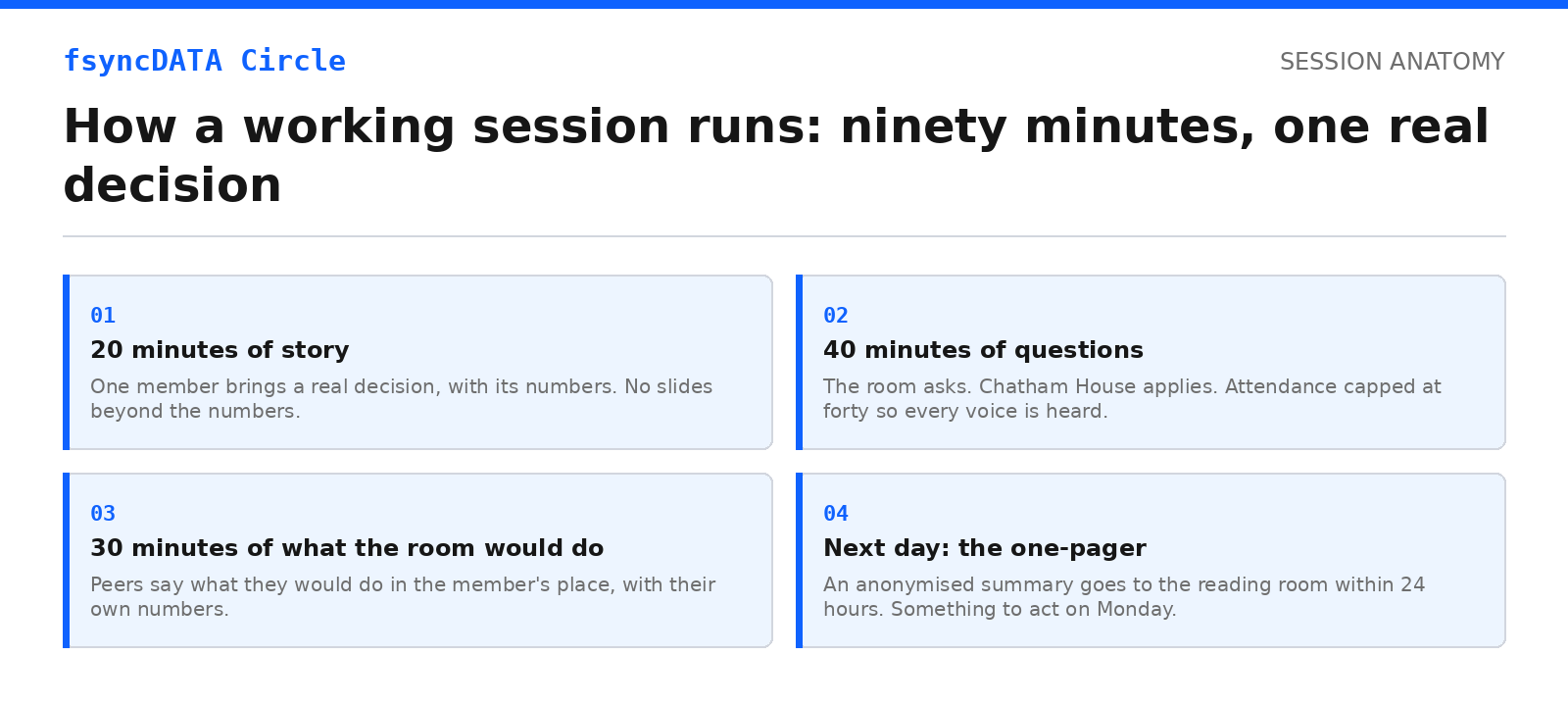
One member brings a real decision, with its numbers. Twenty minutes of story, forty of questions from the room, thirty of what the room would do. No slides beyond the numbers. Attendance is capped at forty so every voice is heard. A one-page summary, anonymised, goes to the reading room the next day.
The secretariat prepares the member who presents in the GCC data platform curriculum: a short call the week before to agree what numbers can be shown and how the story is anonymised in the one-pager. The member presenting may refuse any recording of their session. Chatham House applies to every minute, and to the one-pager, and the one-strike rule enforces it.
What you leave with is something you can act on Monday: a number to check in your own estate, a question to put to a vendor, a design you will not repeat, or a peer you can call when the same thing happens to you. That last outcome is the one the secretariat measures. The test of the GCC data platform curriculum, twelve months after joining, is whether every member has three people in the Circle they would call before calling a vendor.
10
Six formats, one membership
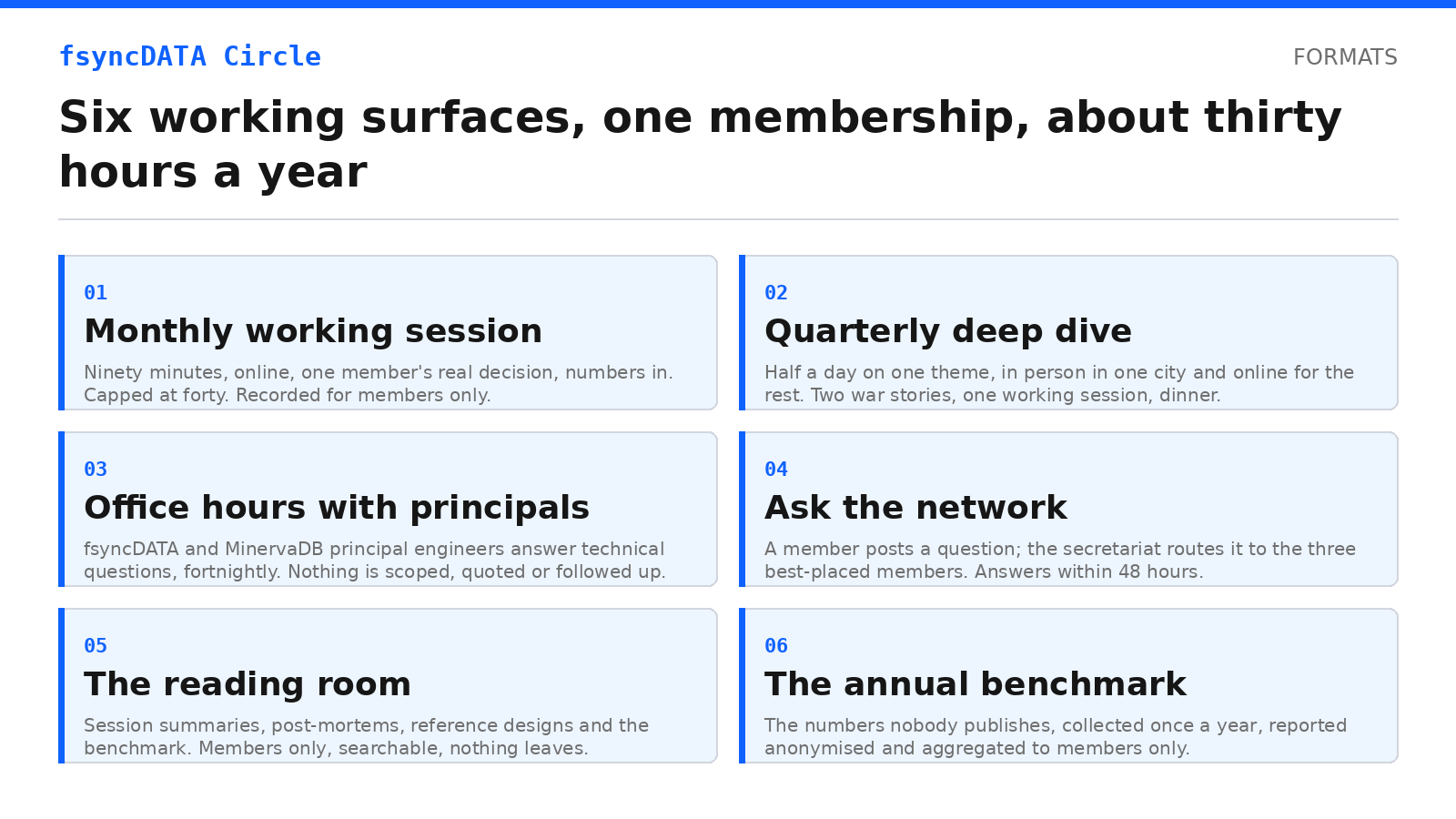
| Format | Cadence | What it is |
|---|---|---|
| Monthly working session | Monthly, online, 90 minutes | One decision, numbers in, capped at forty. Recorded for members only; never published. |
| Quarterly deep dive | Quarterly, half a day, one city plus online | Two member war stories, one open working session, dinner after for those in the room. |
| Office hours with principals | Fortnightly, one hour | fsyncDATA and MinervaDB principal engineers answer members’ technical questions. Nothing is scoped, quoted or followed up. |
| Ask the network | Continuous, 48-hour answers | A member posts a question; the secretariat routes it to the three members best placed to answer. Anonymised on request. |
| The reading room | Updated within 24 hours of every session | Session summaries, post-mortems, reference designs and the benchmark. Members only. Searchable. Nothing leaves. |
| The annual benchmark | Issued January, read out April | The numbers nobody publishes, collected once a year, reported anonymised and aggregated to members only. |
What every format has in common: a member’s real decision at the center of it; the numbers left in, under Chatham House; a written, anonymised summary within 24 hours; no vendor in the room, fsyncDATA’s sales team included. What no format ever includes: a sponsor slot, a product demonstration or a case study “presented by”; a follow-up from anyone offering services; an attendee list shared with anyone outside the Circle; a recording that leaves the reading room.
Office hours deserve one more sentence. They are the only place in the GCC data platform curriculum where fsyncDATA’s own engineers speak, and they speak only to answer. The charter forbids them from scoping, quoting or following up, and the council can find fsyncDATA in breach if they do. The mechanism is described on the Circle charter page.
11
Time economics of the GCC data platform curriculum
Less calendar than one conference trip. Twelve monthly sessions, four deep dives and the office hours you choose to attend add up to roughly thirty hours a year, most of them online and none of them in an expo hall. The ask is that you attend at least six of the twelve working sessions, answer the benchmark honestly once a year, give one contribution of your choosing, and nominate one person a year who belongs in the room.
Set the GCC data platform curriculum against that: a conference week costs five days, a flight and a sponsor-shaped agenda, and returns a stack of slides with the cost column removed. The GCC data platform curriculum is designed to cost less time and return more: a peer who has already run the migration you are about to run, seen the invoice you are about to receive, or survived the audit you are preparing for.
Everything in the GCC data platform curriculum above is described as proposed to the founding cohort. Founding members approve the benchmark’s questions before they are issued and vote on the members’ choice theme; the council may reorder themes if the year demands it. Nothing on this site is an offer of services. © 2026 MinervaDB Inc.