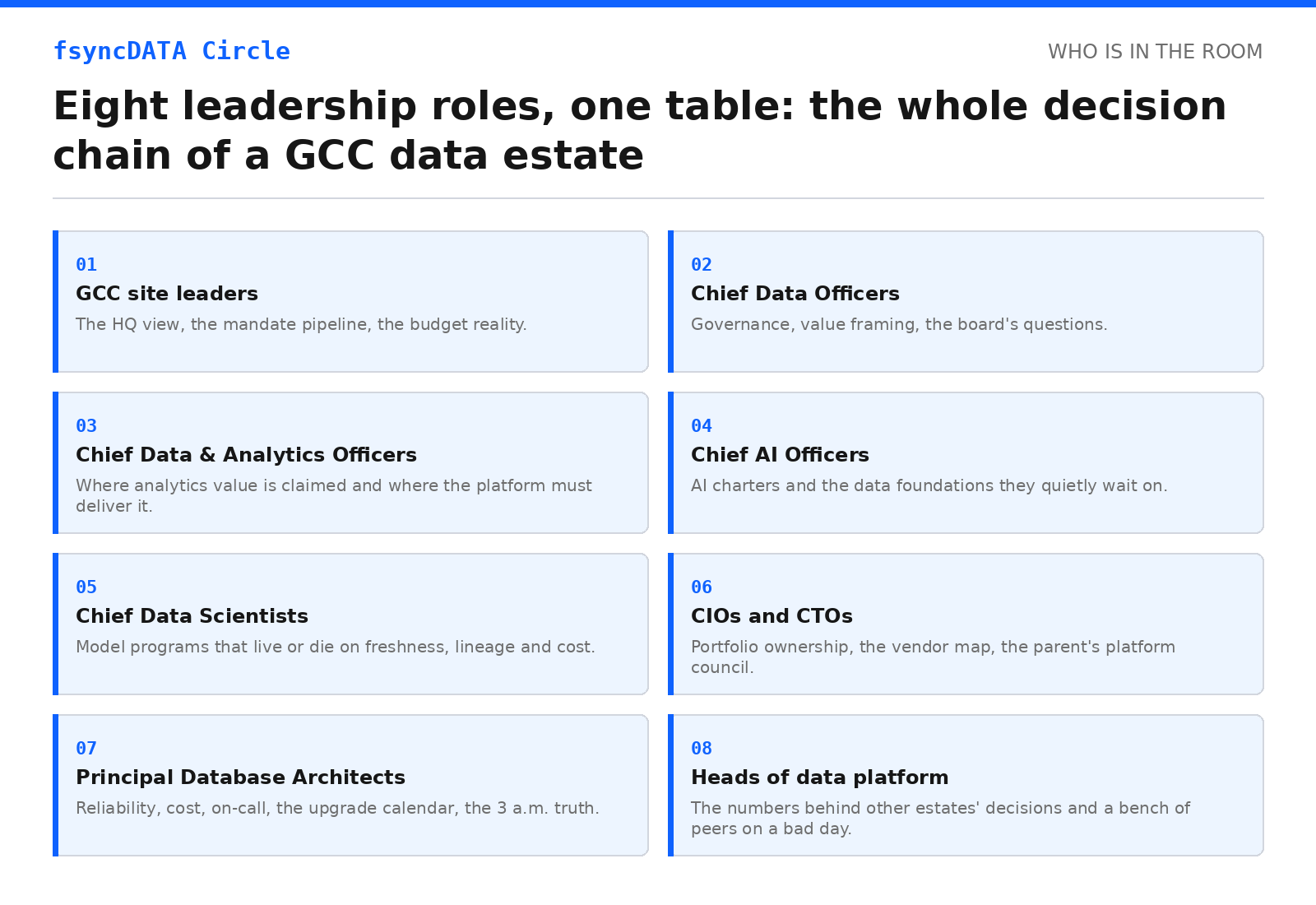
The fsyncDATA Circle seats eight GCC leadership roles at one table: site leaders, chief data officers, chief data and analytics officers, chief AI officers, chief data scientists, CIOs, CTOs, and principal database architects together with the heads of data platform who run production. The mix is the point.
8
GCC leadership roles at one table
6
sectors, no more than a third from any one
3
center stages, mixed by design
2
members maximum from any one company
01
Why the GCC leadership roles sit at one table
Most rooms seat one role. Platform heads meet platform heads and agree the CDO does not understand cost; CDOs meet CDOs and agree the platform team is slow; CIOs meet CIOs and agree that HQ does not listen. Each of those rooms is comfortable and each is useless for the decision that actually needs making, because that decision crosses all of them.
A capability center’s data estate is decided by a chain. The site leader owns the mandate and the budget conversation with HQ. The CDO or CDAO owns governance and the value case. The chief AI officer or chief data scientist owns the charter that depends on the platform being ready. The CIO or CTO owns the portfolio and the vendor map. The principal database architect and the head of data platform own reliability, cost, the on-call rota and the upgrade calendar. The Circle seats the whole chain, so the conversation you have here is the one you cannot have at work.
Each of the GCC leadership roles brings something the others do not have and comes for something the others hold. The table below is the short version; the sections that follow say what each role can expect from the room and what the room expects from them.
One more reason the GCC leadership roles share a table: the chain is where cost is decided. A platform head knows what the warehouse costs per terabyte; the CDAO knows what the board will fund; the site leader knows what HQ will ratify. Put the three in one room with the numbers left in and a decision that would take a quarter of email takes ninety minutes. Put them in three rooms and each learns only what the other two chose to put on a slide.
| Role | What they bring | What they come for |
|---|---|---|
| GCC site leaders | The HQ view, the mandate pipeline, the budget reality | How other centers won platform ownership and kept it |
| Chief Data Officers, Chief Data & Analytics Officers | Governance, value framing, the board’s questions | What the platform actually needs before analytics and AI charters can be honoured |
| Chief AI Officers, Chief Data Scientists | AI charters, model programs, freshness and lineage requirements | The foundations work that precedes every model initiative, and how long it really took |
| CIOs and CTOs | Portfolio ownership, the vendor map, the parent’s platform council | How centers earn a seat at the parent’s table, and what to bring to it |
| Principal Database Architects, heads of data platform | Reliability, cost, on-call, the upgrade calendar, what production does at 3 a.m. | The numbers behind other estates’ decisions, and a bench of peers on a bad day |
02
GCC site leaders
The first of the GCC leadership roles, the site leader, is accountable for mandate growth, cost and the HQ relationship. Of all the GCC leadership roles this is the one most often asked “is that normal?” by a parent, and least often equipped to answer. Site leaders bring the HQ view into the room: what the parent’s platform council actually wants from an India vendor, how mandates move, what a budget conversation looks like from the other side of the ocean.
What site leaders come for is the experience of other centers that won platform ownership and kept it. Portfolio ownership is the first theme in the year-one curriculum for a reason: it is the decision that turns a center from a delivery location into the owner of a P&L and a platform, and it is won differently in every parent. Site leaders also use the annual benchmark for the first number every board asks about: cloud data spend as a share of the center’s cloud bill, and its growth against data growth.
The Circle asks site leaders to bring a real mandate decision, with its numbers, at least once. It does not ask them to represent their company. Seats are personal, and a site leader who moves to another center keeps theirs.
03
Chief Data Officers and Chief Data and Analytics Officers
Chief data officers and chief data and analytics officers own governance, value framing and the board’s questions. They bring the language in which platform work is justified upward, and the pressure under which it is cut. Among the GCC leadership roles they are the ones who most often discover, late, that an analytics or AI charter has been waiting on foundations nobody funded.
What these GCC leadership roles come for is a candid account of what the platform actually needs before those charters can be honoured. In the Circle that account comes from the architects and platform heads across the table, under Chatham House, with the numbers left in: how long the lakehouse really took, what the warehouse really costs per terabyte, what freshness SLA the month-end close actually needs.
CDAOs in particular sit at the seam between analytics value and platform reliability. The Circle’s scope discipline matters to them: nothing in the room is about dashboards or models; everything is about the platforms they run on. That is the conversation CDAOs rarely get to have with peers who own the same seam.
04
Chief AI Officers and Chief Data Scientists
Chief AI officers and chief data scientists are the newest of the GCC leadership roles and the ones under the most pressure. Roughly half of the centers set up in India since FY21 carry AI charters by design, and more than 1,200 centers have embedded AI and ML mandates, according to the Nasscom–Zinnov India GCC Landscape 2026. Every one of those mandates sits on a data platform that was usually built for something else.
What they bring is the model program: its freshness requirements, its lineage requirements, its cost, and its governance exposure under India’s DPDP Act. What they come for is the AI-foundations theme, and the members who have already done the vector, streaming and governance work three charters were quietly waiting on. The May 2027 deep dive in Pune is built for exactly this conversation.
The Circle’s charter is unusually relevant to these roles. No AI agent operates on any member’s systems in any Circle format, no member data enters third-party AI tools, and the benchmark’s AI-readiness measure is self-assessed and reported only in aggregate. Chief AI officers can speak plainly about what is and is not ready without the sentence travelling.
05
CIOs and CTOs
CIOs and CTOs, the fourth pair of GCC leadership roles, own the portfolio, the vendor map and the relationship with the parent’s platform council. They bring the view of the estate as a whole: which engines, which clouds, which contracts, which end-of-support dates. Of the GCC leadership roles they are the most likely to be measured on consolidation and the least likely to have peers who have consolidated the same estate shape.
What they come for is the HQ-relationship theme and the end-of-support calendar. How centers earn a seat at the parent’s platform council, told by two who did, is the July 2027 working session. What is actually forced by the 2027 end-of-support wave across commercial and open-source engines, and what is optional, is the February 2027 deep dive in Hyderabad.
CIOs and CTOs also use the member directory differently from other roles. Estate shape is a directory field, opt-in, and a CIO facing a specific migration can ask the secretariat for a warm introduction to a member who has run the same one. The request goes to the other member first; nothing is shared without consent.
06
Principal Database Architects and heads of data platform
Principal database architects and heads of data platform own reliability, cost, on-call and the upgrade calendar. They know what production actually does at 3 a.m. Among the GCC leadership roles they are the ones with the numbers, and the ones whose numbers are most often removed from the slide before it reaches the board.
What these GCC leadership roles bring is the truth behind the uptime slide: incident counts per platform, on-call load, what the freshness SLA costs to guarantee, which engine is one resignation away from unsupported. What they come for is the numbers behind other estates’ decisions, and a bench of peers on a bad day. The fortnightly office hours with fsyncDATA and MinervaDB principal engineers are built around their questions; nothing asked there is scoped, quoted or followed up.
The Circle states plainly a benefit that most rooms leave implicit. Principal architects and senior data engineers in the Circle are seen by the people who will hire the next head of platform. Successor visibility is good for both, and it is why the room deliberately includes the next generation of the roles above it.
07
Sector mix across the GCC leadership roles
The sector mix across the GCC leadership roles is designed, not accidental. BFSI captives bring regulated change, commercial engines and PostgreSQL modernisation. Retail and CPG centers bring peak seasons, syndicated data and real-time analytics. Software and product centers bring cloud-native estates and a DBRE culture. Healthcare and pharma centers bring validated environments and governance. Industrial and engineering centers bring SAP-centric estates and telemetry. PE-backed mid-market centers bring fast decisions and tight budgets.
No more than a third of the founding cohort comes from any one sector. That constraint exists because the same GCC leadership roles in different sectors solve the same problem under different constraints, and the room learns most when a BFSI architect hears how a retail platform head handled the same engine under a very different change regime.
| Sector | Typical estate | What the room learns from them |
|---|---|---|
| BFSI captives | Oracle, Db2, SQL Server, growing PostgreSQL; strict change control | Regulated change, evidence discipline, commercial-engine exits |
| Retail and CPG | MySQL, PostgreSQL, MongoDB, Redis, large warehouses, real-time analytics | Peak-season capacity, freshness under load, cost per terabyte |
| Software and product | PostgreSQL, MongoDB, Kafka, ClickHouse; cloud DBaaS heavy | DBRE culture, committed-spend strategy, on-call design |
| Healthcare and pharma | Oracle, SQL Server, PostgreSQL; validated environments | Validation, global standards, vendor count |
| Industrial and engineering | SAP HANA, Oracle, SQL Server, time-series | SAP-centric estates, telemetry platforms, HANA lifecycle |
| PE-backed mid-market | Mixed open-source estates, fast decisions | Residency, access control, budget discipline |
08
Stage mix: Day-1, scaling and portfolio-owner centers
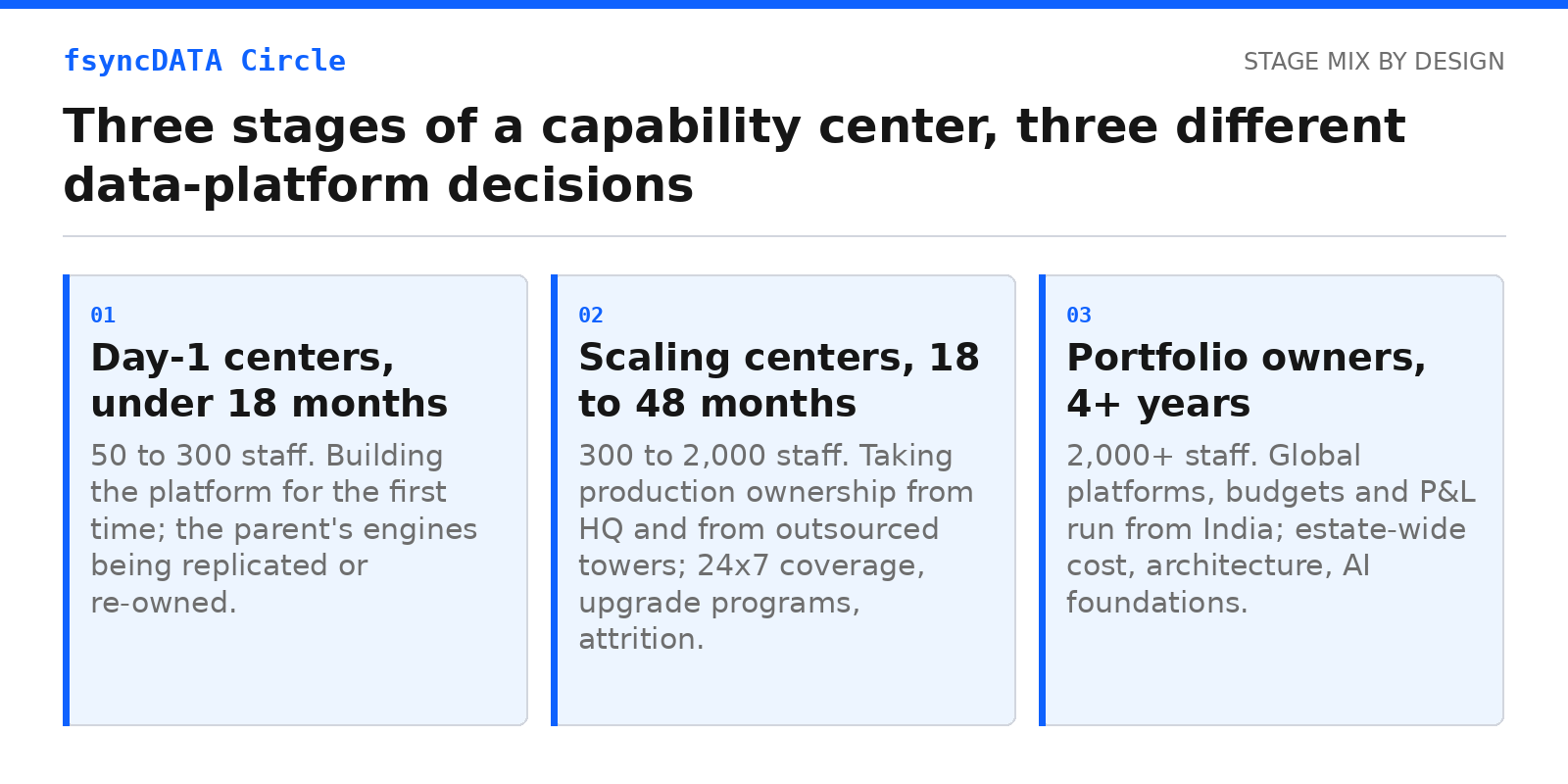
A center’s data-platform need, and the GCC leadership roles it has filled, change predictably with its age. Day-1 centers under eighteen months old, with 50 to 300 staff, are building the platform for the first time while the parent’s engines are replicated or re-owned. Scaling centers between eighteen and forty-eight months, with 300 to 2,000 staff, are taking production ownership from HQ and from outsourced towers and need 24×7 coverage, upgrade programs and continuity through attrition.
Portfolio owners past four years, with 2,000 or more staff, run global platforms, budgets and P&L from India and are deciding estate-wide cost optimisation, architecture and AI foundations. The Circle mixes all three on purpose. A Day-1 center learns what a portfolio owner wishes it had done in year one. A portfolio owner learns what the newest centers are being asked to build.
The GCC leadership roles look different at each stage. A Day-1 center’s CIO may also be its head of platform. A portfolio owner may have all eight roles filled and reporting to different parents. The Circle’s directory records stage alongside role so that the secretariat can pair members across stages deliberately, in cohort mixers and in the three introductions every new member receives.
09
Criteria for a seat and what disqualifies
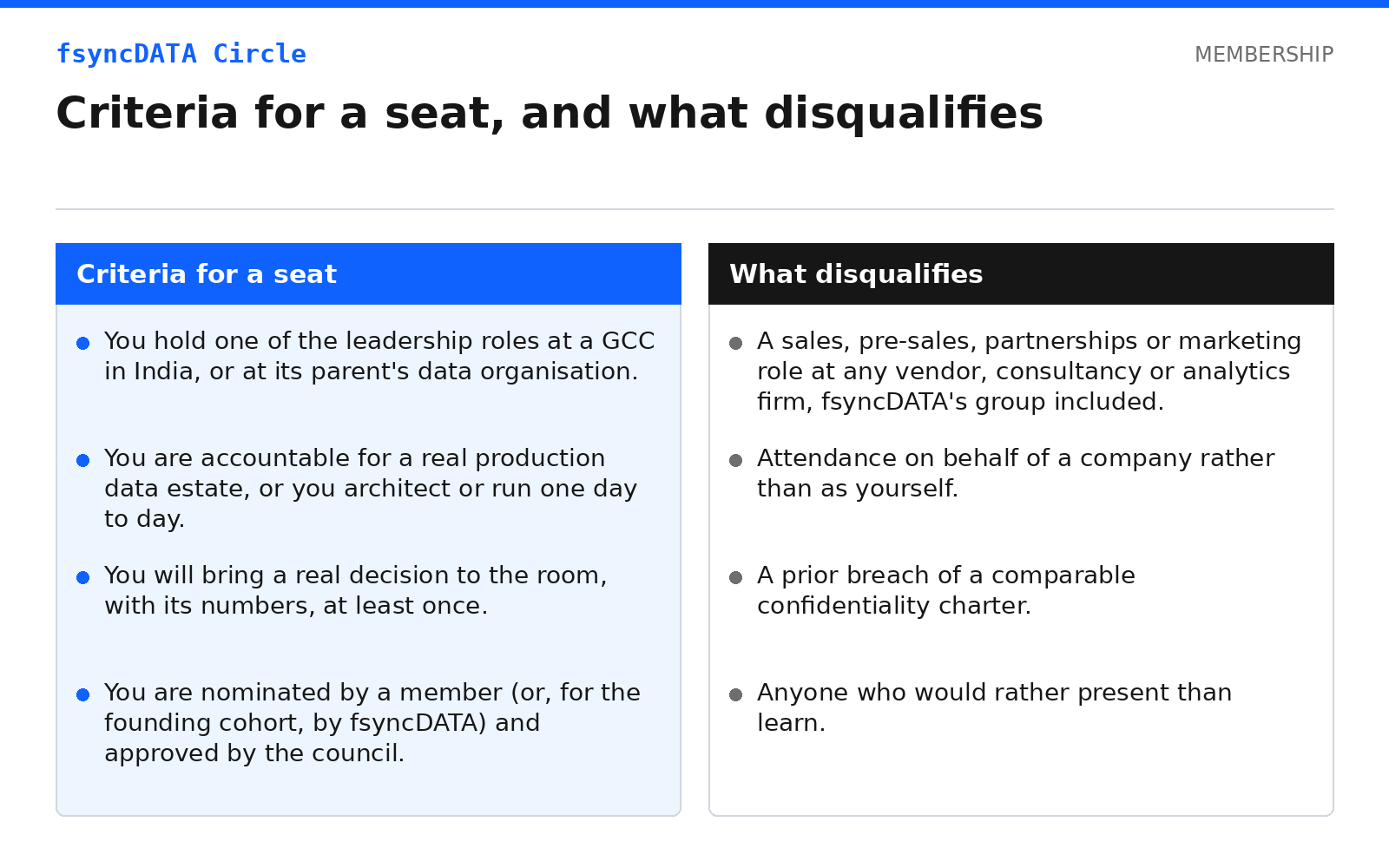
You qualify for a seat if you hold one of the GCC leadership roles above at a Global Capability Center in India or at its parent’s data organisation; you are accountable for a real production data estate, or you architect or run one day to day; you are willing to bring a real decision to the room, with its numbers, at least once; and you are nominated by a member, or, for the founding cohort, by fsyncDATA, and approved by the members’ council.
What disqualifies: a sales, pre-sales, partnerships or marketing role at any vendor, consultancy or analytics firm, fsyncDATA’s group included; attendance on behalf of a company rather than as yourself; a prior breach of a comparable confidentiality charter. The Circle is also not for analysts, consultants or advisors attending to prospect, anyone unable to speak for a real production estate, or anyone who would rather present than learn.
Membership across all GCC leadership roles is personal. Seats belong to people, not companies. A member who changes employer keeps the seat; a member who changes roles to a disqualifying one is thanked and released. There is no membership fee. The price of a seat is one contribution a year, as set out in the Circle charter.
10
How the GCC leadership roles shape the founding sixty
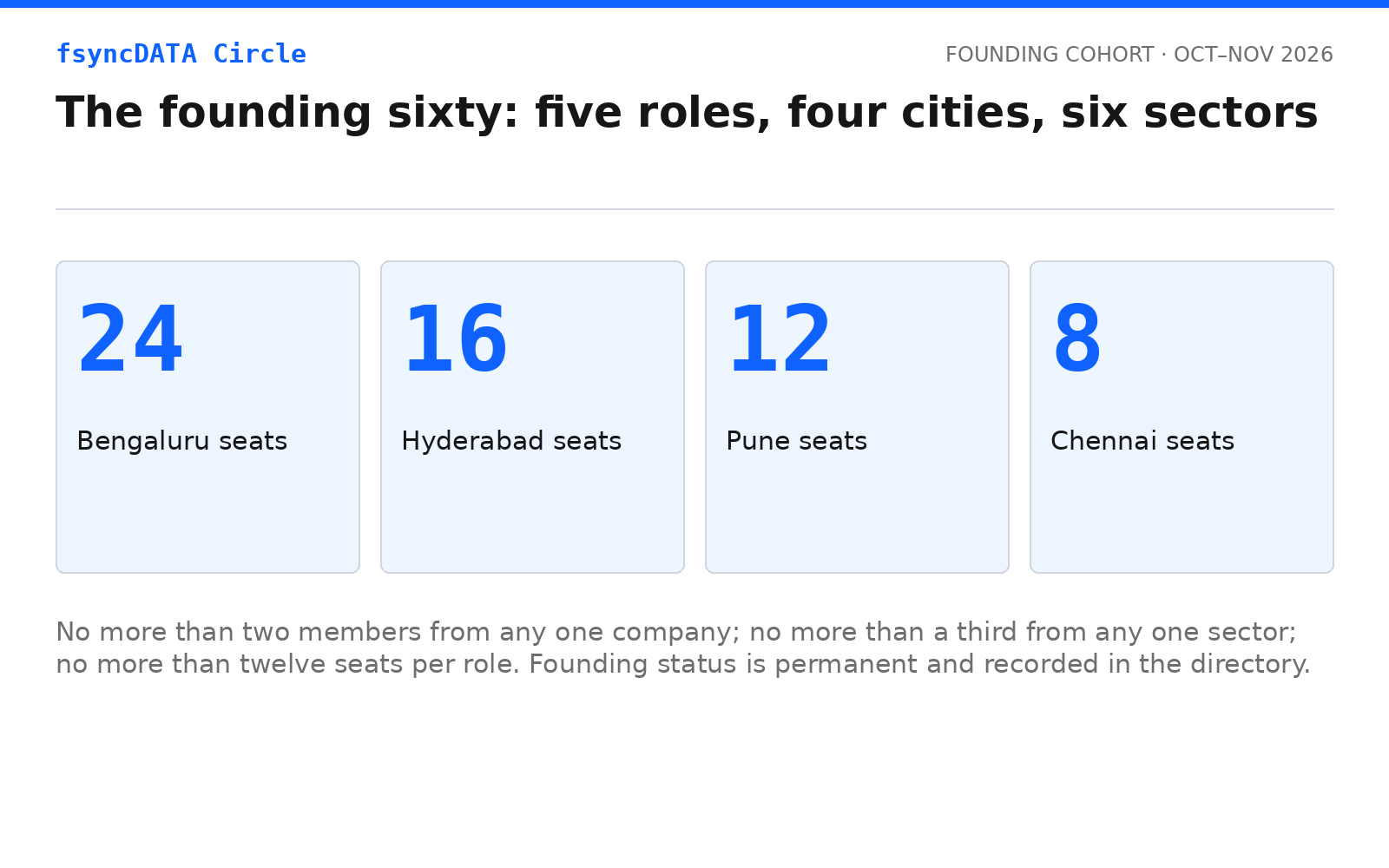
The founding cohort is sixty seats, filled between October and November 2026, with no more than twelve seats per role and no more than two members from any one company. The composition target across the GCC leadership roles is: site leaders 10; chief data officers, chief data and analytics officers and heads of data 10; CIOs, CTOs, chief AI officers and chief data scientists 14; principal database architects and data architects 14; heads of data platform and senior data engineers 12.
Across cities: Bengaluru 24, Hyderabad 16, Pune 12, Chennai 8. Across sectors: no more than a third from any one. Founding members adopt the charter, elect the first council, set the second cohort’s size, approve the benchmark’s questions before they are issued, and choose which city hosts the annual assembly. Founding status is permanent and is recorded in the directory.
After the founding cohort, every seat across the GCC leadership roles is filled by a member’s nomination and the council’s approval, at a pace the council sets. The Circle is designed to stay small enough that every member can know every other member. If that means it stops growing, it stops growing.
Market context for the GCC leadership roles above, from the Nasscom–Zinnov India GCC Landscape 2026: about 2,117 centers across 3,728 units, 2.36 million people, US$98.4 billion in FY26 export revenue, 506 Forbes Global 2000 parents, and more than 100 new centers a year. Roughly 30% of centers are in Bengaluru, which is why the founding session and the annual assembly are held there.
This page describes the Circle as proposed to its founding cohort, who may amend the charter at the founding session. Nothing on this site is an offer of services. © 2026 MinervaDB Inc.