Every member has been asked by a board or a parent “is that normal?” and had no honest way to answer. The GCC data platform benchmark exists so that the answer, for India’s capability centers specifically, is known to the people who need it and to nobody else.
8
measures in the GCC data platform benchmark, collected once a year
5
responses minimum per cell, or the cell is suppressed
0
raw responses retained after aggregation
1
report, identical for every member and for the convener
01
Why a GCC data platform benchmark exists
Vendors publish benchmarks that sell something. Analysts publish benchmarks that are global, or American, or drawn from whoever answered a web survey. Neither tells a site leader in Hyderabad whether the share of the cloud bill going to databases and warehouses in a 900-person BFSI captive is high, low or normal for India’s centers. That number is not published anywhere, because the only people who have it are the people who would have to give it up.
The GCC data platform benchmark is the Circle’s answer. Members give their numbers once a year, under rules that make the giving safe; the secretariat aggregates and anonymises; every member receives the same report. The convener receives the same report and nothing more. Raw responses are deleted after aggregation. The council audits the process annually.
It is the only artefact of the Circle that has a public face at all, and that face is small: a three-paragraph summary with no numbers, released by the council if it chooses, to raise the Circle’s profile. Everything else stays in the reading room.
02
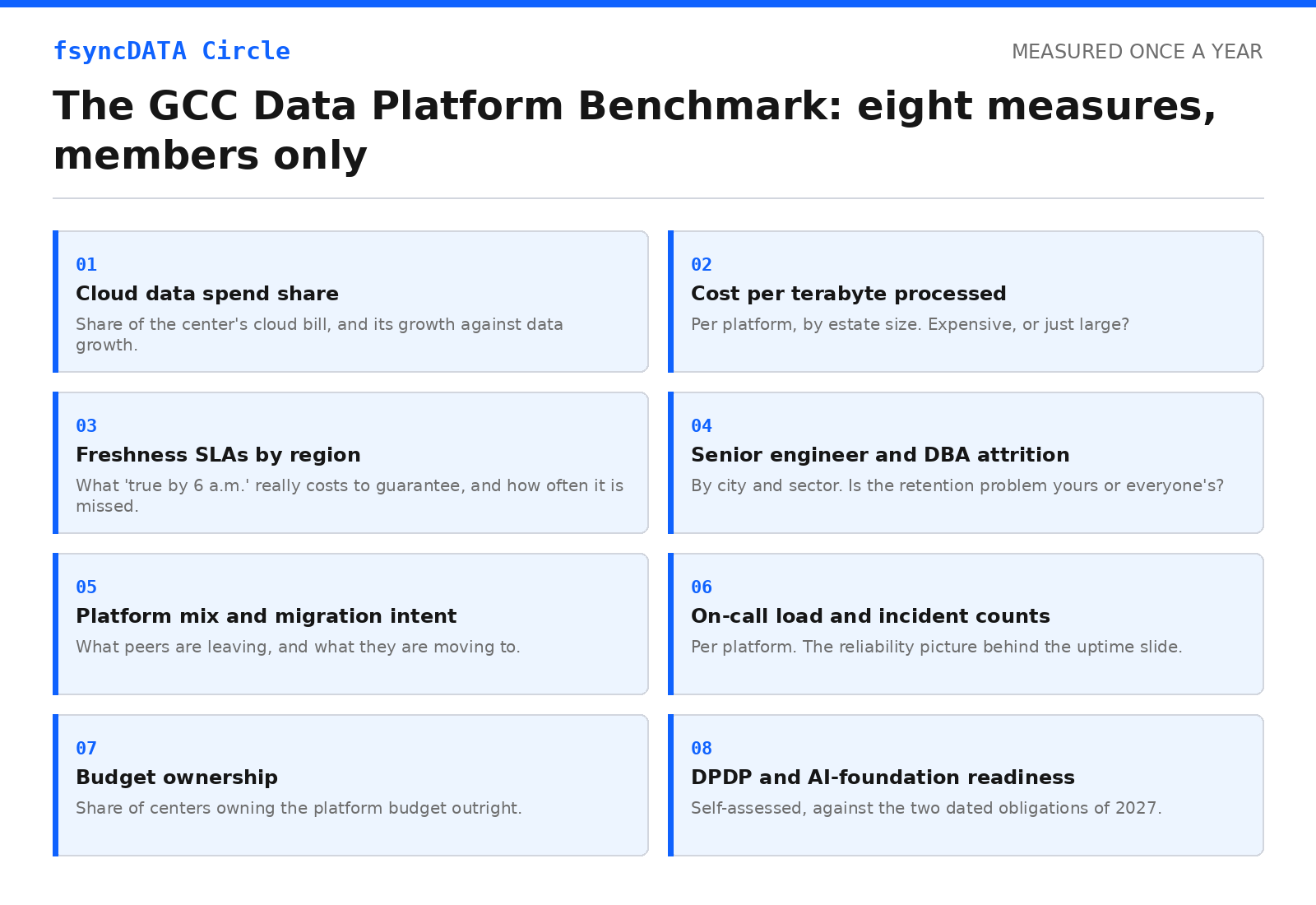
The eight measures
| Measured | Why it matters to a member |
|---|---|
| Cloud data spend as a share of the center’s cloud bill, and its growth against data growth | The first number a site leader is asked about, and the one no vendor will publish |
| Cost per terabyte processed, per platform, by estate size | Whether your estate is expensive, or just large |
| Freshness SLAs by region and how often they are missed | What “the numbers are true by 6 a.m.” really costs to guarantee |
| Senior data engineer and DBA attrition, by city and sector | Whether your retention problem is yours or everyone’s |
| Platform mix and migration intent for the coming year | What your peers are leaving, and what they are moving to |
| On-call load and incident counts per platform | The reliability picture behind the uptime slide |
| Share of centers owning the platform budget outright | How far portfolio ownership has actually travelled |
| DPDP and AI-foundation readiness, self-assessed | Where the room is on the two dated obligations of 2027 |
Eight measures is deliberately few. A GCC data platform benchmark that asks sixty questions gets answered by a junior analyst from whatever is on hand; one that asks eight gets answered by the member, with real numbers. Founding members approve the exact questions before the first survey is issued in January 2027, and may add or remove measures at each annual charter review.
03
Measure 1: cloud data spend against data growth
India’s public cloud spend is growing faster than most centers’ data, and database and warehouse lines are typically the largest and least understood share of the bill. Within a center, that share is the first thing a site leader is asked about when a parent’s FinOps team arrives, and the last thing anyone can benchmark, because no vendor will publish the distribution and no center will publish its own.
The GCC data platform benchmark asks two questions here: what share of the center’s cloud bill goes to database, warehouse and streaming platforms, and how that share moved over twelve months against the growth of stored and processed data. The second is the useful one. An estate whose data spend grows in line with data is being run; one whose spend grows faster is being billed.
In the GCC data platform benchmark this is reported by estate size band, sector and cloud, with cells of fewer than five responses suppressed. Members see where their estate sits in the distribution; nobody sees which estate is which.
04
Measure 2: cost per terabyte processed
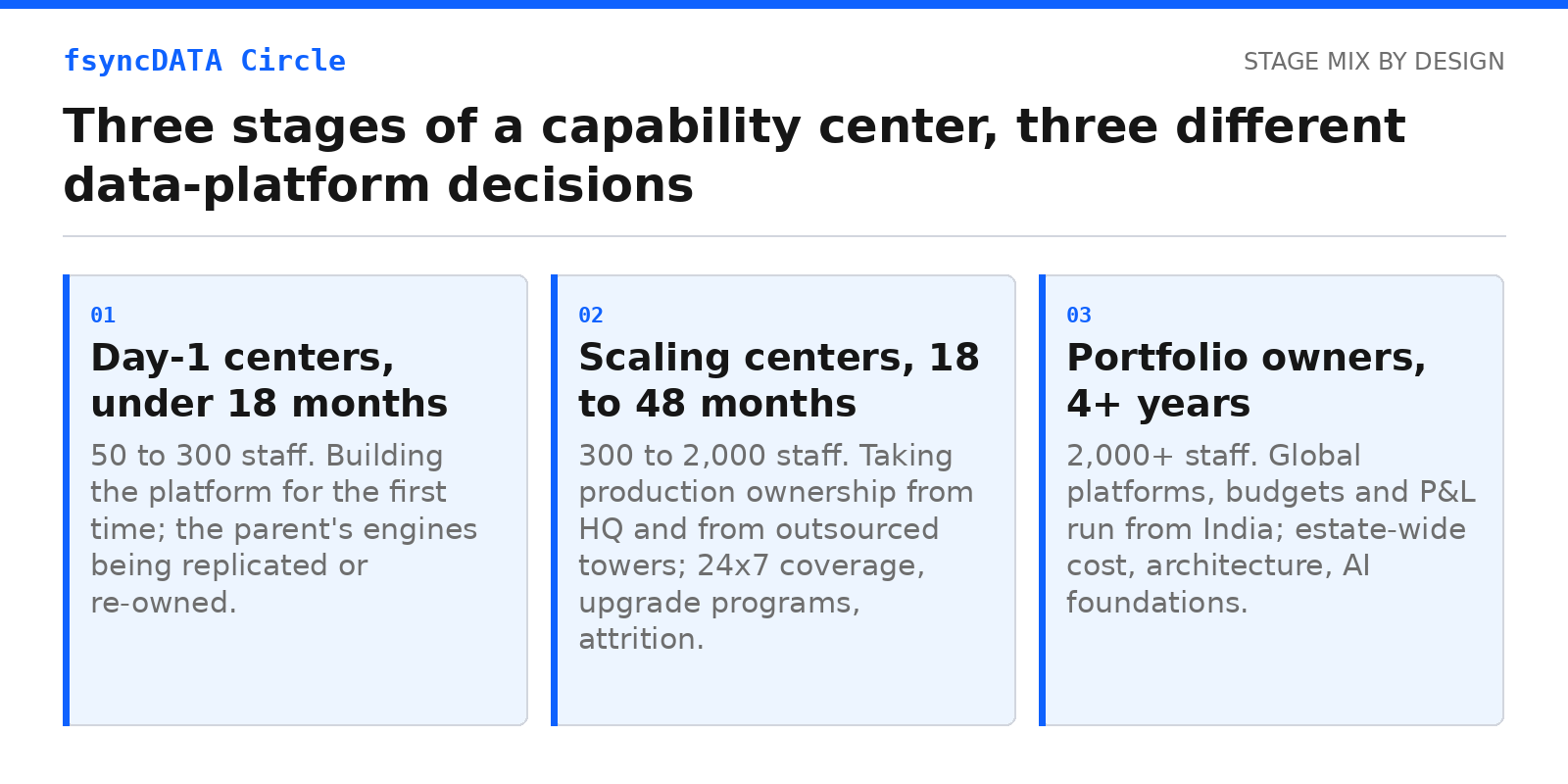
“Is our warehouse expensive?” has two honest answers: expensive relative to the work it does, or simply large. Cost per terabyte processed, per platform, separates the two. The GCC data platform benchmark collects it by platform class (OLTP database, warehouse, lakehouse, streaming) and by estate size band, so that a member can compare their warehouse to warehouses of similar scale rather than to an average that mixes a Day-1 center with a portfolio owner.
For the GCC data platform benchmark, members define terabytes processed the way their own platform reports them; the secretariat’s guidance note says which counter to use for each common platform so the numbers are comparable. Where a platform does not expose a comparable counter, the member reports storage and the cell is labelled accordingly.
05
Measures 3 and 6: freshness, on-call and incidents
Freshness SLAs by region, and how often they are missed, is the measure behind the sentence every center says to its parent at month-end. The GCC data platform benchmark asks what freshness commitment each member’s estate makes per region, whether it is contractual or informal, and how many times in twelve months it was missed. The reliability and freshness working session in January 2027 is timed so that the benchmark survey opens the same month.
On-call load and incident counts per platform is the companion measure. How many people carry the pager for the data estate, how many incidents per platform per quarter, what share were P0 outage risks versus P1 degradation. This is the reliability picture that sits behind the uptime slide, and it is the measure principal database architects and heads of data platform most often say they cannot get for any estate but their own.
Both measures in the GCC data platform benchmark are reported in distributions, not averages. An average incident count across a room that contains both a validated pharma estate and a retail estate in peak season tells nobody anything; the spread by sector and stage does.
06
Measures 4 and 7: attrition and budget ownership
Senior data engineer and DBA attrition, by city and sector, answers the question every site leader has asked in a budget review: is this our problem or everyone’s? Attrition in these roles is structural in Bengaluru, Hyderabad and Pune, but it varies, and the GCC data platform benchmark is the only place the variation is measured for India’s centers specifically. The talent and attrition session in June 2027 works the readout.
Share of centers owning the platform budget outright measures how far portfolio ownership has actually travelled. Industry surveys suggest fewer than half of India’s centers report meaningful budget ownership; the benchmark asks members directly, for the data platform budget specifically, and reports the share by stage. A Day-1 center learns what to expect; a portfolio owner learns whether it is still unusual.
07
Measures 5 and 8: platform mix, DPDP and AI readiness
Platform mix and migration intent for the coming year is the measure members quote most in the reading room. Which engines and platforms does each estate run today, in what proportion, and which does it intend to leave or adopt in the next twelve months? Reported in aggregate, this is the only vendor-neutral picture of where India’s GCC data estates are moving, and the GCC data platform benchmark is the only place it is drawn from the people who own the estates rather than from the people who sell to them.
DPDP and AI-foundation readiness, self-assessed, tracks the two dated obligations of 2027. Each member rates their estate’s readiness on a short scale for retention, erasure, breach telemetry and residency under India’s DPDP Act, and for the vector, streaming and governance foundations their AI charters depend on. The room sees where it stands in aggregate in April 2027, one month after the DPDP working session and one month before the AI-foundations deep dive.
Self-assessment is a known weakness of any GCC data platform benchmark and is stated as such in the report. The measure is useful for trend, not for audit, and the council may replace it with something sharper once the room has agreed what sharper means.
What answering the GCC data platform benchmark takes
About ninety minutes, once a year, for the member or a delegate the member trusts with the numbers. The survey asks for figures most estates already report internally: the cloud bill by service line, storage and processed volume by platform, the freshness commitments in the operating agreement with the parent, the on-call rota, incident counts from the ticketing system, headcount movements in the data platform team, and the platform inventory. The secretariat’s guidance note maps each question to the counter or report where the figure usually lives.
Where a member cannot produce a figure, the answer is left blank rather than estimated. A blank in the GCC data platform benchmark is honest; a guess is noise that other members will act on. Members may also mark any answer as excluded from the platform-mix cross-tabulation if they believe the combination of sector, stage and platform would identify their center even with cell suppression. The secretariat honours every such request without asking why.
08
How the GCC data platform benchmark handles data
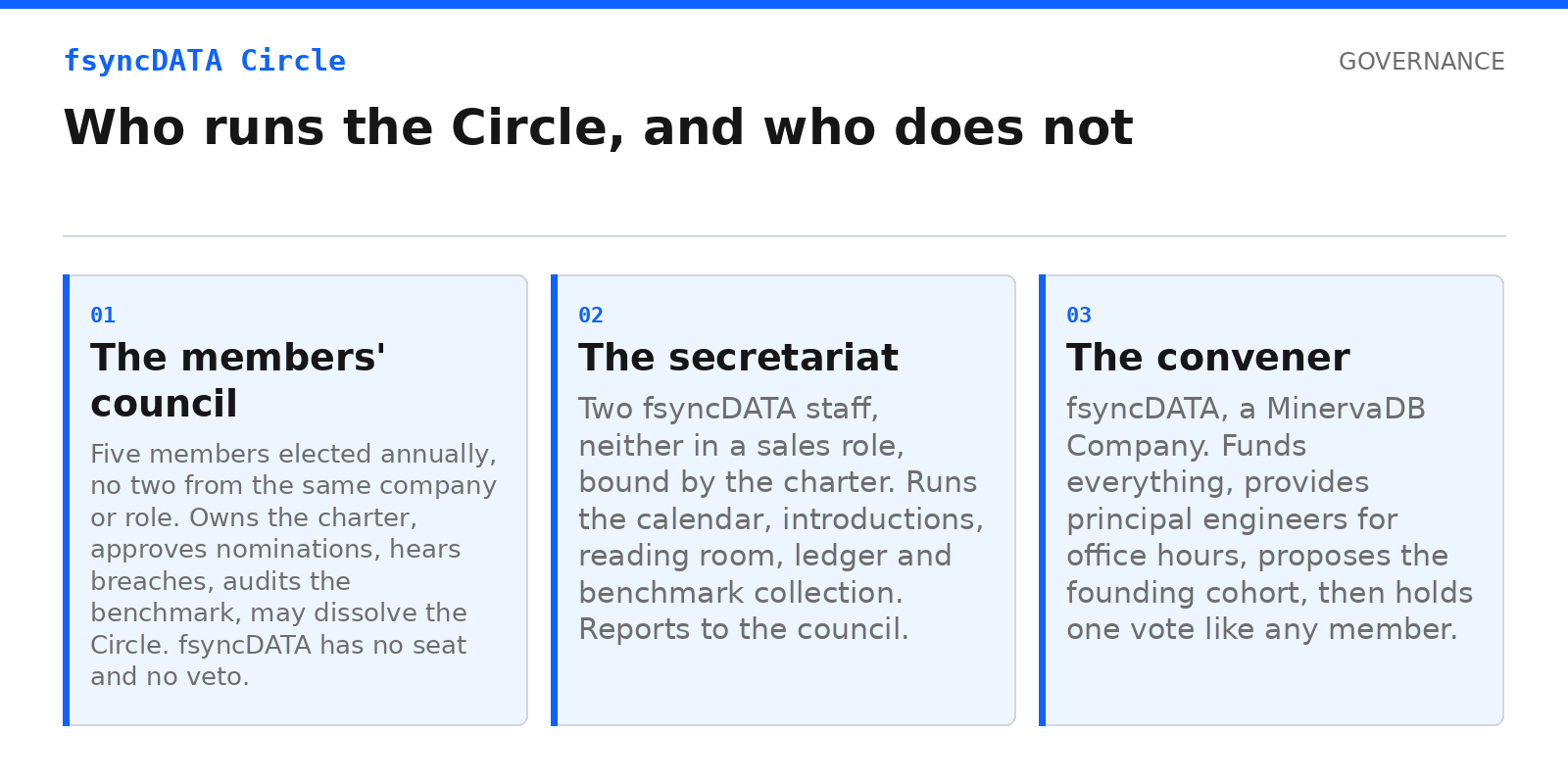
Responses are collected by the secretariat through a members-only survey, held on India-resident infrastructure, aggregated and anonymised before anyone, including fsyncDATA, sees results. Minimum five responses per cell or the cell is suppressed. Raw responses are deleted after aggregation. The council audits the process annually and may commission an independent audit of the controls at any time, at fsyncDATA’s cost.
- Collected once a year, January, by the secretariat, from members only
- Held on India-resident infrastructure used only to run the Circle
- Aggregated and anonymised before anyone sees results, fsyncDATA included
- Minimum five responses per reporting cell, or the cell is suppressed
- Raw responses deleted after aggregation; no member-level data retained
- Never sold, never exported, never shared with fsyncDATA’s or MinervaDB’s commercial teams
- Audited annually by the members’ council
These GCC data platform benchmark rules are part of the Circle charter, not a privacy notice that can be revised. Rule 5 forbids the sale of benchmark responses to anyone, ever, and the council can dissolve the Circle if the convener breaks it. The charter is on the Circle charter page; the governance behind the audit is on the members council page.
09
Who sees the GCC data platform benchmark
Access to the GCC data platform benchmark is the clearest example of what membership buys and what leaving costs. The report is not emailed, not downloadable outside the reading room, and not retained by a member who leaves. It is read where it is kept, by the people who contributed to it.
Members, in full, at the April readout and in the reading room. The readout is a working session in its own right: the first annual GCC data platform benchmark is presented to the room in April 2027, followed by a session on what surprised it. The full report then lives in the reading room, searchable, members only, for as long as the member remains in the Circle.
fsyncDATA receives the same GCC data platform benchmark report as everyone and no more. Not the raw responses, not the member-level data, not an early look. This is written into the charter because the convener’s incentive to see more is obvious, and the answer to an obvious incentive is a rule, not a promise.
The public sees, at most, a three-paragraph summary with no numbers, released by the council if it chooses. The Circle’s profile benefits from the world knowing that India’s GCC data leaders have measured these things; the members benefit from the world not knowing what they found.
10
The benchmark calendar
The GCC data platform benchmark runs on a fixed annual rhythm so that members can plan the ninety minutes it takes to answer, and so that the readout lands before the budget cycles it informs. Year one is compressed by the founding date; from year two the survey opens each January and the readout is each April, with the measures reviewed at the October assembly.
| When | What happens |
|---|---|
| November 2026 | Founding members approve the benchmark’s questions at the founding session in Bengaluru |
| January 2027 | Survey issued to members alongside the reliability and freshness working session |
| February to March 2027 | Responses collected; secretariat aggregates, anonymises and suppresses small cells |
| April 2027 | Benchmark readout: first annual GCC data platform benchmark, members only, with a session on what surprised the room |
| April 2027 onward | Full report in the reading room; council audits the process; public summary released only if the council chooses |
| October 2027 | Annual assembly reviews the measures for year two |
The full year is on the Circle calendar. Each benchmark measure is paired with a working session in the GCC data platform curriculum so that the numbers arrive in the same season as the decisions they inform.
11
What founding members decide about the GCC data platform benchmark
Founding members approve the benchmark’s questions before it is issued, and set the size and pace of the second cohort, which determines how many responses the first GCC data platform benchmark can draw on. With sixty founding seats across five roles, four cities and six sectors, and no more than two members from any one company, the first survey can expect responses from roughly forty to fifty distinct centers, enough for the sector and stage cells to clear the five-response threshold in most cases.
Founding members also decide whether the self-assessed readiness measure stands or is replaced, whether cost per terabyte is reported by platform class or by named platform, and whether the public summary is released at all in year one. These are decisions the people whose numbers are in the report should make, and the charter gives them to the room.
Market scale, for context: the Nasscom–Zinnov India GCC Landscape 2026 counts about 2,117 centers across 3,728 units. The Circle does not aim to benchmark the market; it aims to benchmark the room, honestly, for the room. Sixty centers whose leaders trust the process produce a better number than two thousand who answered a vendor’s web form. The Nasscom figures are the market; the GCC data platform benchmark is the members.
This page describes the GCC data platform benchmark as proposed to the founding cohort, who approve its questions before issue. Nothing on this site is an offer of services. © 2026 MinervaDB Inc.