The fsyncDATA GCC leadership conferences are two open-door days a year, one in Bengaluru and one in Hyderabad, for the people who run and build India’s Global Capability Center data estates. Tech talks, break-fix sessions, hands-on labs and structured networking through the day; music, dance and a long dinner in the evening. Alongside them, fsyncDATA Learning: online tracks for aspiring data platform engineers, data platform operations people and data architects, open to professionals and colleges.
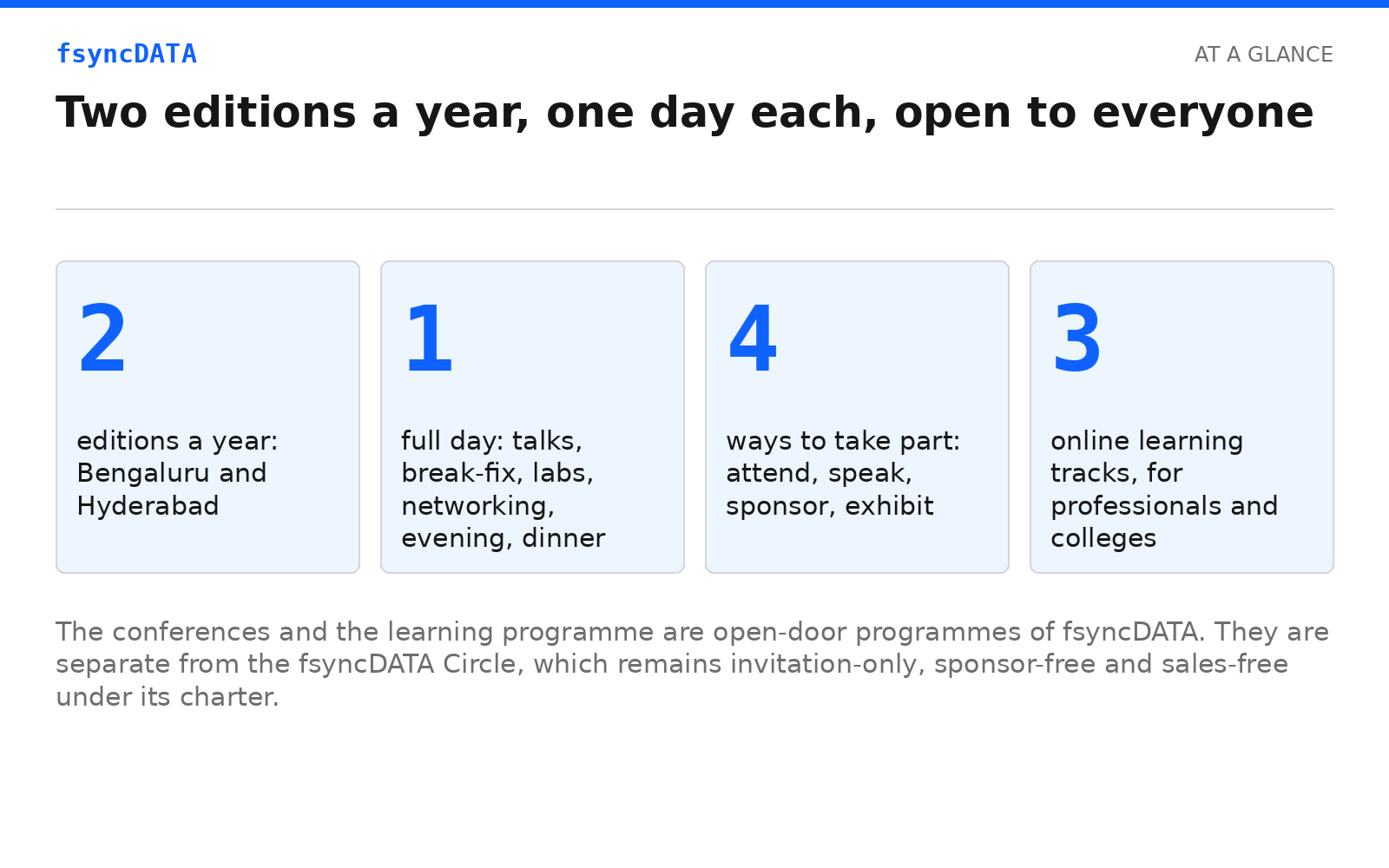
2
GCC leadership conferences a year: Bengaluru and Hyderabad
1
full open-door day: talks, break-fix, labs, evening, dinner
4
ways to take part: attend, speak, sponsor, exhibit
3
online learning tracks, for professionals and colleges
01
What the GCC leadership conferences are
Most technology conferences in India are built for the vendor: the stage is sold, the agenda follows the sponsors, and the practitioners who actually run production estates sit in the audience. The GCC leadership conferences invert that. The stage is for practitioners from India’s capability centers and the engineers who keep their platforms up; sponsors and exhibitors are welcome, funded and named, and they work the floor rather than the podium.
The audience is the whole decision chain of a center’s data estate: site leaders, chief data and analytics officers, chief AI officers and chief data scientists, CIOs and CTOs, principal database architects, heads of data platform, and the engineers who will hold those roles next. Students and early-career engineers from partner colleges attend the labs and the talks at no cost.
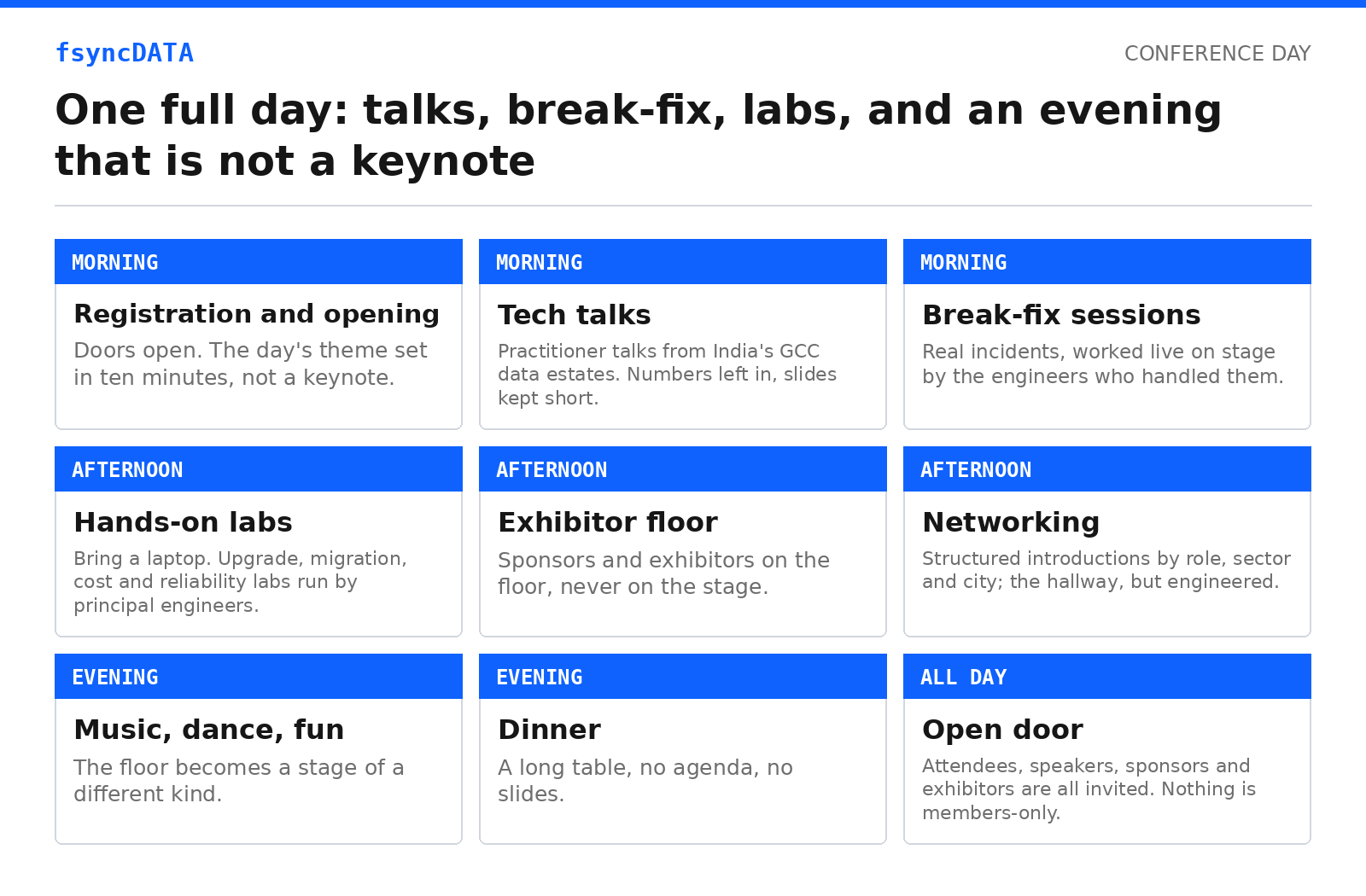
Each edition of the GCC leadership conferences is one full day. It starts with registration and a ten-minute framing of the day’s theme, runs tech talks and break-fix sessions through the morning, hands-on labs and the exhibitor floor through the afternoon, structured networking before the evening, and then music, dance and dinner. Nothing about the GCC leadership conferences is members-only.
02
Two editions a year: Bengaluru and Hyderabad
Bengaluru hosts roughly 30% of India’s capability centers; Hyderabad is the second concentration. Each city gets one edition a year, six months apart, so that a leader in either city can attend one without travelling and both without missing a quarter-end. The two editions share a format and a theme for the year; the speakers, labs and floor are local to each city.
Dates and venues for the first GCC leadership conferences will be published on this page and sent to everyone who registers interest below. We will not announce a date until the venue, the lab infrastructure and the first ten practitioner speakers are confirmed, because a conference that slips its date has already told its attendees what it thinks of their calendars.
Both editions of the GCC leadership conferences are priced to be open. Attendance for practitioners from capability centers and their parents, and for students from partner colleges, is intended to be free or close to it, funded by sponsors and exhibitors. Exact terms are published with the dates.
03
The conference day, hour by hour
| Block | What happens | Who is on stage |
|---|---|---|
| Morning | Registration, a ten-minute framing of the day, tech talks, break-fix sessions | Practitioners from India’s GCC data estates; fsyncDATA and MinervaDB principal engineers for break-fix |
| Afternoon | Hands-on labs, the exhibitor floor, structured networking | Lab leads; exhibitors on the floor; the secretariat’s introductions desk |
| Evening | Music, dance, fun, then dinner | Nobody. No slides after sunset |
A day at the GCC leadership conferences is long on purpose and light on ceremony. There is no opening keynote from a sponsor, no awards segment, no panel of vendors agreeing with each other. Talks are thirty minutes with the numbers left in; break-fix sessions are forty-five; labs are ninety. Attendees choose two of three parallel tracks in each block.
04
Tech talks and break-fix sessions
Tech talks at the GCC leadership conferences are practitioner talks: a head of data platform on what a major-version wave across a validated PostgreSQL estate actually cost; a CIO on how a center earned a seat at the parent’s platform council; a principal architect on a lakehouse design three years on and what they would change. Vendor speakers are welcome to submit; they speak from the floor and the labs, not the main stage.
Break-fix sessions are the part of the GCC leadership conferences that does not exist elsewhere. A real incident, anonymised where needed, is worked live on stage by the engineers who handled it: the alert, the first wrong hypothesis, the query that found it, the change that fixed it, the rollback that was ready in case it did not, and the verification query that proved the fix before anyone declared it fixed. The audience sees the terminal, not the retrospective slide. fsyncDATA and MinervaDB principal engineers run several; practitioners from centers are invited to run their own.
Every talk and break-fix session carries the caveat we apply in our own work: what worked on one estate must be tested on yours before it goes anywhere near production, and every estate should be behind a tested disaster-recovery posture before it tries.
05
Hands-on labs
Bring a laptop. Labs at the GCC leadership conferences are ninety minutes, capped at thirty seats, run by principal engineers on infrastructure the conference provides. The first year’s lab list is drawn from the decisions India’s centers face in 2027: a rolling major-version upgrade with rollback; a Kafka ZooKeeper-to-KRaft migration; a database FinOps review on a real bill; a replication and failover drill; retention, erasure and breach-telemetry design for DPDP; vector and streaming foundations for an AI charter.
Labs are the reason students are in the room at the GCC leadership conferences. A final-year engineering student who has upgraded a production-shaped database cluster under supervision, watched it fail over, and rolled it back has done something most job descriptions ask for and few graduates have touched. Partner colleges receive lab seats in each edition and the lab material afterwards through fsyncDATA Learning.
06
The evening: networking, music, dance, dinner
The afternoon of the GCC leadership conferences closes with structured networking, because the hallway does not reliably produce the introductions people came for. The secretariat seats attendees by role, sector and city for short rounds with one prompt each, so that a site leader meets a principal architect from a different sector and a student meets the head of platform who will hire them.
Then the day changes register. Music, dance and fun on the floor, and a long dinner with no agenda and no slides. The GCC leadership conferences are meant to be remembered for the evening as much as the talks; a conference that ends at five with a sponsor’s closing remarks has wasted the one hour when people actually talk to each other.
Sponsors and exhibitors of the GCC leadership conferences are at the dinner as guests, like everyone else. Nothing is presented after sunset, by anyone.
What a first-time attendee should expect: to hear numbers they have never seen on a conference slide, to watch an incident handled rather than summarised, to leave a lab having done the thing rather than heard about it, and to go home with three people from other centers they can call. What they should not expect: a keynote, a sponsor panel, a badge scan, or a follow-up email from anyone they did not give their card to. The GCC leadership conferences are built to be judged by what attendees do differently on Monday, and the practitioner committee reads every piece of feedback before the next edition is programmed.
Practical details
Both venues are chosen for step-free access, quiet rooms and reliable connectivity for the labs. Talks and break-fix sessions are recorded and published after each edition, with a speaker’s right to refuse recording of their own session. Labs are not recorded. A short code of conduct applies to everyone at the GCC leadership conferences, sponsors and exhibitors included: speak for your own estate, ask before you advise, disagree with numbers rather than people, and take no photograph of a slide that shows a number without the speaker’s consent.
Attendees receive the programme two weeks ahead and choose tracks on the day. Dietary requirements are collected at registration for the dinner. Nobody is asked for a badge scan, and no attendee list is shared with sponsors or exhibitors; an exhibitor who wants to follow up with someone asks them at the stand.
07
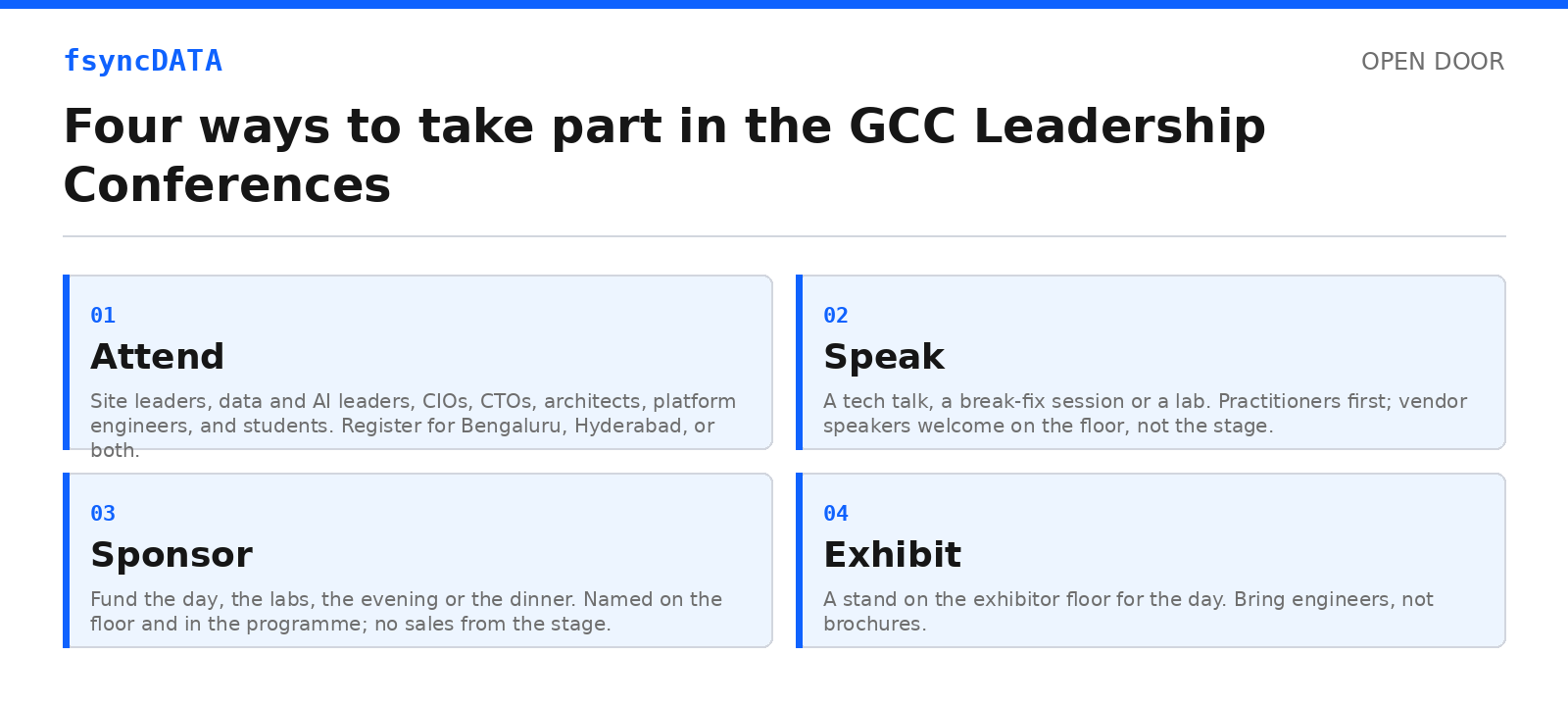
Open door: attend, speak, sponsor, exhibit
| Take part as | What it means | How |
|---|---|---|
| Attendee | Register for Bengaluru, Hyderabad or both. Choose your tracks on the day. | Register interest below; dates follow |
| Speaker | A thirty-minute tech talk, a forty-five-minute break-fix session, or a ninety-minute lab. Practitioners first. | Send a one-paragraph outline below |
| Sponsor | Fund the day, the labs, the evening or the dinner. Named on the floor and in the programme. No sales from the stage. | Tell us what you would like to support |
| Exhibitor | A stand on the exhibitor floor for the day. Bring engineers, not brochures. | Tell us what you would show |
The rule for sponsors and exhibitors is written so that nobody is surprised: you are welcome, you are named, you are funded, and you do not get the stage. The programme is chosen by a practitioner committee that fsyncDATA convenes but does not chair; sponsorship buys presence, not a slot. That rule is what lets the GCC leadership conferences put practitioners on stage with their numbers, and it is the reason the audience will come back.
What speakers can expect
A practitioner committee reviews outlines and replies within three weeks. Accepted speakers get a short preparation call, a slide review that removes nothing but logos, help anonymising an estate where needed, and travel within India covered for practitioners from capability centers who are not otherwise funded. Speakers at the GCC leadership conferences keep their material and their recording rights.
What sponsors and exhibitors get, and do not
Named on the floor plan, the programme, the website and the evening; a stand; passes for engineers; a seat at the dinner. Not a stage slot, not the attendee list, not a say over the programme, and not a route into the fsyncDATA Circle, which takes no sponsorship of any kind. Sponsorship tiers and terms are published with the dates for each edition of the GCC leadership conferences, and they are the same for every sponsor.
08
fsyncDATA Learning: online tracks for the next generation
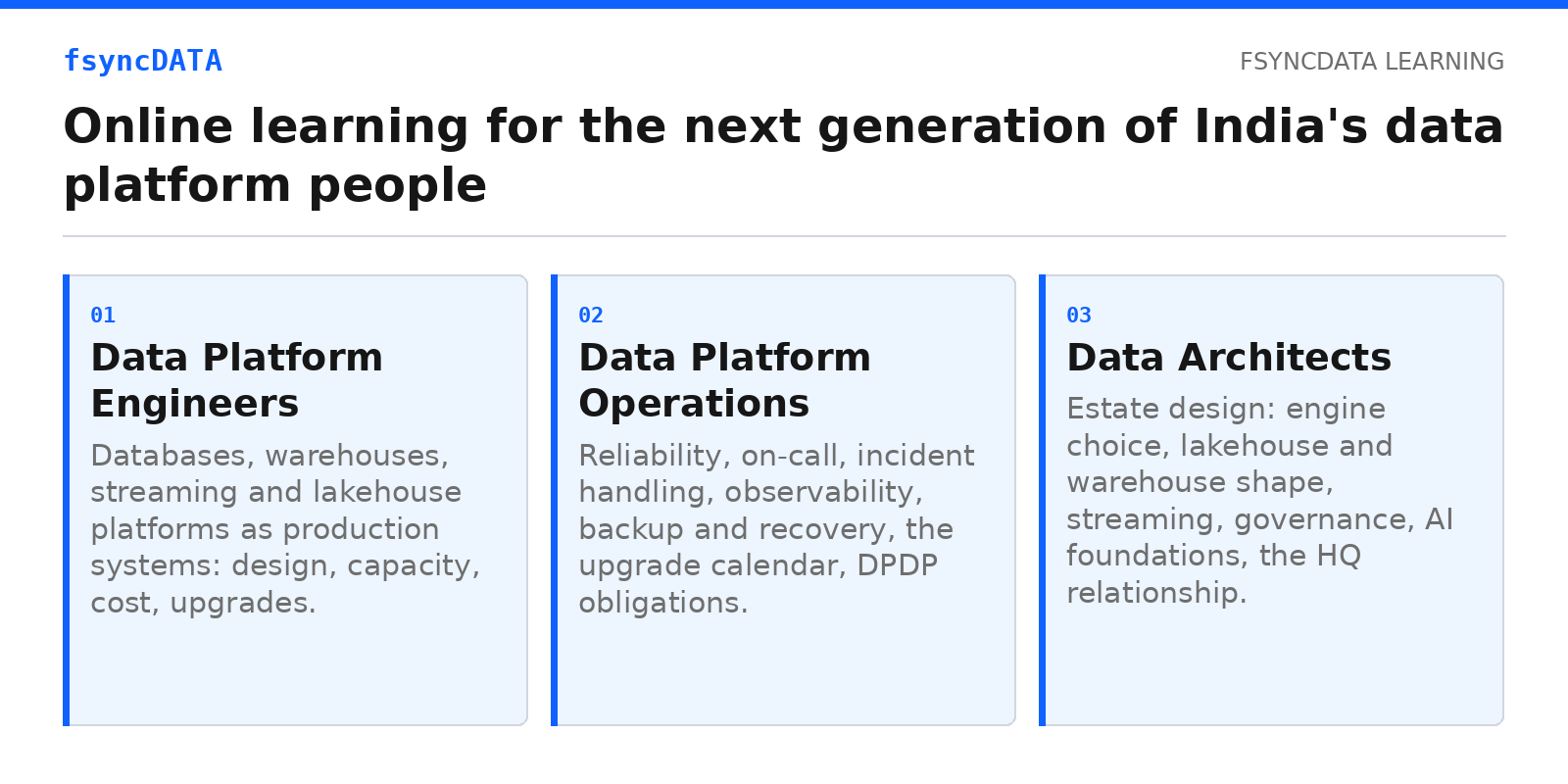
Alongside the GCC leadership conferences, fsyncDATA is building fsyncDATA Learning: online learning for the people who will run India’s data platforms next. Three tracks, each built from the same material the conferences run live, each accessible to working professionals and to colleges.
| Track | For | What it covers |
|---|---|---|
| Data Platform Engineer | Engineers moving from application or DBA work into platform ownership | Databases, warehouses, streaming and lakehouse platforms as production systems: design, capacity, cost, upgrades, migration |
| Data Platform Operations | SREs, DBAs and on-call engineers who keep estates up | Reliability, incident handling, observability, backup and recovery, the upgrade calendar, DPDP obligations, runbooks |
| Data Architect | Senior engineers and leads deciding estate shape | Engine choice, warehouse and lakehouse shape, streaming, governance, AI foundations, the HQ relationship, cost |
Each track is a sequence of recorded sessions, the conference labs as self-paced exercises with the same infrastructure, and a live office hour a fortnight with a principal engineer. Material is version-pinned and dated, and re-verified each conference cycle, because a course that teaches last year’s end-of-support calendar is worse than no course.
Enrolment opens with the first of the GCC leadership conferences. Professionals enrol individually; colleges enrol cohorts. Register interest below and say which track, and you will hear when it opens.
09
For colleges
Colleges are part of the design, not an afterthought. India’s capability centers hire thousands of engineers a year into data platform roles, and the gap between a database course and a production estate is the gap the GCC leadership conferences and fsyncDATA Learning exist to close. A partner college receives lab seats at each edition, the three learning tracks for a cohort, and a standing invitation for faculty to attend the talks and break-fix sessions.
What we ask of a college: a named faculty contact, a cohort of students who will complete the track, and honest feedback on what the material gets wrong. What we do not ask: a fee, a logo on a banner, or exclusivity. Colleges anywhere in India may apply; the first cohorts will be drawn from institutions in and around Bengaluru and Hyderabad because the labs are there.
Who runs the conferences
A conference desk inside fsyncDATA, separate from the Circle’s secretariat, runs registration, sponsors, exhibitors and venues. A practitioner committee of six, drawn from India’s capability centers and refreshed each year, chooses the programme and the labs; fsyncDATA convenes it and holds one seat. The committee’s names are published with each edition’s programme, and its selections are final. Speakers, sponsors and exhibitors deal with the desk; the programme is never negotiated with a sponsor.
10
How the GCC leadership conferences relate to the Circle
The fsyncDATA Circle and the GCC leadership conferences are different things, and it matters that they stay different. The Circle is invitation-only, sixty founding seats, Chatham House with one strike, no sponsors, no sales, governed by an elected council that fsyncDATA does not sit on. The conferences are open-door, sponsored, exhibited, and public. Nothing said inside the Circle is ever presented at a conference, and no conference sponsor gains anything inside the Circle.
Circle members may attend, speak at or sponsor the conferences exactly as anyone else may, as themselves. The Circle is not mentioned from the conference stage, the conferences are not a route to a Circle seat, and the two are run by different people. The Circle’s rules are on the Circle charter page; if you are a GCC data leader looking for the private room rather than the public day, that is the page to read, and the request an invitation page follows it.
What the two share is a conviction: that India’s capability centers now own the data platforms of the world’s largest enterprises, that the people running them deserve rooms built for them, and that a room built for them is one where practitioners speak and vendors listen. Market context, from the Nasscom–Zinnov India GCC Landscape 2026: about 2,117 centers, 2.36 million people, more than 1,200 centers with embedded AI and ML mandates, all of them on data platforms.
11
Register your interest
Use the form to register interest in the GCC leadership conferences as an attendee, speaker, sponsor or exhibitor, or in a learning track, individually or for a college. The conference desk replies within five working days. Dates, venues and terms for the first editions are published here and sent to everyone on this list first. Nothing you enter is added to any other list or shared with the Circle’s secretariat.
The GCC leadership conferences and fsyncDATA Learning are programmes of fsyncDATA, the India-domiciled data-platform operations business of MinervaDB Inc., described at minervadb.com. fsyncDATA is a working name; entity and domain registrations are in progress. Dates, venues, speakers and terms are published on this page when confirmed and not before. © 2026 MinervaDB Inc.