The most valuable outcome of a club is a phone number you can call at 3 a.m. Hallways do not produce those reliably. The GCC peer network inside fsyncDATA Circle produces them on purpose, through six mechanisms the secretariat runs and the council measures.
3
introductions in your first month in the GCC peer network
48
hours to an answer from the GCC peer network
4
cities with quarterly dinners, twelve seats each
3
peers in the GCC peer network you would call before a vendor: the test, at twelve months
01
Why a GCC peer network has to be engineered
Every conference promises networking and delivers a hallway. The people you meet are the people who happened to be standing near the coffee, which means the people in your own role, from your own sector, who already agree with you. Senior people are polite in hallways and say nothing they would not say on stage. The one person who ran the migration you are about to run was in another room, and you never found out.
A GCC peer network for the leaders who run India’s capability center data estates has to solve three problems the hallway cannot. It has to put people across roles and stages together, because the site leader and the principal architect need each other and never meet. It has to make the first conversation safe enough to include numbers. And it has to produce the kind of relationship that survives the event, so that when the same thing happens to you a year later, you have someone to call.
The Circle solves all three by treating networking as a service the secretariat delivers, with the same care it gives the calendar and the reading room, and by measuring the result. The six mechanisms below are the service. The test at the end of this page is the measure.
02
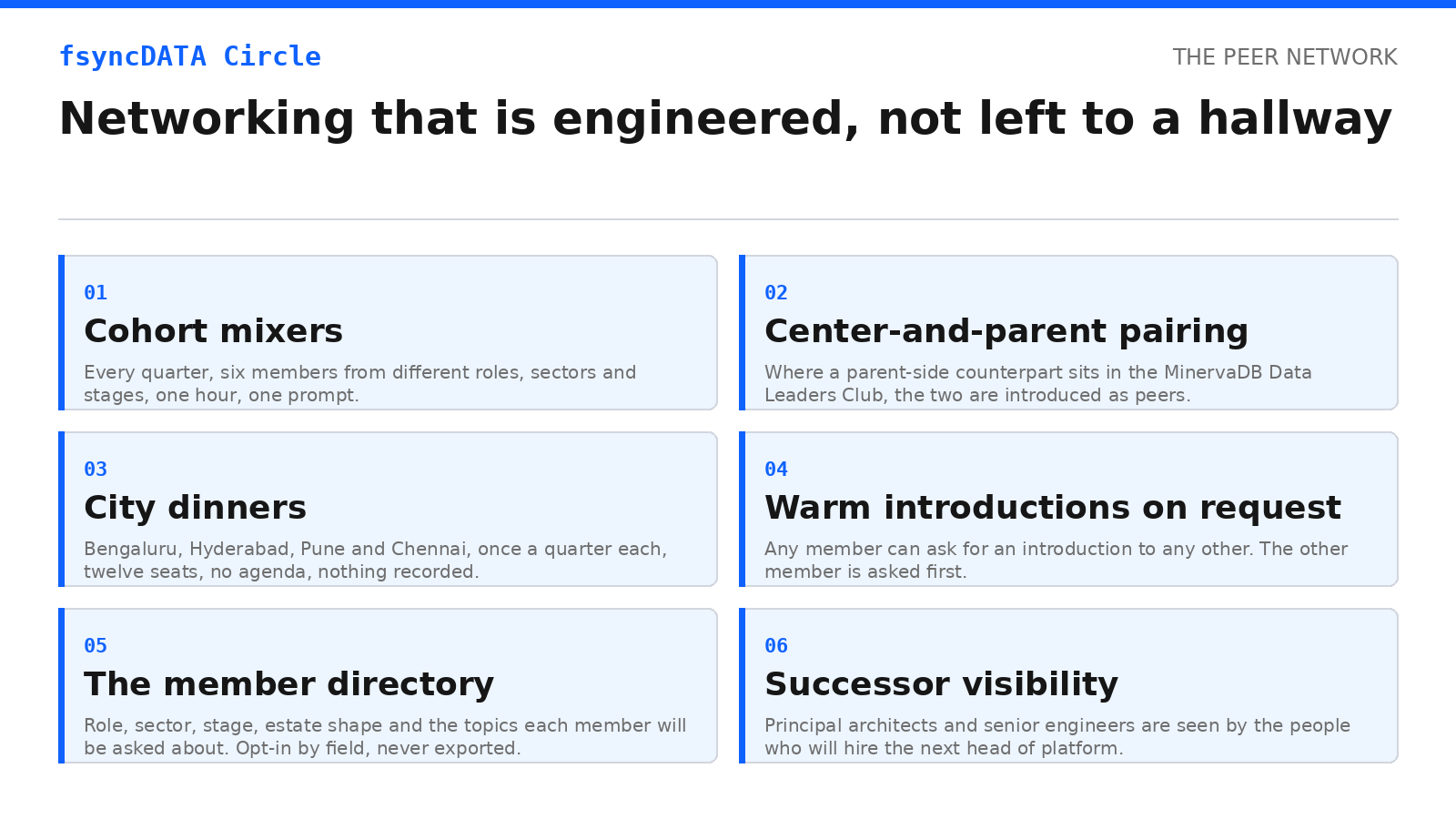
Cohort mixers
Every quarter, six members from different roles, sectors and stages are seated together for an hour with one prompt. The secretariat chooses the six so that each person meets someone they would never otherwise sit with: a Day-1 center’s CIO with a portfolio owner’s head of platform, a BFSI chief data officer with a retail principal architect, a chief AI officer with the site leader who has to fund the foundations.
The prompt is a real question from the reading room, not an icebreaker. An hour is long enough to get past titles and short enough that nobody has to clear an afternoon. Mixers run online in the weeks between working sessions and in person on deep-dive days. Nothing is recorded, nothing is written up, and the secretariat rotates the groups so that over a year a member has sat with roughly two dozen others in the GCC peer network.
What a mixer prompt looks like
A typical prompt: “One of you has a warehouse whose cost grew 40% while data grew 12%. Each of you, in turn, say what you would check first and why.” Six people, six answers, and the site leader in the group discovers that the principal architect’s first check is the one their own platform team has never been asked to run. The GCC peer network works because the prompt forces every role to speak from its own vantage point, and because nobody is presenting.
Members may decline a mixer in any quarter without reason. The secretariat re-seats the group rather than running it short, so that every mixer has the full spread of roles, sectors and stages.
03
Center-and-parent pairing
Where a member’s parent-side counterpart is also a member of the sister MinervaDB Data Leaders Club, the two are introduced as peers, not as vendor and delivery location. This is the mechanism that no other GCC peer network in India can offer, because no other convener holds a relationship on both sides of the ocean.
The Data Leaders Club is the global, online-first club for enterprise data leaders convened by MinervaDB. The Circle is its India GCC sister: the same charter, the same no-pitch rule, a room scoped to capability centers. Members of either may be introduced to members of the other, with consent, and the two councils meet once a year. For a site leader trying to earn a seat at the parent’s platform council, an introduction to the person who chairs it, made as one club member to another, changes the conversation.
Pairing is only ever made with both members’ consent, and the parent-side member is asked first. Neither the Circle nor the Data Leaders Club shares its directory with the other; the secretariats make the introduction and step back.
04
City dinners in Bengaluru, Hyderabad, Pune and Chennai
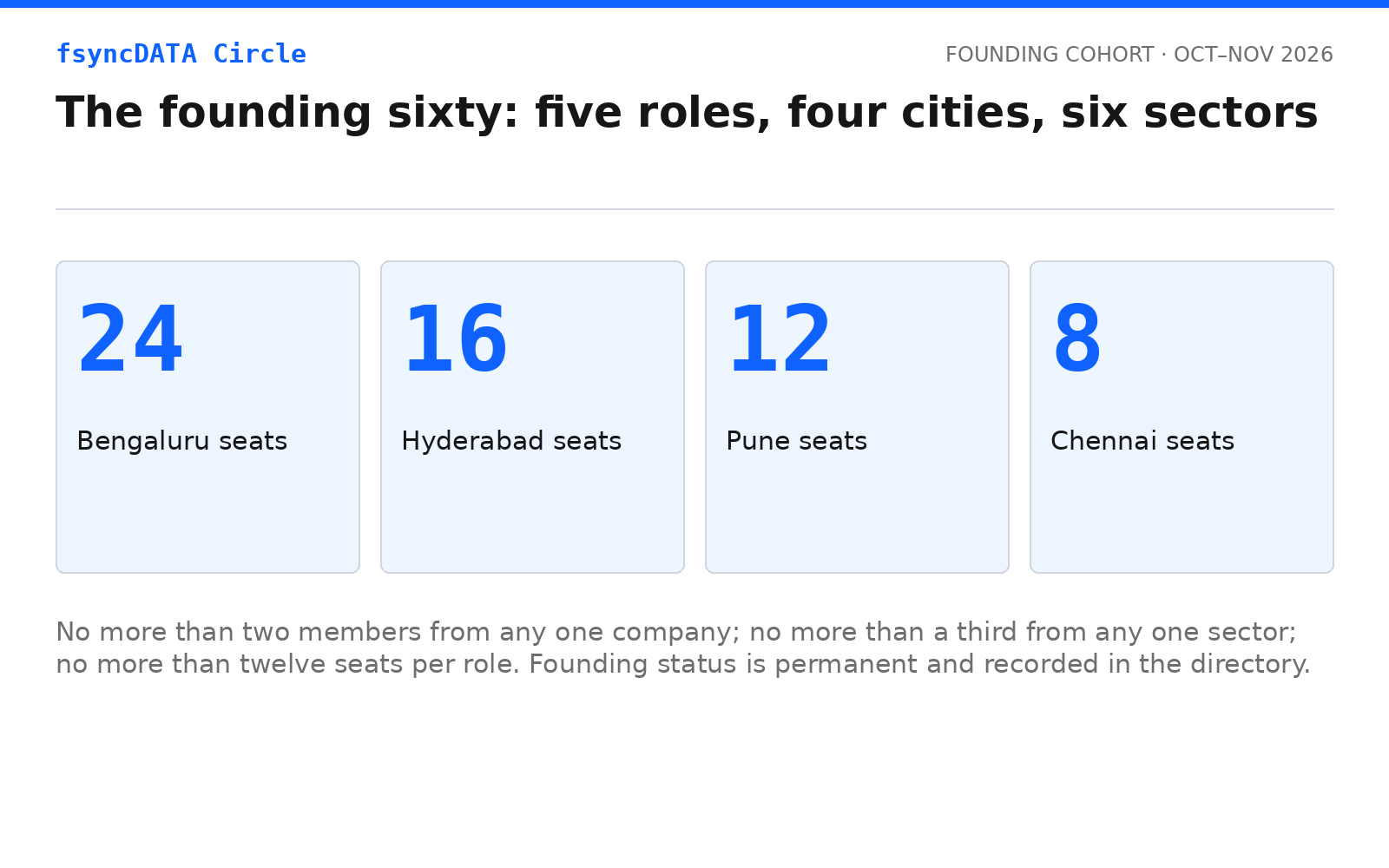
Bengaluru, Hyderabad, Pune and Chennai, once a quarter each, twelve seats, no agenda. Hospitality, not infrastructure: nothing is presented, nothing is recorded, nobody from fsyncDATA’s commercial side is in the room. City dinners are the part of the GCC peer network designed to make the rest of it work.
Seats are offered by the secretariat in rotation so that every member in a city is invited at least twice a year, and members may ask to be seated with someone specific. Dinners on deep-dive days are larger, twelve to twenty seats, and follow the afternoon’s sessions. All dinners are paid for by fsyncDATA under Rule 5 of the charter, with no hospitality partner named and no sponsor, ever.
05
Warm introductions on request
Any member can ask the secretariat for an introduction to any other member. The request goes to the other member first; nothing is shared without consent. The secretariat carries the request with context, why this member is asking and what they hope to learn, and the other member may decline without giving a reason.
This is the GCC peer network’s most-used mechanism after the first quarter. A CIO facing an engine consolidation asks to meet the member whose directory entry says they ran one. A chief data scientist asks to meet the principal architect who built vector capability into a regulated estate. A Day-1 site leader asks to meet the portfolio owner who wishes they had done things differently in year one. The secretariat records only that an introduction was requested and whether it was made.
How an introduction request is carried
The asking member writes two or three sentences to the secretariat: what they are facing, what they hope to learn, and whether they are happy to be named. The secretariat sends that, verbatim, to the member being asked, with the asker’s directory fields the asker has opted in. The member being asked replies yes, no, or not now. On yes, the secretariat sends both members each other’s preferred contact details and steps out. On no, the asker is told only that the member was unavailable. Nothing about the exchange is retained beyond the fact that an introduction was requested and whether it was made, for the value ledger.
06
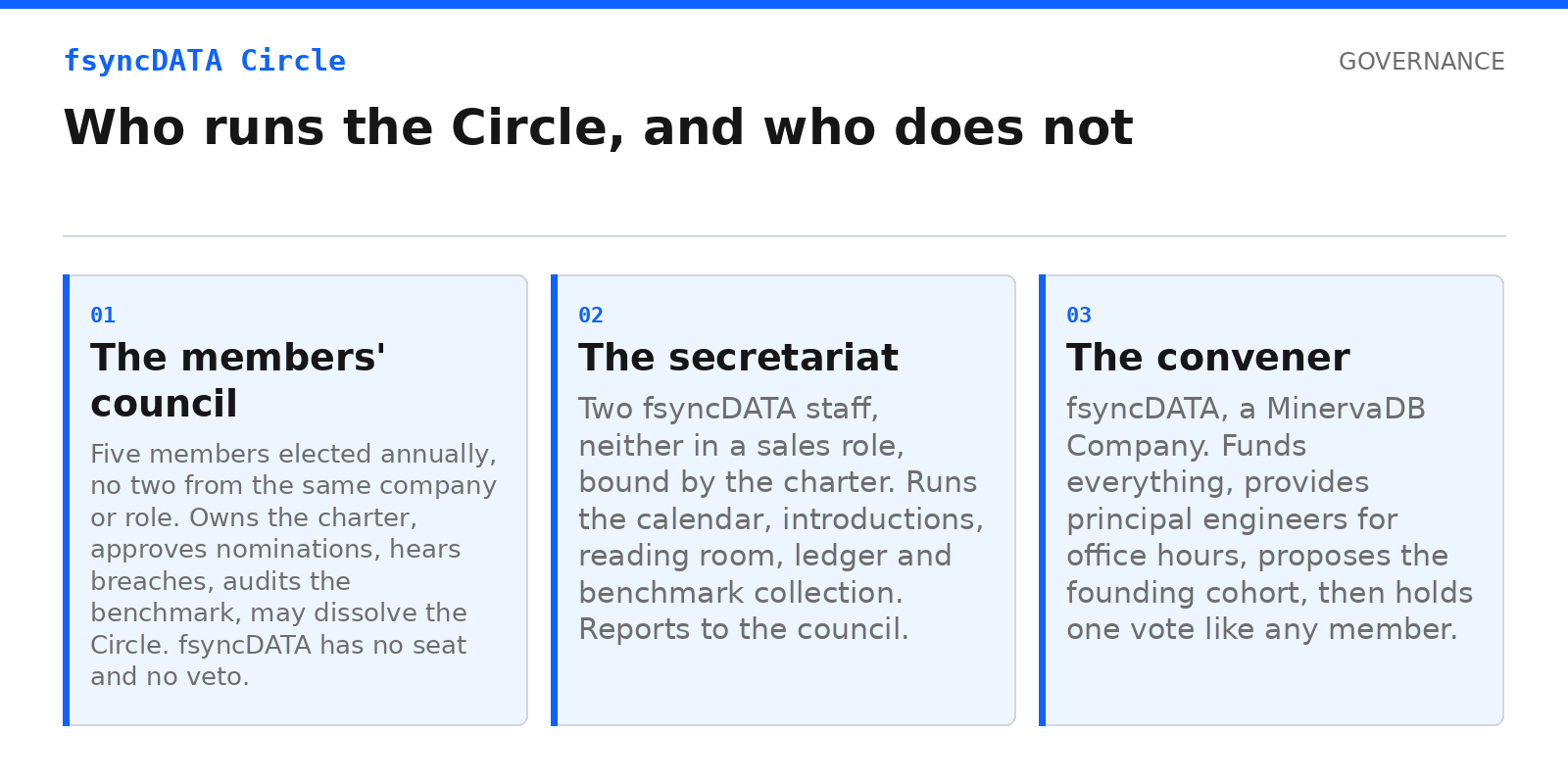
The member directory
Role, sector, stage, estate shape and the topics each member is willing to be asked about. Members only, opt-in by field, never exported. The member directory is the GCC peer network’s map: it is how the secretariat chooses mixers, routes ask-the-network questions and carries introduction requests, and how members find each other directly.
Every field is optional. A member may list their role and city and nothing else; a member may list the three topics they can be asked about and the three they want to learn, which is what most do after the profile call. Estate shape is described in bands, not figures. Nothing in the directory is ever exported, shared with fsyncDATA’s or MinervaDB’s commercial teams, or retained after a member leaves. The council may commission an independent audit of these controls at any time, at fsyncDATA’s cost.
| Directory field | Opt-in | Used for |
|---|---|---|
| Role and city | Default on | Mixers, dinners, city allocation |
| Sector and stage | Default on | Mixers, benchmark cells, introductions |
| Estate shape (in bands) | Opt-in | Introductions, ask-the-network routing |
| Topics I can be asked about | Opt-in | Ask-the-network routing, introductions |
| Topics I want to learn | Opt-in | Introductions in the first month, mixer prompts |
| Founding status | Recorded | Permanent recognition; priority nomination rights |
07
Successor visibility
Principal database architects and senior data engineers in the Circle are seen by the people who will hire the next head of platform. That is a benefit to both, and it is stated plainly because most rooms leave it implicit and then pretend it is not happening. The GCC peer network includes the next generation of the roles above it on purpose.
What this is not: a recruitment channel. Rule 1 forbids selling and the code of conduct forbids poaching conversations inside any Circle format. What it is: a room in which the person who runs production at 3 a.m. is heard by the CIO of another center, on the merits of what they say about their own estate. What happens after that, outside the Circle, is between adults.
Successor visibility and the value ledger
The value ledger records a senior engineer’s or principal architect’s contributions the same way it records a site leader’s: sessions attended, questions answered, decisions brought. A principal architect who has answered a dozen ask-the-network questions in a year has a record that speaks for itself, visible to the member and to the council, and never exported. The GCC peer network does nothing with that record except show it to its owner at renewal. What the owner does with it is theirs.
08
Ask the network: 48-hour answers from the GCC peer network
A member posts a question; the secretariat routes it to the three members best placed to answer, chosen from the directory; answers arrive within 48 hours; the asker may be anonymised on request. Ask-the-network is the GCC peer network’s fastest mechanism and the one that most often produces the moment members describe as the Circle becoming real.
Questions are specific by design. “Has anyone run a major-version upgrade on a validated PostgreSQL estate under strict change control, and what did the evidence pack look like?” gets three answers from people who have. “What do you think of vendor X?” is returned to the asker with a suggestion to rephrase it as a question about their own estate. Answers stay in the Circle; a considered answer counts as a member’s give-to-get contribution for the year.
09
Your first ninety days in the GCC peer network
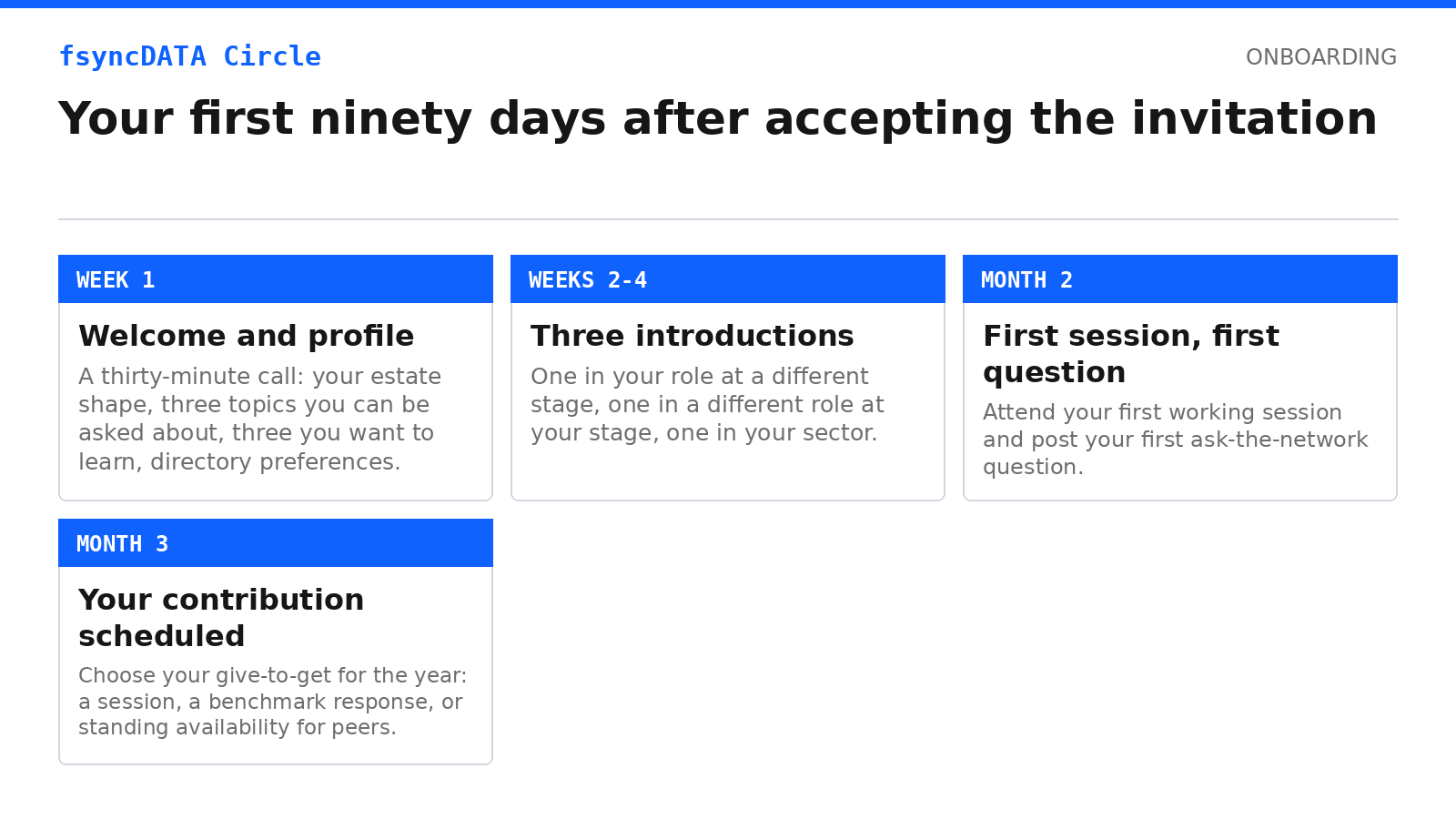
Week one: a thirty-minute call with the secretariat covering your estate shape, the three topics you can be asked about, the three you want to learn, and your directory preferences. Weeks two to four: the secretariat introduces you to three members chosen for complementarity, one in your role at a different stage, one in a different role at your stage, one in your sector.
Month two: you attend your first working session and post your first ask-the-network question. Most members report the first answer as the moment the GCC peer network became real. Month three: with the secretariat, you choose your give-to-get for the year, a session, a benchmark response, or standing availability for peers’ questions.
The mechanics of a working session are on the GCC data platform curriculum page; the dates are on the Circle calendar.
What happens when the GCC peer network fails someone
It will, occasionally. A member in a small sector in a small city may find the room thin on their exact problem. The secretariat’s answer is the sister club: a request for a parent-side introduction through the MinervaDB Data Leaders Club, or a note to the council that the second cohort should include the missing profile. The value ledger shows the secretariat who has asked and not been answered, and those members are the first the secretariat calls before renewal.
Members who do not use ask-the-network in their first quarter are called by the secretariat, not to chase, but to check whether the directory fields they opted into are bringing the right questions their way. In the GCC peer network the secretariat’s job is to make asking easy; a member who has nothing to ask yet is not a problem, but a member who has something to ask and does not know how is.
10
The one test the GCC peer network is measured on
The test of the networking is simple: twelve months after joining, does every member have three people in the Circle they would call before calling a vendor? The secretariat measures it, by asking, and the council sees the number. If the number is not three, the mechanisms above change until it is.
This is an unusual thing for a convener to commit to, because the honest answer to “who would you call before calling a vendor?” is a list that does not include the convener. That is the point. A GCC peer network that works makes fsyncDATA less necessary to its members, not more, and the Circle charter is written so that we cannot lose by that.
Market context: India’s roughly 2,117 capability centers employ about 2.36 million people, and the senior data roles among them move between centers constantly, according to the Nasscom–Zinnov India GCC Landscape 2026. A GCC peer network that follows the person rather than the company, under Rule 3 of the charter, is the only kind that survives that movement.
Numbers the council will see
Beyond the three-people test, the secretariat reports to the council each quarter: mixers run and seats filled, dinners held per city, introductions requested and made, ask-the-network questions posted and answered within 48 hours, and directory opt-in rates by field. None of these are reported per member. Together they tell the council whether the GCC peer network is a service or a promise, and the council can direct the secretariat to change any mechanism on the strength of them.
11
What you may always refuse
- Any introduction, without giving a reason
- Any directory field you would rather not share
- Any recording of a session you present
- Any seat at a dinner or mixer, in any quarter
- Any contact from fsyncDATA about services, which should never happen inside the Circle
Refusals are never recorded against a member and never affect the value ledger. The GCC peer network is built on consent at every step, because the alternative, a directory that can be mined and a room that can be worked, is the thing members joined to escape.
Everything above describes the GCC peer network as proposed to the founding cohort, who may amend the charter at the founding session in Bengaluru in November 2026. Nothing on this site is an offer of services. © 2026 MinervaDB Inc.