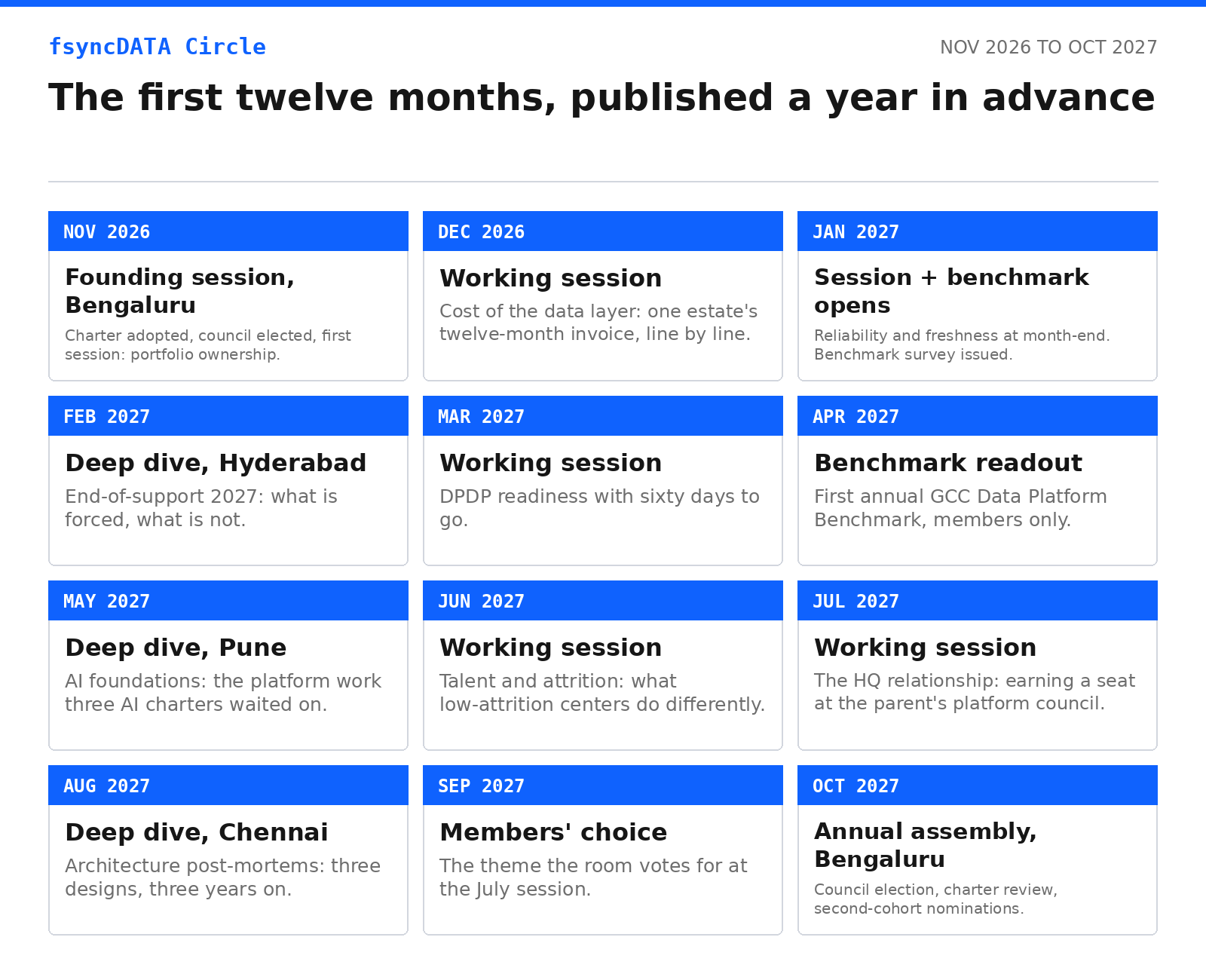
The Circle calendar for the first twelve months is published in advance so that members can hold the dates. Working sessions are monthly and online; deep dives rotate between Bengaluru, Hyderabad, Pune and Chennai with online access for everyone; the benchmark opens in January and is read out in April; the annual assembly closes the year in October.
12
monthly working sessions on the Circle calendar, online
4
deep dives: Hyderabad, Pune, Chennai, Bengaluru
1
benchmark readout, April 2027
30
hours a year, less than one conference trip
01
Why the Circle calendar is published a year ahead
Senior people do not attend what they cannot plan for. A club that announces next month’s session three weeks ahead gets whoever happens to be free; a club that publishes twelve months of dates gets the people it invited. The Circle calendar is set a year ahead for that reason, and the ask on members is proportionate: attend at least six of the twelve working sessions, and the deep dives you choose.
The sequence is not arbitrary. The Circle calendar follows the year of a capability center’s data estate: portfolio ownership first, because it is the decision everything else depends on; cost before the renewal season; reliability at month-end in January; end-of-support before the 2027 wave; DPDP readiness sixty days before its dated obligation; AI foundations after the benchmark has shown the room where it stands; talent in the quarter attrition peaks; the HQ relationship before budget cycles open.
Each entry below names the format, the city where relevant, and the theme from the GCC data platform curriculum it works. Deep dives are half a day in person plus dinner; working sessions are ninety minutes online.
02
November 2026: founding session, Bengaluru
The founding session in Bengaluru is where the Circle becomes real. Founding members present, in person or online, adopt or amend the charter, elect the first members’ council, set the size and pace of the second cohort, approve the benchmark’s questions, and choose which city hosts the annual assembly. Then the first working session runs the same evening.
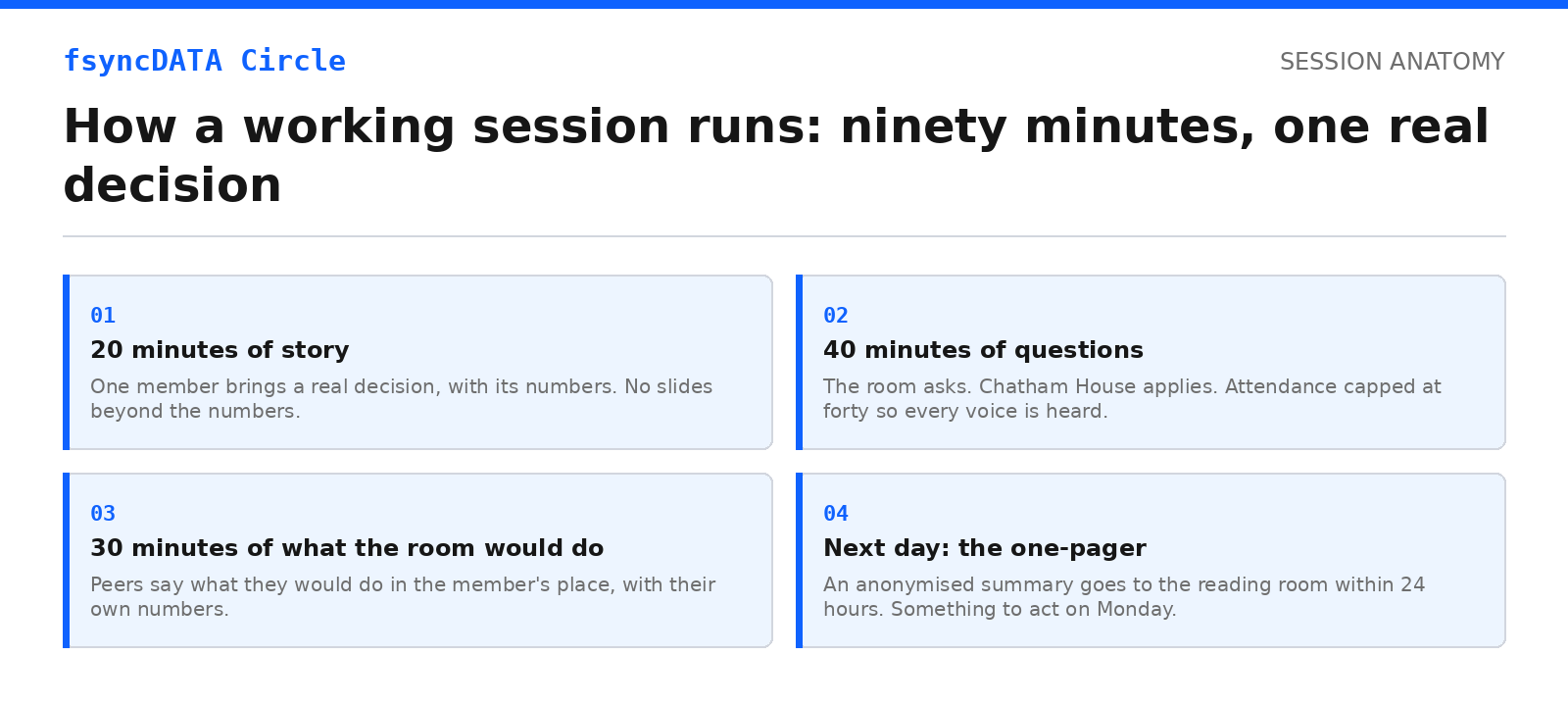
That first session is portfolio ownership, told by a center that won it: what the parent’s platform council needed to see, which artefacts, in what order, and what the site leader traded for the mandate. It sets the tone for the Circle calendar as a whole: a real decision, real numbers, forty minutes of questions from the room, thirty of what the room would do.
Founding invitees who have not yet accepted may attend the November session as guests before deciding. Bengaluru is chosen because roughly 30% of India’s capability centers are there, and because 24 of the sixty founding seats are allocated to the city.
03
December 2026 and January 2027: cost, reliability, benchmark opens
December 2026 is a working session on the cost of the data layer: one estate’s twelve-month invoice, explained line by line by the member who paid it. What changed, what it cost to change, what did not improve. It sits on the Circle calendar in December because cloud commit renewals and annual database subscriptions cluster at the turn of the year.
January 2027 is reliability and freshness: month-end, the honest version. Which estates meet their freshness SLA per region, how they are run, what they pay in on-call load to do it. The benchmark survey is issued to members the same month, so that the freshness and on-call questions are answered while the session is fresh.
What a deep-dive day on the Circle calendar looks like
Deep dives start at two in the afternoon and end with dinner. The first hour is a member war story with its numbers and forty minutes of questions. The second hour is the second war story, on the same theme from a different sector or stage. After a break, the open working session takes one live decision from a member in the room and works it for ninety minutes. The secretariat closes with what goes to the reading room and what does not. Dinner is twelve to twenty seats, no agenda, nothing recorded.
Online attendees join the three sessions on the same link as the monthly working sessions and can ask questions through the secretariat or directly. Recordings of deep-dive sessions are for members only and expire when a member leaves; the dinner is never recorded. Members presenting may refuse recording of their own session.
04
February 2027: deep dive, Hyderabad
February 2027 is the first deep dive, in Hyderabad: end-of-support 2027, what is forced and what is not. Half a day. Two member war stories, one on a major-version wave across an OLTP estate, one on the decision to pay extended support instead. One open working session on the calendar of end-of-support dates itself, across commercial and open-source engines and the cloud DBaaS fleets that auto-enrol end-of-life engines into paid extended support. Dinner after, for those in the room.
Hyderabad holds 16 of the founding seats. Members elsewhere join online for the sessions; the dinner is for the room. Every deep dive on the Circle calendar follows this shape, and every one is followed within 24 hours by anonymised one-pagers in the reading room.
05
March and April 2027: DPDP readiness and the benchmark readout
March 2027 is DPDP readiness with sixty days to go: retention, erasure and breach-telemetry designs compared across members’ estates. India’s Digital Personal Data Protection Act brings dated obligations for India-resident platforms; the Circle calendar places this session so that a member who discovers a gap in March has time to close it. The session is about design, not legal advice, and members take their own counsel.
April 2027 is the benchmark readout: the first annual GCC Data Platform Benchmark, presented to members only, followed by a working session on what surprised the room. Eight measures, reported anonymised and aggregated, with cells of fewer than five responses suppressed. From this point the Circle has something no other room in India has, and the reading room carries it for as long as a member remains. Method and measures are on the GCC data platform benchmark page.
06
May 2027: deep dive, Pune
May 2027 is the second deep dive, in Pune: AI foundations, the platform work three AI charters were waiting on, and how long it actually took. Vector capability, streaming freshness, governance and residency posture, told by the members who built them, with elapsed time and cost left in. It follows the April readout on the Circle calendar deliberately, so that the room’s self-assessed AI-readiness numbers are on the table before the war stories begin.
Pune holds 12 of the founding seats. As with every deep dive, nothing in the room touches models; everything is about what models read from. No AI agent operates on any member’s systems in any Circle format, and no member data enters third-party AI tools.
07
June and July 2027: talent, attrition and the HQ relationship
June 2027 is talent and attrition: what the centers with the lowest senior-engineer attrition do differently. Attrition among senior data engineers and DBAs is structural in Bengaluru, Hyderabad and Pune, and the benchmark’s city-and-sector figures are read out in April so that June’s session works from numbers rather than anecdotes. The Circle calendar places it in the quarter in which attrition most often peaks.
July 2027 is the HQ relationship: earning a seat at the parent’s platform council, told by two who did. Site leaders and CIOs most often ask for this theme first; it is placed in July, after eight months of the room building the evidence a parent will want to see, and before the budget cycles in which that seat is usually won or lost. The July session also votes on the September theme.
08
August 2027: deep dive, Chennai
August 2027 is the third deep dive, in Chennai: architecture post-mortems. Three designs, three years on, and what each would change. Lakehouse, warehouse and streaming choices with their consequences, told by the architects who made them, without the launch-keynote gloss. This is the session on the Circle calendar that data architects and principal database architects most often name as the reason they accepted.
Chennai holds 8 of the founding seats, the smallest of the four cities, and the deep dive is placed there so that the Circle calendar visits every founding city in its first year. Members in the other three cities join online.
09
September and October 2027: members’ choice and the annual assembly
September 2027 is the members’ choice: the theme the room voted for at the July session. The Circle calendar leaves one slot open on purpose. By September the room will know what it needs that the founding curriculum did not anticipate, and the council schedules whatever the vote returns.
October 2027 is the annual assembly, in Bengaluru unless founding members chose otherwise in November. Council election, charter review, nominations for the second cohort, and the year’s best session revisited. The assembly is also where the benchmark’s measures are reviewed for year two, and where founding members exercise their standing seat at the charter review.
| Month | Format | City | Theme |
|---|---|---|---|
| November 2026 | Founding session + working session | Bengaluru (and online) | Charter, council, portfolio ownership |
| December 2026 | Working session | Online | Cost of the data layer |
| January 2027 | Working session + benchmark opens | Online | Reliability and freshness |
| February 2027 | Deep dive | Hyderabad (and online) | End-of-support 2027 |
| March 2027 | Working session | Online | DPDP readiness |
| April 2027 | Benchmark readout | Online | First annual GCC Data Platform Benchmark |
| May 2027 | Deep dive | Pune (and online) | AI foundations |
| June 2027 | Working session | Online | Talent and attrition |
| July 2027 | Working session | Online | The HQ relationship |
| August 2027 | Deep dive | Chennai (and online) | Architecture post-mortems |
| September 2027 | Working session | Online | Members’ choice |
| October 2027 | Annual assembly | Bengaluru (and online) | Council election, charter review, second cohort |
Two further notes on the Circle calendar. Sessions never clash with the last three working days of a month, because heads of data platform and principal architects are running month-end close; and no session is scheduled in the week of Diwali or in the last week of December. Where a public holiday differs between the four cities, the secretariat follows Bengaluru’s.
The secretariat also keeps a short reserve list of member-offered decisions so that if a scheduled presenter withdraws, the session on the Circle calendar still runs on its published date with a real decision at its center. A published date has never been the thing that moves; the presenter is.
10
What runs all year on the Circle calendar
Alongside the monthly dates, the Circle calendar carries five things that run all year. Fortnightly office hours with fsyncDATA and MinervaDB principal engineers, one hour, where members’ technical questions are answered and nothing is scoped, quoted or followed up. Ask-the-network, continuous, with answers routed by the secretariat within 48 hours.
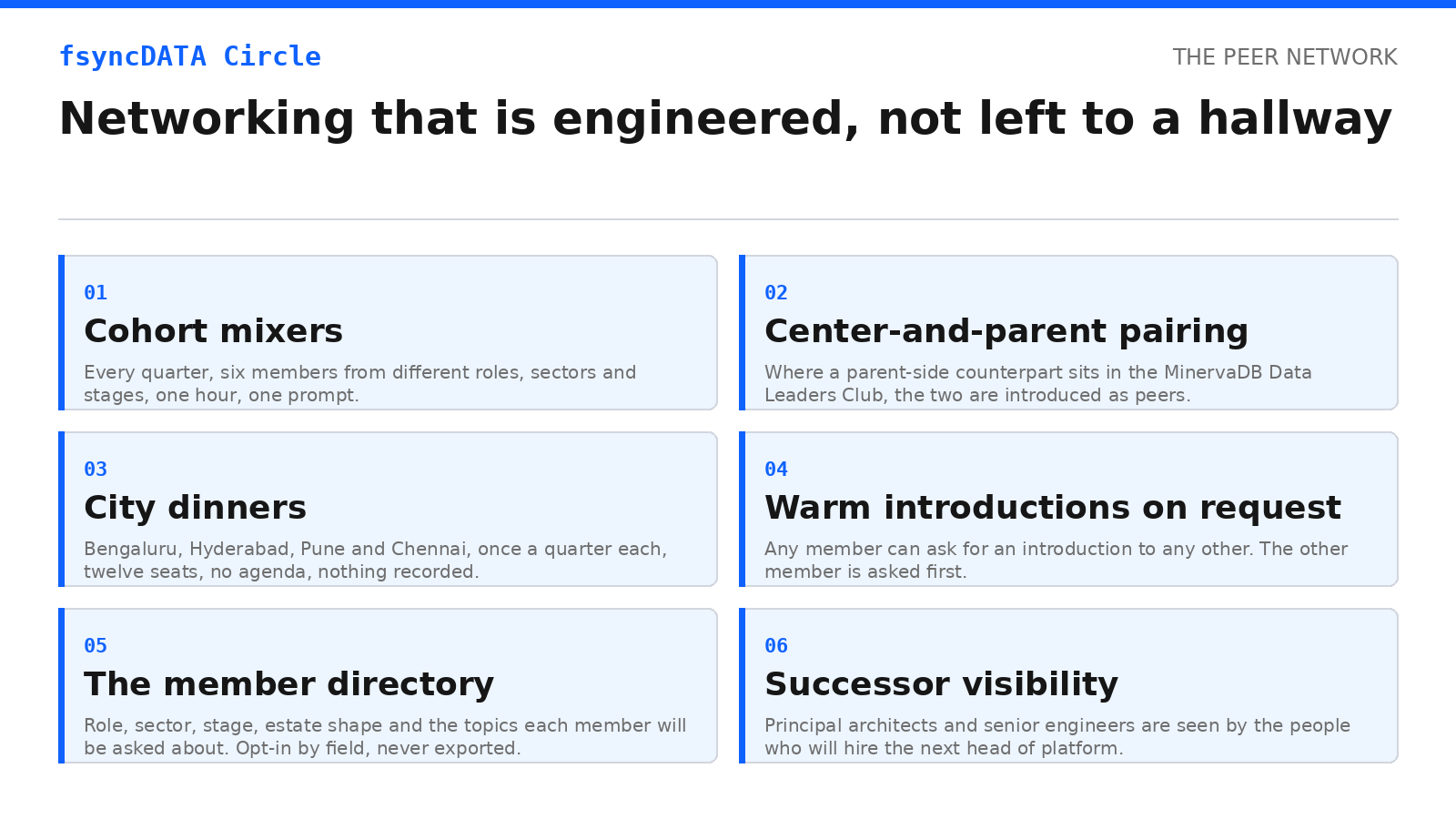
Quarterly cohort mixers: six members from different roles, sectors and stages, seated together for an hour with one prompt, chosen by the secretariat so that each person meets someone they would never otherwise sit with. Quarterly city dinners in Bengaluru, Hyderabad, Pune and Chennai, twelve seats, no agenda, nothing presented, nothing recorded. And the reading room, updated within 24 hours of every session. The networking mechanics are on the GCC peer network page.
- Fortnightly office hours with principal engineers
- Ask-the-network within 48 hours
- Quarterly cohort mixers
- Quarterly city dinners in four cities
- The reading room, updated within 24 hours of every session
Attendance, guests and the Circle calendar
Attendance at working sessions is capped at forty so that every voice is heard; if a session on the Circle calendar oversubscribes, the secretariat offers a second sitting the following week rather than raising the cap. Members may not send substitutes under Rule 3 of the charter. Guests are limited to founding invitees attending the November 2026 session before deciding, and to nominees the council has approved who are attending their first session before their profile call.
Members who miss a session read the anonymised one-pager in the reading room the next day and may watch the recording. The value ledger records attendance; the ask is six of twelve, and members who fall short are asked, kindly, whether the Circle calendar is working for them before anything else is assumed.
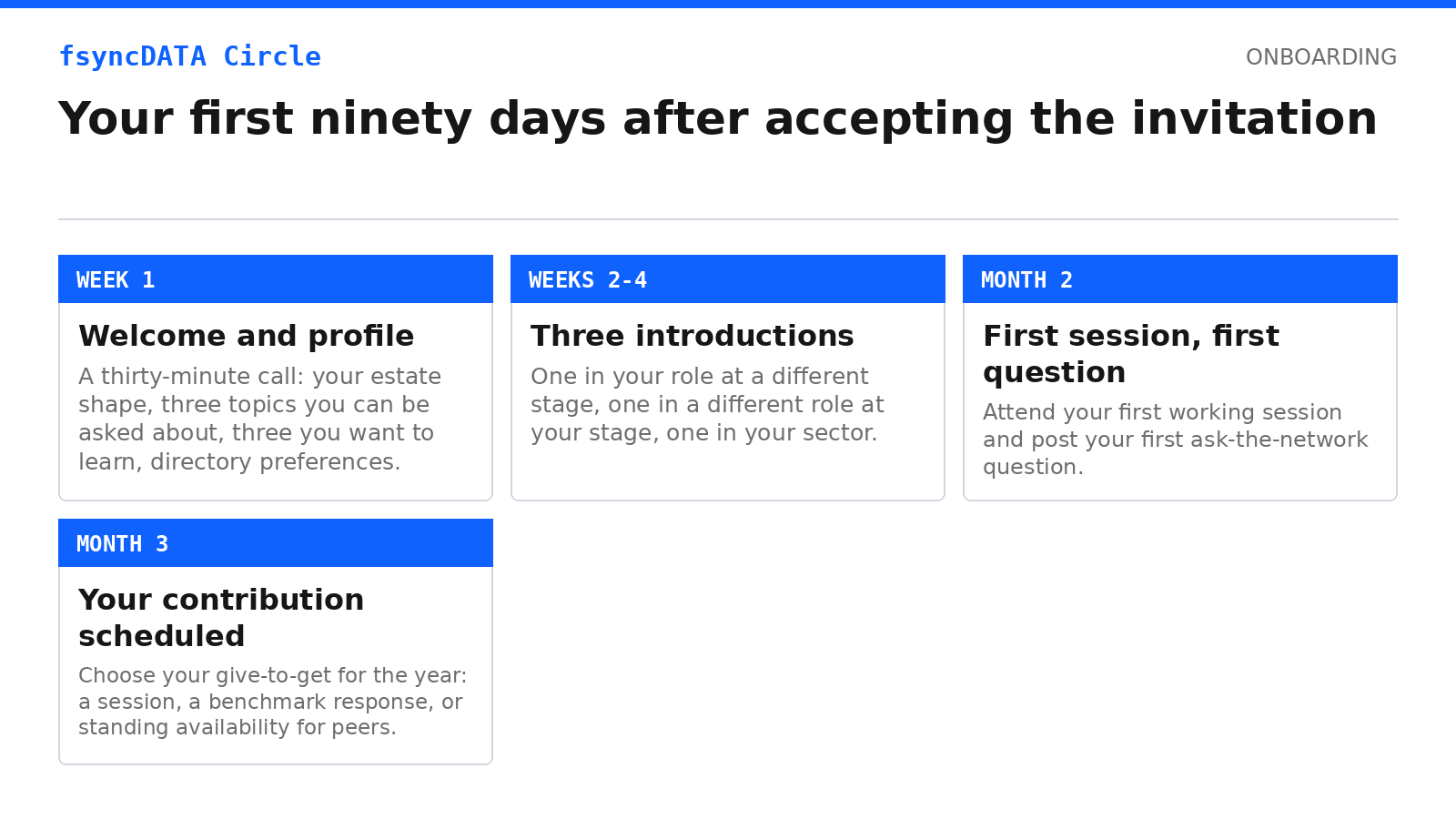
Members who join after the founding cohort receive the same Circle calendar on the day their nomination is approved, with the sessions already held marked as available in the reading room. A member joining in month seven has five sessions to attend and six one-pagers to read; the ask of six of twelve is prorated for the first year.
Every entry on the Circle calendar is confirmed by the secretariat in the member’s calendar invitation, with venue, online link and the presenting member’s theme, forty-five days ahead.
11
Holding the dates: how the Circle calendar works for members
Members receive the Circle calendar as invitations at the profile call in week one, with the online links for every working session and the venues for every deep dive. Deep-dive venues are paid for by fsyncDATA with no hospitality partner named, under Rule 5 of the charter. Sessions are recorded for members only and never published; a member presenting may refuse recording.
Time economics of the Circle calendar: twelve monthly sessions, four deep dives and the office hours you choose to attend add up to roughly thirty hours a year, most of them online and none of them in an expo hall. Less calendar than one conference trip. The ask is six of twelve working sessions, the benchmark once a year, one contribution, one nomination.
Dates on the Circle calendar are set for India Standard Time. Online sessions are scheduled in the early evening IST so that parent-side members of the sister MinervaDB Data Leaders Club in Europe can join where the two councils have agreed a shared session. The Circle calendar is maintained by the secretariat and any change to a published date is announced at least sixty days ahead.
Everything above describes the Circle calendar as proposed to the founding cohort. The council may reorder themes if the year demands it, and founding members choose the city of the annual assembly. Nothing on this site is an offer of services. © 2026 MinervaDB Inc.
WordCamp and industry events in the same cities are not part of the Circle calendar; the Circle does not co-locate with any conference, sponsor any event or share its dates with any organiser. Members who want the market context behind the calendar can find it in the Nasscom–Zinnov India GCC Landscape 2026.