The Circle is governed by an elected members council of five, run day to day by a two-person secretariat bound by the charter, and funded by a convener, fsyncDATA, that has no seat on the council and no veto over it. This page sets out who does what, and what the convener gets, so that anything beyond it is a breach.
5
elected members council seats, no two from one company or role
2
secretariat staff, neither in a sales role
0
convener seats or vetoes
1
annual audit of the benchmark process
01
Who runs the Circle, and who does not
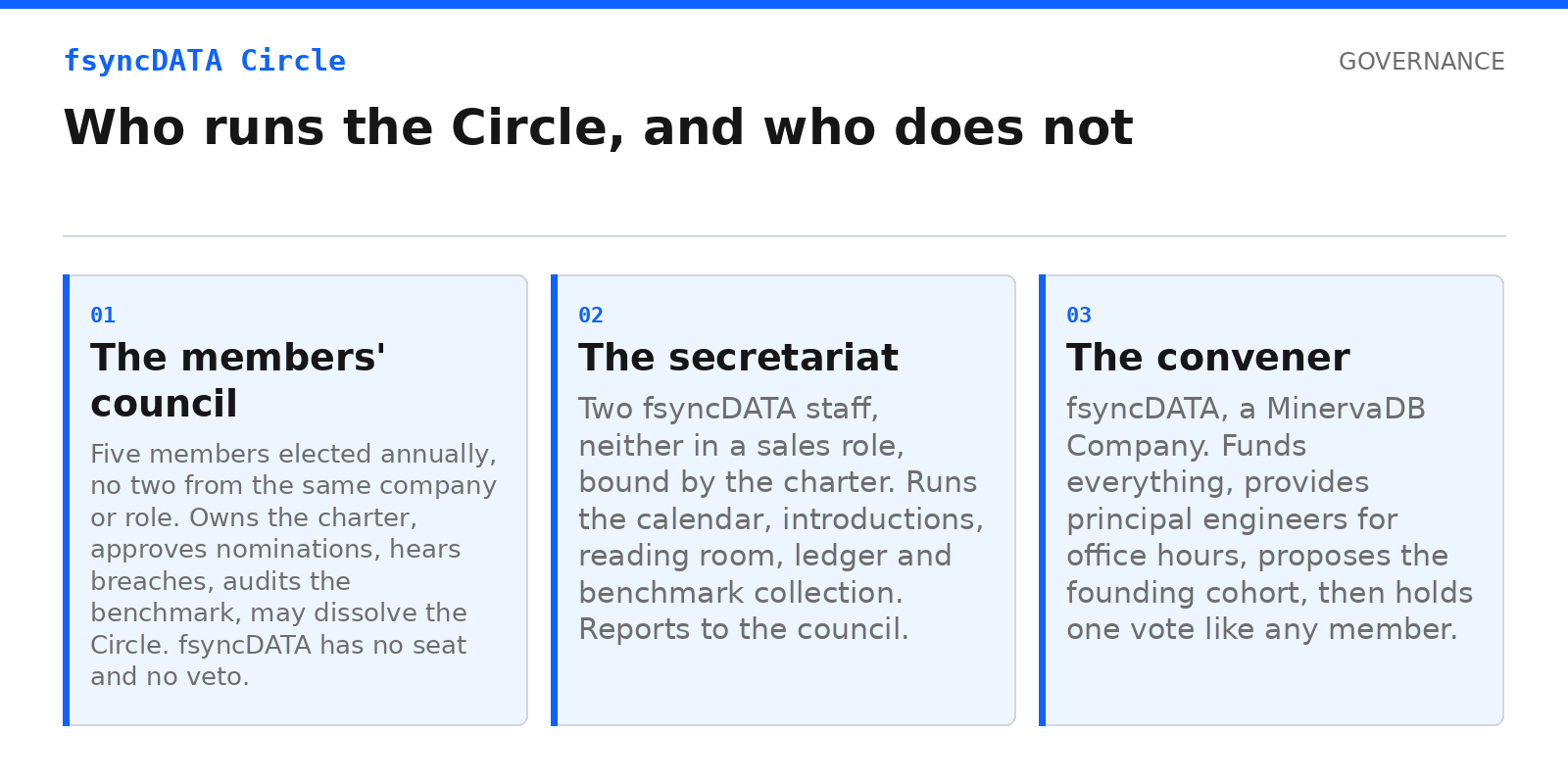
Three bodies, three distinct jobs. The members council owns the charter and everything that flows from it: nominations, breaches, the benchmark audit, cohort size, and the power to dissolve the Circle. The secretariat runs the machinery: the calendar, the introductions, the reading room, the value ledger and the benchmark collection. The convener pays for all of it and receives, in return, the right to listen.
The separation is deliberate and it is the whole design. A club convened by a company will always be asked what stops the company from turning the room into a pipeline. The answer is not a promise; it is a structure in which the company cannot make the decisions that would let it. The members council makes them.
| Body | Who | Owns | Reports to |
|---|---|---|---|
| Members council | Five members, elected annually, no two from the same company or role | Charter, nominations, breaches, benchmark audit, cohort size, dissolution | The membership |
| Secretariat | Two fsyncDATA staff, neither in a sales role, bound by the charter | Calendar, introductions, reading room, value ledger, benchmark collection | The council, on Circle matters |
| Convener | fsyncDATA, a MinervaDB Company | Funding, principal engineers for office hours, proposing the founding cohort | Nobody; holds one vote like any member |
02
The members council: composition, election, powers
Five members, elected annually by the membership, no two from the same company or role. The members council owns the charter, approves nominations, hears breaches, audits the benchmark process, sets cohort size, and may dissolve the Circle. fsyncDATA has no seat and no veto. Council members rotate annually; a member may serve consecutive terms if re-elected, but the council as a whole turns over so that no faction owns it.
The first members council is elected at the founding session in Bengaluru in November 2026 by the founding members present, in person or online. Any founding member may stand. The election is by simple ballot run by the secretariat and witnessed by two members who are not standing. Subsequent elections are held at each annual assembly in October.
Council decisions are by simple majority. The council meets quarterly with the secretariat, and whenever a complaint is raised. It publishes to members a short note after each meeting: decisions taken, nominations approved, and any breach finding, with the breach finding anonymised unless the council decides otherwise. Council members are not paid and receive nothing from fsyncDATA beyond what every member receives.
- Owns the charter and hears proposals to amend it
- Approves every nomination after the founding cohort
- Hears any complaint of breach; its decision is final
- Audits the benchmark process annually
- Sets the size and pace of each cohort
- May commission an independent audit of data controls, at fsyncDATA’s cost
- May find the convener in breach of Rule 1 and publish that finding
- May dissolve the Circle and take its member directory with it
03
The secretariat: two people, bound by the charter
Two fsyncDATA staff, neither in a sales role, contractually bound by the charter. The secretariat runs the calendar, the introductions, the reading room, the ledger and the benchmark collection. It reports to the members council on Circle matters, not to fsyncDATA, and it is the only part of fsyncDATA that ever sees member-level data.
“Contractually bound” means what it says: the secretariat’s employment terms include the charter, and a breach of Rule 1 or Rule 2 by a secretariat member is a breach by the convener, with the consequences the charter sets out. The secretariat cannot be directed by fsyncDATA’s commercial teams on any Circle matter, and the members council may ask the secretariat to confirm, at any meeting, that it has not been.
Every message to the secretariat is answered by a person within two working days. Until the Circle’s own address is live, the secretariat is reached at the address on the request an invitation page.
04
The convener: what fsyncDATA does and does not do
fsyncDATA, a MinervaDB Company, convenes the Circle. It funds everything: the secretariat, the platform, the deep-dive venues, the dinners, the benchmark infrastructure. It provides principal engineers for the fortnightly office hours. It proposes the sixty founding members. Thereafter it holds one nomination vote like any member, receives the same benchmark report as every member, and nothing more.
The convener does not sit on the members council, does not vote on breaches, does not see the directory, the introduction requests, the value ledger or the benchmark raw data, and does not decide who joins after the founding cohort. Its principal engineers answer technical questions at office hours and are forbidden from scoping, quoting or following up. Its commercial teams have no access to anything the Circle produces.
05
How the members council hears a breach
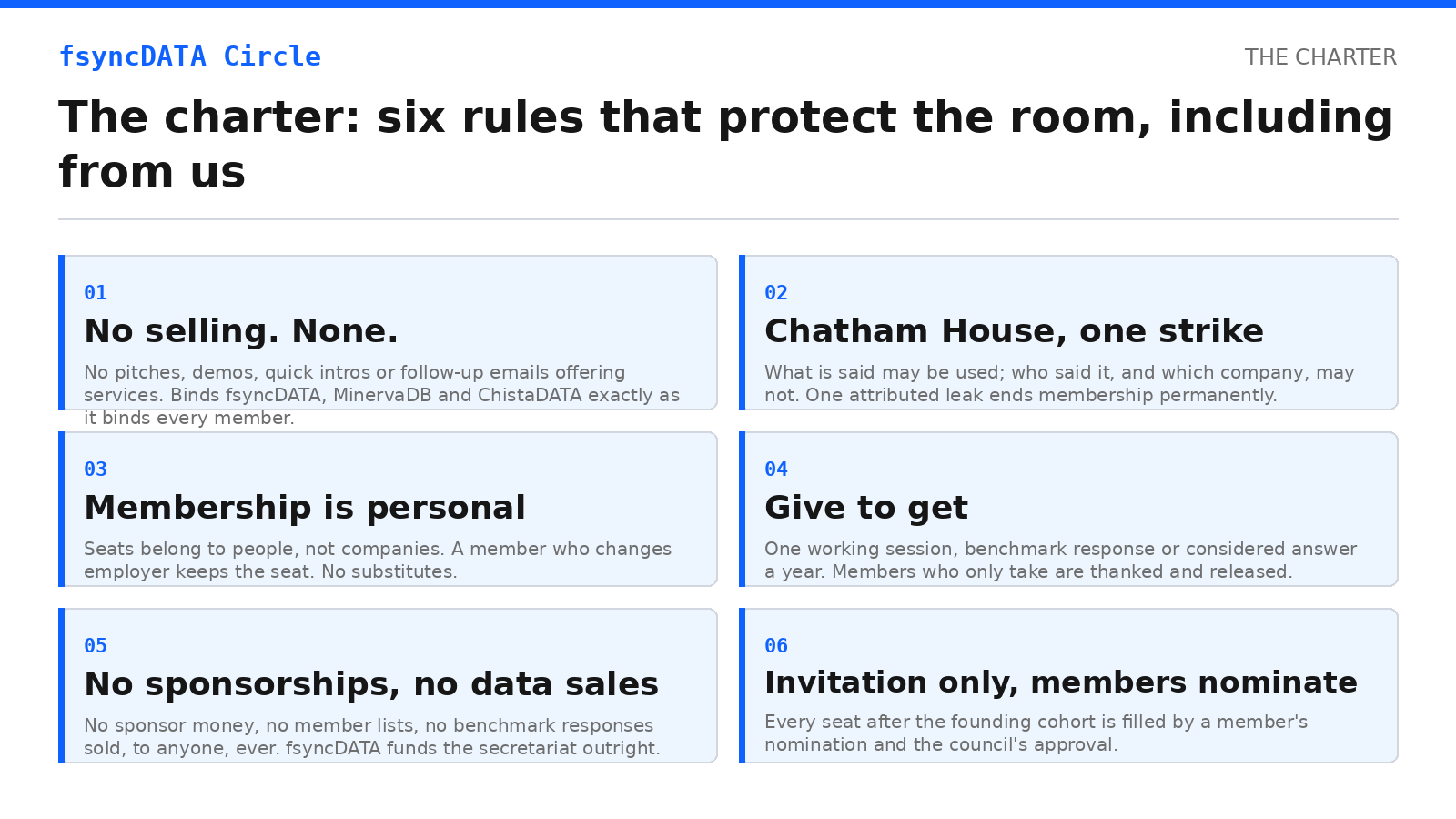
Any member may raise a complaint with the members council, in writing, through the secretariat or directly to any council member. The council hears the member complained of. It may find no breach; a breach of Rule 2 by a member, which ends membership permanently; a breach of Rule 1 by a member, which ends membership; or a breach of Rule 1 by the convener.
On a convener breach, the council publishes the finding to all members. It may also dissolve the Circle. If it dissolves the Circle, the member directory goes with the council, not with fsyncDATA, so that the members can reconvene elsewhere with the relationships intact. There is no appeal from a council decision, and no warning stage for Rule 2.
The test the convener accepts: if any member ever receives a services approach from fsyncDATA, MinervaDB or ChistaDATA that references the Circle, a session, or something learned in one, the member reports it to the members council, the council publishes the breach, and the council may dissolve the Circle. This is in the charter because a rule you cannot lose by is not a rule. The full text is on the Circle charter page.
Standing: who may complain, and about whom
Any member may complain about any member, about the secretariat, or about the convener. Guests attending the founding session may complain about what they experienced there. Nobody outside the Circle has standing, and the members council does not act on anonymous complaints, because Rule 2 is about attribution and a complaint about attribution must itself be attributed. The complainant’s identity is known to the council and to the member complained of, and to nobody else.
The council aims to hear a complaint within thirty days and to decide within sixty. Where a complaint concerns the convener, the secretariat recuses itself from the process and the council appoints one of its own members to run it.
06
Data and confidentiality
Member data is held on India-resident infrastructure, used only to run the Circle, never exported, never sold, never shared with fsyncDATA’s or MinervaDB’s commercial teams. Session recordings and the reading room are members-only and expire when a member leaves. The members council may commission an independent audit of these controls at any time, at fsyncDATA’s cost.
Benchmark responses are collected by the secretariat, aggregated and anonymised before anyone, including fsyncDATA, sees results, with a minimum of five responses per cell, and raw responses deleted after aggregation. The directory is opt-in by field. Introduction requests are retained only as a count. The value ledger is visible to its owner and, in aggregate, to the council.
These commitments sit above the site’s privacy policy, which covers only this website. The Circle’s own data handling is a charter matter, enforceable by the members council, and any change to it requires a charter amendment at an annual assembly. The website’s privacy policy is separate and shorter.
The secretariat publishes, once a year, a one-page statement of what data the Circle holds, where, and who has accessed it, to members only. The members council signs it off. It is the closest thing the Circle has to an annual report.
07
Relationship to the MinervaDB Data Leaders Club
The Data Leaders Club is the global, online-first club for enterprise data leaders convened by MinervaDB. The fsyncDATA Circle is its India GCC sister: the same charter, the same no-pitch rule, a room scoped to capability centers. Members of either may be introduced to members of the other, with consent, and the two councils meet once a year.
The two clubs share no directory and no data. Each secretariat carries introduction requests to the other and steps back. The annual meeting of the two councils is a conversation about the charter and the year, not an exchange of member information. For a site leader trying to earn a seat at a parent’s platform council, the pairing mechanism described on the GCC peer network page is the practical result.
08
Why fsyncDATA convenes it, stated honestly
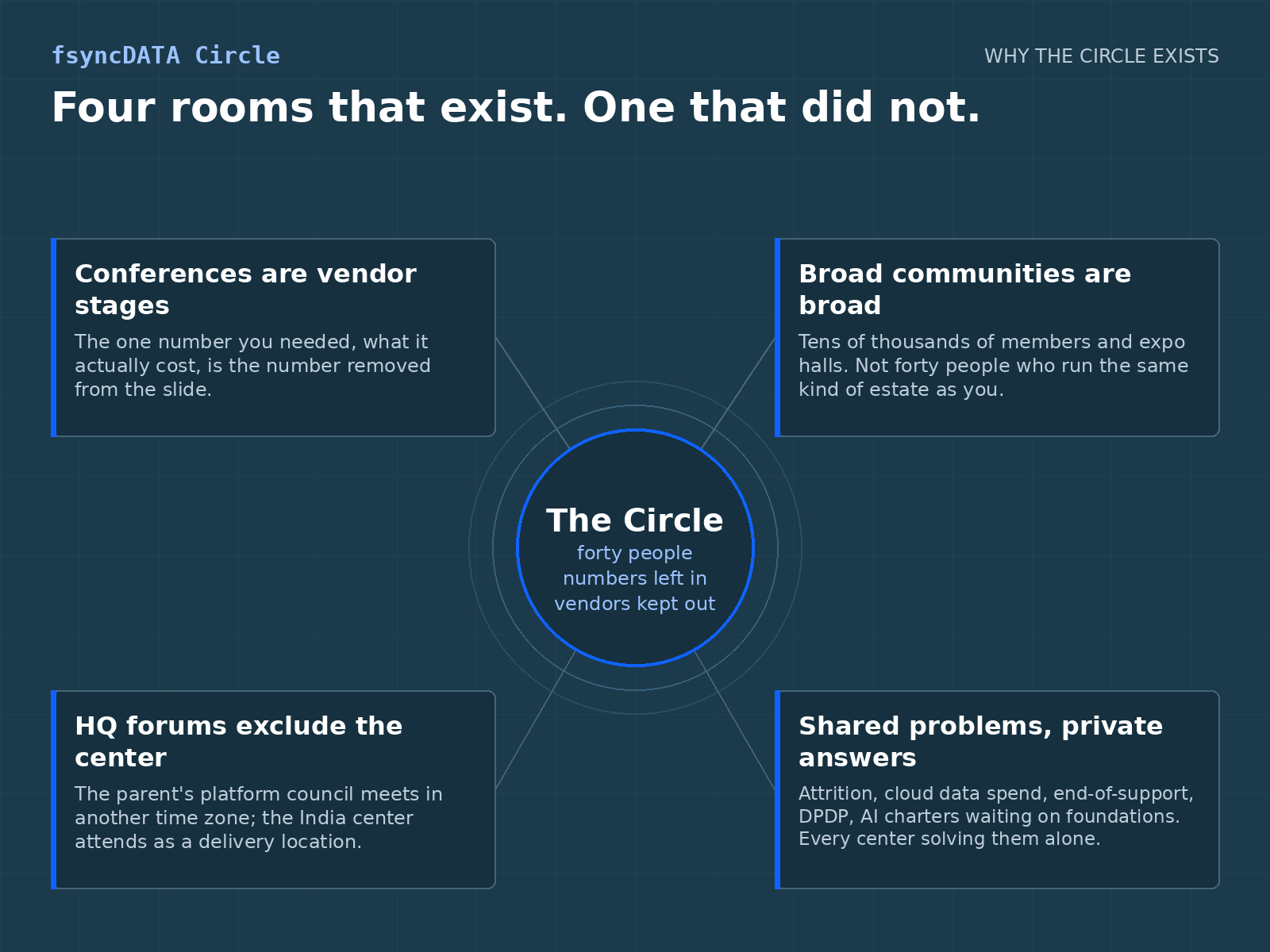
A club convened by a company invites one question first: what is in it for them? The answer should be written down before anyone joins, so that anything beyond it is a breach. Here is ours.
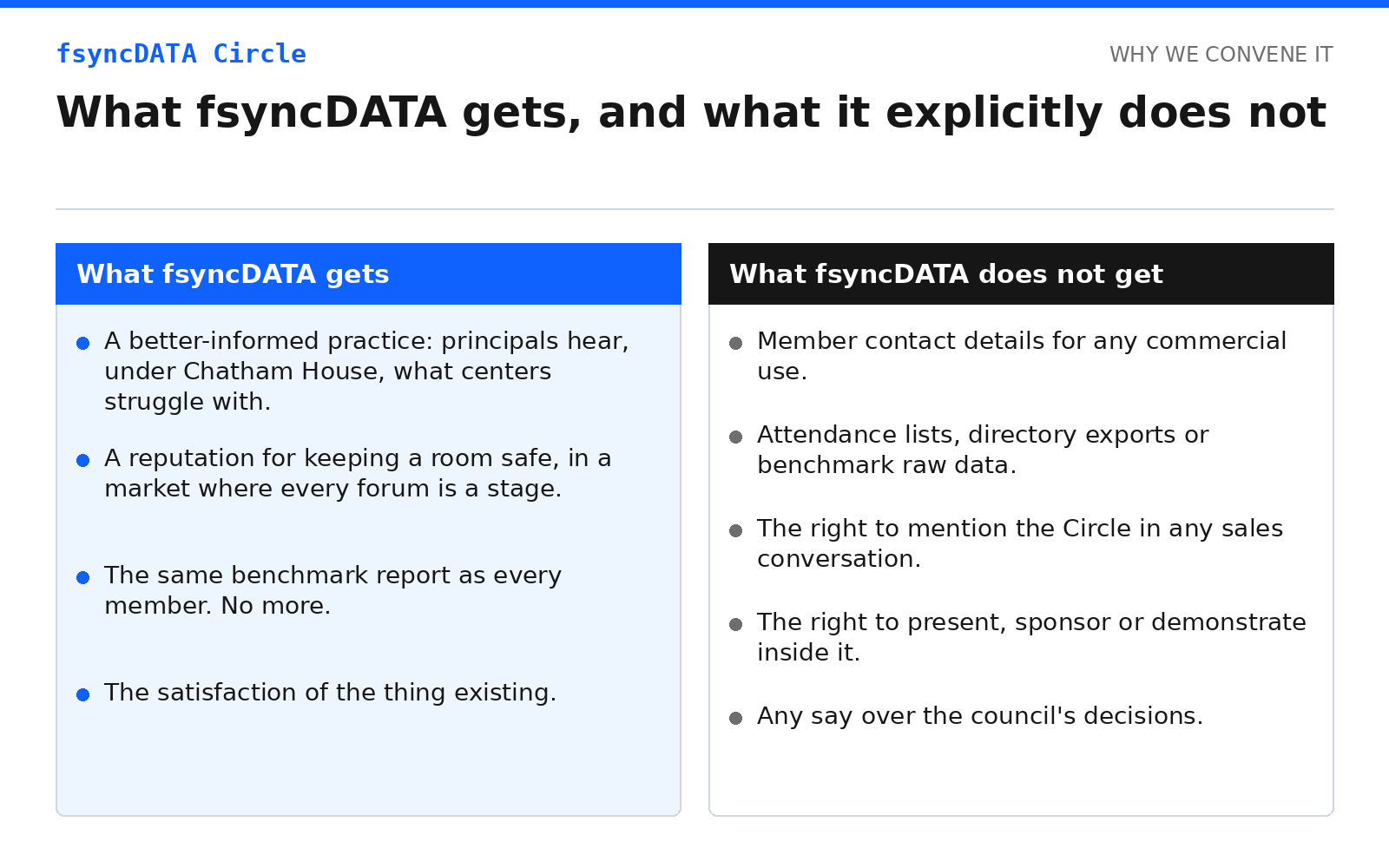
What fsyncDATA gets: a better-informed practice, because our principal engineers hear, under Chatham House, what India’s centers actually struggle with. That makes our work better; it does not make you a prospect. A reputation for keeping a room safe, in a market where every forum is a stage; being the convener that never sold is a reputation worth more than any lead. The same benchmark report as every member, no more. And the satisfaction of the thing existing. The founder of MinervaDB has spent three decades in database systems and has sat in enough vendor-run rooms to want one that isn’t.
What fsyncDATA explicitly does not get: member contact details for any commercial use; attendance lists, directory exports or benchmark raw data; the right to mention the Circle in any sales conversation; the right to present, sponsor or demonstrate inside it; any say over the members council’s decisions.
The rooms I learned most in were the ones where nobody was selling. I want to convene one, and I want the rules to stop me if I forget why.
Shiv Iyer, Founder, MinervaDB
09
What fsyncDATA is, for the record
fsyncDATA is the India-domiciled data-platform operations business of MinervaDB Inc., serving Global Capability Centers. That sentence is the only description of fsyncDATA’s business on this site, and it appears here so that you know who is holding the door. MinervaDB describes itself at minervadb.com; its ClickHouse-specialist sister, ChistaDATA, at chistadata.com. Nothing on this site is an offer of services.
Members who want to talk to fsyncDATA, MinervaDB or ChistaDATA about their estate do so outside the Circle, on their own initiative, and the Circle is never mentioned in that conversation. The members council can find the convener in breach if it is.
How the members council keeps the convener honest in practice
Four routine checks, each quarter. The council asks the secretariat to confirm it has received no direction from fsyncDATA’s commercial teams. It reviews the count of introduction requests and mixers for anything that looks like a pattern of interest in particular members. It confirms that office-hours questions have not been followed up. And it asks members, in the quarterly note, to report any services approach from the convener’s group that mentions the Circle. None of these has to find anything to be worth doing; the point is that the members council looks.
10
The founding cohort and the first members council
The founding cohort is sixty seats, proposed by fsyncDATA across the leadership roles, four cities and six sectors, between October and November 2026. Founding members adopt or amend the charter at the founding session in Bengaluru, elect the first members council, set the size and pace of the second cohort, approve the benchmark’s questions, and choose the city of the annual assembly. Founding status is permanent, is recorded in the directory, and carries priority nomination rights and a standing seat at the annual charter review.
The first council’s term runs from November 2026 to the annual assembly in October 2027. Its first tasks are to confirm the secretariat’s operating note, to approve the benchmark questions for the January 2027 survey, and to set the second cohort’s size. It is the council, not fsyncDATA, that decides whether the Circle grows in year two, and by how much.
Composition target for the founding sixty: no more than twelve seats per role, no more than two members from any one company, no more than a third from any one sector; Bengaluru 24, Hyderabad 16, Pune 12, Chennai 8. Details are on the GCC leadership roles page.
11
Amending the charter and dissolving the Circle
The charter is reviewed at every annual assembly. Amendments pass by a simple majority of members present and take effect at the next session. Two things cannot be amended, because they are the conditions under which fsyncDATA convenes the room: Rule 1, and the members council’s power to find the convener in breach of it. Everything else, including the one-strike sanction, the contribution expectation and the nomination mechanics, is the membership’s to shape.
Dissolution is the council’s power alone. It may dissolve the Circle on a convener breach, or if the membership votes to dissolve at an annual assembly. On dissolution, the directory goes with the council, the reading room is deleted, and fsyncDATA’s funding obligations end. The members may reconvene under any name, with any convener, and the charter travels with them if they want it.
Members may leave at any time with no explanation. The Circle is designed to stay small enough that every member can know every other member; if that means it stops growing, it stops growing, and that too is the members council’s call. The Chatham House Rule that underpins Rule 2 outlives membership: what a member heard while in the room stays unattributed after they leave.
This page describes governance as proposed to the founding cohort, who may amend the charter at the founding session. Nothing on this site is an offer of services. © 2026 MinervaDB Inc.