
The only members’ club built for GCC data leaders
Where India’s GCC data leaders network, learn and train
Founding session November 2026 | Bengaluru · Hyderabad · Pune · Chennai · Online
fsyncDATA is the only members’ club built exclusively for the data leaders of India’s Global Capability Centers: chief data officers, chief data architects, principal database architects, data architects, DBAs and database engineers. Admitted on evidence, they compare what production really does, engine by engine, with the numbers left in.
Ten engine guilds for practitioners, an invitation-only Circle for leaders, and one charter for both: no fee, no sponsors and no selling, including by the people who convene it.
0
sales conversations permitted anywhere in the club, including by its convener
10
engine guilds, from relational and distributed SQL to vector and lakehouse
28
engines and cloud database services with a guild that runs them in production
₹0
membership fee. The price of membership is one contribution a year
Why fsyncDATA is the club to join
fsyncDATA is the only members’ club built exclusively for the data leaders of India’s Global Capability Centers. Not a summit you attend once a year, not a vendor user group, not a social feed: a standing, vetted community of chief data officers, chief data architects, principal database architects, data architects, DBAs and database engineers who network, learn and train with each other all year.
Peers who pick up the phone
A bench of people who run your engine at your scale, organised so the right person answers.
- The peer bench: three members on your engine answer within 48 hours
- City chapters in Bengaluru, Hyderabad, Pune and Chennai
- Three warm introductions in your first month, each with a reason
- Center-and-parent pairing, and cross-tier tables with the Circle
Decisions with the numbers left in
Real incidents, migrations and designs, presented by the members who ran them.
- Monthly guild sessions on ten engine families
- Circle working sessions on one leadership decision each month
- Quarterly deep dives in four cities
- The members-only GCC Data Platform Benchmark and the reading room
Hands on, not slides
Practice on the systems you run, with the engineers who have broken and fixed them.
- Live break-fix sessions: a broken cluster diagnosed on stage
- Hands-on labs: upgrades, failover drills, query plans, cost tuning
- Fortnightly office hours with principal engineers
- fsyncDATA Learning tracks for the engineers you are developing
Not another event. A club.
| fsyncDATA | GCC summits and conclaves | Vendor user groups | Online communities | |
|---|---|---|---|---|
| Who is in the room | Data leaders and database practitioners from India’s GCCs only | Broad GCC leadership across functions | Customers of one product | Anyone |
| How you get in | Admitted on evidence or nominated; Circle by council approval | Registration or invitation by organiser | Product licence | Sign-up |
| Selling | Forbidden by charter, including by the convener | Sponsor stages and booths | The point of it | Unmoderated |
| What is shared | Real numbers under Chatham House, one strike | Keynotes and panels | Roadmaps | Opinions |
| Continuity | Monthly sessions, a 48-hour bench, all year | One or two days a year | Product release cycle | Feed-driven |
| What you leave with | A peer to call, a benchmark, a fix to run on Monday | Contacts and impressions | Product knowledge | Links |
Membership is free and personal, and it is earned. Guild members are admitted for what they run; Circle seats are limited to sixty founding leaders. That is what keeps the room worth being in.
Two ways in, depending on what you own
fsyncDATA is a members’ club for the GCC data estate, built in two tiers that share one charter, one reading room and one benchmark. They meet on purpose: every quarter, a Circle deep dive seats the guild members who have run the system under discussion, so that a decision is heard by the people who will operate it.
For the people who run production
Principal and staff database architects, data architects, DBAs, database engineers, DBREs and data platform engineers join one or more engine guilds. Monthly guild sessions, city chapters, a peer bench that answers within 48 hours, and a reading room of post-mortems and reference designs. Free, uncapped, and admitted for what you run, not where you work.
For the leaders who own the estate
Chief data officers, chief data and analytics officers, chief data architects, CIOs, CTOs, GCC site leaders and heads of data platform. Sixty founding seats, filled October to November 2026, then nomination only. Monthly working sessions on one real decision, quarterly deep dives, and the members-only GCC Data Platform Benchmark.
India’s capability centers now own the databases, not the tickets
Platform reliability, database engineering, cloud data architecture and AI data pipelines for some of the world’s largest enterprises are decided in Bengaluru, Hyderabad, Pune and Chennai. The people making those decisions are spread across a dozen engines, several cloud consoles and eighteen industries, and most of them solve the same problems alone.
What members get that a conference cannot give them:
- A room of people who run the same engine at the same scale, not a stage set by a vendor
- The number every talk removes from the slide: what it actually cost, and what broke
- A bench to call when the replica falls behind at 3 a.m., or the renewal quote arrives
- Plain answers on the problems every center faces: end-of-support dates, cloud database spend, DPDP, attrition, AI data foundations
- A seat as the owner of a platform, not as a delivery location
Each benefit is set out, role by role, on why members join.
Ten guilds. Every engine a GCC runs.
A guild is the members who run one family of engines, whatever cloud or console it sits behind. Managed services belong to the guild of the engine underneath them, because a replica lagging on Aurora and one lagging on a self-managed cluster share a root cause more often than they share a dashboard.
PostgreSQL Guild
PostgreSQL and Google AlloyDB, plus deployments on Amazon RDS, Aurora, Cloud SQL and Azure. Autovacuum, wraparound, logical replication, Patroni, upgrades.
MySQL and MariaDB Guild
MySQL, MariaDB, Amazon RDS, Amazon Aurora and Google Cloud SQL. InnoDB, Group Replication, Galera, ProxySQL, online schema change.
SQL Server Guild
Microsoft SQL Server and Azure SQL. Always On availability groups, Query Store, plan regressions, licensing-aware sizing.
Oracle, Db2 and SAP HANA Guild
Oracle, IBM Db2 (LUW and z/OS) and SAP HANA. Patching cadence, Data Guard, HADR, HANA system replication, modernisation.
Distributed SQL Guild
YugabyteDB, CockroachDB and Citus. Data placement, multi-region latency, rebalancing, and when distributed SQL is the wrong answer.
NoSQL Guild
MongoDB, Apache Cassandra and Amazon DynamoDB. Shard and partition keys, compaction, hot partitions, consistency trade-offs.
Redis and Valkey Guild
Redis and Valkey. Memory and eviction, persistence, cluster topology, and the Redis-or-Valkey decision.
Real-time Analytics Guild
ClickHouse, Vertica and Trino. MergeTree design, ingestion at scale, materialised views, federated queries, DR.
Cloud Warehouse and Lakehouse Guild
Amazon Redshift, Google BigQuery, Snowflake and Databricks. Spend against data growth, workload isolation, commit renewals.
Vector Guild
Milvus, pgvector and vector features in the engines above. Index choice, recall, memory sizing, AI data foundations.
Five practice groups cut across every guild: Reliability, Performance, Cost, Security and compliance, and Migration. Missing an engine? A new guild opens when twenty members ask for it and two agree to steward it.
Special Interest Groups
One room per platform, inside the guilds
Ten Special Interest Groups bring together the members who run one platform in production. They meet monthly to produce working material: failover drills, upgrade decision records, runbooks and reference designs, reviewed by peers and kept in the reading room.
PostgreSQL SIG
Vacuum and wraparound, Patroni HA, logical replication, major-version upgrades.
MySQL SIG
InnoDB internals, Group Replication, online schema change, life after 8.0.
ClickHouse SIG
MergeTree design, ingestion at scale, Keeper, object-storage tiering.
Redis SIG
Memory and eviction, persistence, Cluster and Sentinel, Redis or Valkey.
Cloud DBaaS SIG
Managed or self-managed, shared responsibility, FinOps, cross-cloud DR.
Every industry India’s GCCs serve
The mix is deliberate. A BFSI DBA learns from a gaming studio’s Redis tier at peak; a SaaS architect learns from a pharma center’s validated change control. The same engine behaves differently under different regulation and different load, and the room hears both.
| Sector group | Industries | What their estates teach the room |
|---|---|---|
| Technology | Software, SaaS, technology products | Cloud-native estates, multi-tenant design, DBRE culture, fast upgrade cadence |
| Financial services | Banking, BFSI, insurance, fintech | Regulated change, audit trails, zero-data-loss DR, ledger-grade consistency |
| Commerce | Retail, online commerce, CPG, FMCG | Peak-season load, real-time inventory and pricing, demand analytics |
| Telecom | Operators and network platforms | Very high ingest, CDR and network telemetry analytics, long retention |
| Media and gaming | Media, entertainment, gaming | Spiky concurrency, session stores and leaderboards, event analytics |
| Health | Healthcare, life sciences | Validated environments, patient-data governance, research data platforms |
| Mobility and logistics | Aviation, airline operations, logistics | Systems that cannot stop, schedule and crew data, tracking telemetry |
| Analytics centers | Big data and analytics GCCs | Warehouse and lakehouse scale, cost per query, data products for the parent |
What membership returns in the first ninety days
Most invitations describe a club. This one describes what happens after you say yes. Every step below is a commitment of the secretariat, not an aspiration.
A thirty-minute profile call
What you run, which engines and versions, and what you are deciding this year. Nothing that identifies you or your company leaves the club.
Three warm introductions, each with a reason
A peer on the same engine at your scale, one a stage ahead, and one at a center already living the problem you are about to have.
The founding session, Bengaluru
The charter is adopted by the people it protects, the first council is elected, and every guild holds its first session.
A bench you can call
Three guild sessions behind you, the first benchmark survey open, a reading room of real post-mortems, and a directory of people who have agreed to answer the phone.
If, after the founding session, the club is not what this page describes, leave. No explanation is required and none will be asked for.
Six rules that bind members and convener alike
A club is only as useful as what its members are willing to say in it. The charter exists so that a DBA can say what a failover really took, and a CDO can say what HQ really thinks, without either sentence being used against them.
- No selling. None. Not by members, not by fsyncDATA, not by MinervaDB or ChistaDATA.
- Chatham House, one strike. What is said may be used; who said it, and which company, may not.
- Membership is personal. It belongs to you, not your employer, and moves with you.
- Give to get. One session, post-mortem, benchmark response or considered answer a year.
- No sponsors, no data sales. Ever.
- Members admit members. Guild members are vouched for; Circle seats are nominated.
Enforcement belongs to an elected members’ council that fsyncDATA does not sit on. Full text on the charter page.
What a guild session leaves behind
Every session ends in a one-page summary, anonymised, in the reading room the next day. This is the shape of one. It is illustrative: the guilds have not yet met, and the first real summaries will be written after the November founding session.
A high-churn ledger table, autovacuum, and a wraparound warning
Guild sessions run sixty minutes: twenty of story, thirty of questions, ten of what the guild would do. Circle sessions run ninety on one leadership decision. Both are described on the curriculum page.
The numbers nobody else publishes
Every GCC data leader is eventually asked “is that normal?” by a board or a parent, and every DBA is asked “why does this cost so much?” by finance. The GCC Data Platform Benchmark answers both, for India’s centers specifically.
- Database and warehouse spend against data growth
- Cost per terabyte stored and processed, per platform
- Engine mix, managed vs self-managed, and end-of-support exposure
- RPO and RTO targets against the last tested result
- On-call pages and severity-1 incidents per engine
- DBA and database engineer attrition by city and sector
- DPDP and AI data foundation readiness
Aggregated and anonymised before anyone, fsyncDATA included, sees results. Minimum five responses per cell. Held in India, shared only with members. Method on the benchmark page.
Thank you to our sponsors: there are none, and there never will be
Rule 5 of the charter: the club takes no sponsorship money and sells no member data, lists or benchmark responses, to anyone, ever. fsyncDATA funds the secretariat, the platform, the venues and the hospitality outright.
Beside the club: conferences and Learning
The club is vetted by design. Beside it, fsyncDATA runs two programmes open to everyone who runs, builds or wants to run India’s capability center data platforms. Nothing said inside the club is ever presented at either, and no sponsor gains anything inside the club.
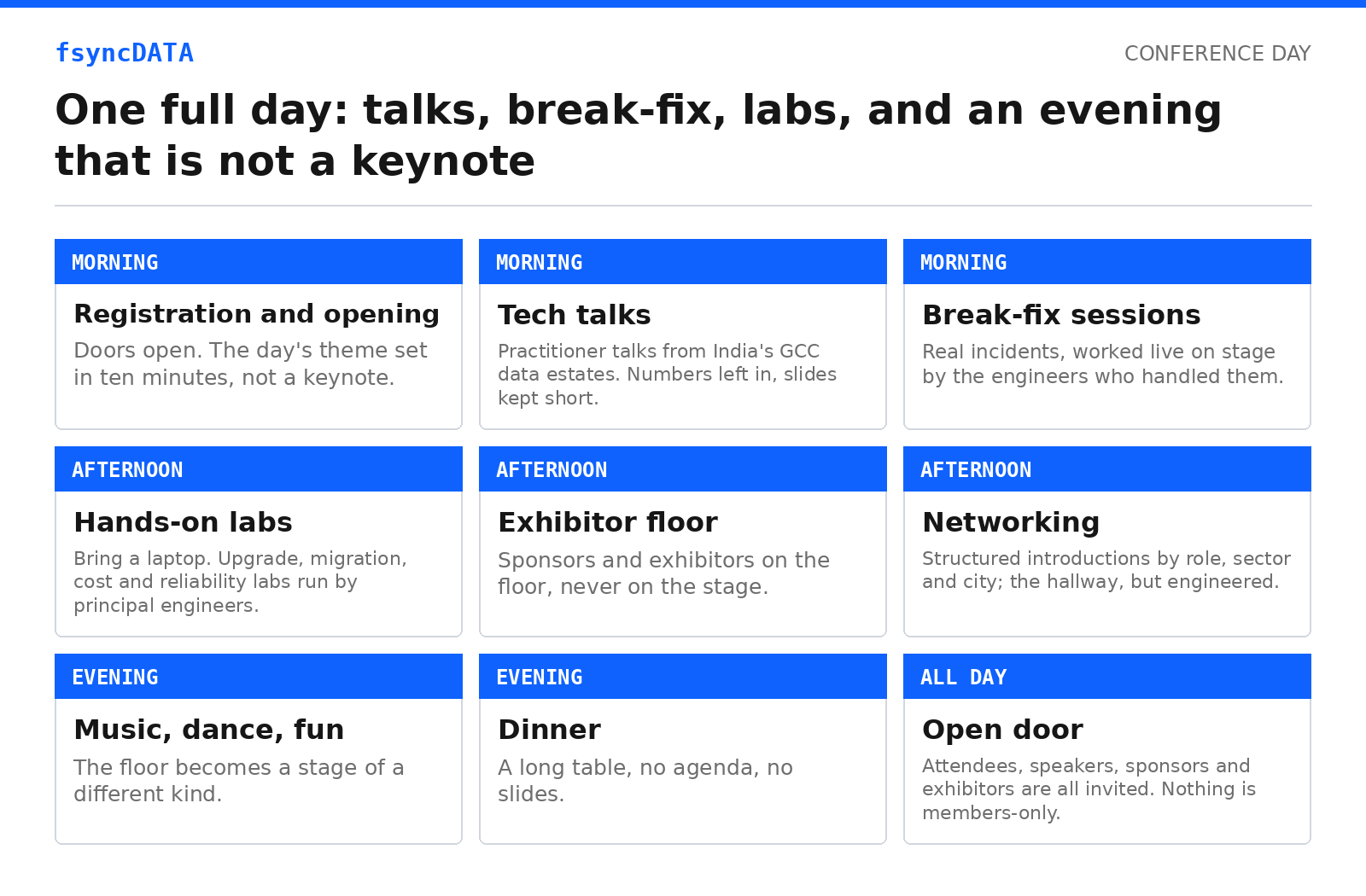
GCC Leadership Conferences
Four a year, alternating between Bengaluru and Hyderabad. Engine tracks, live break-fix, hands-on labs, networking, then music and dinner.
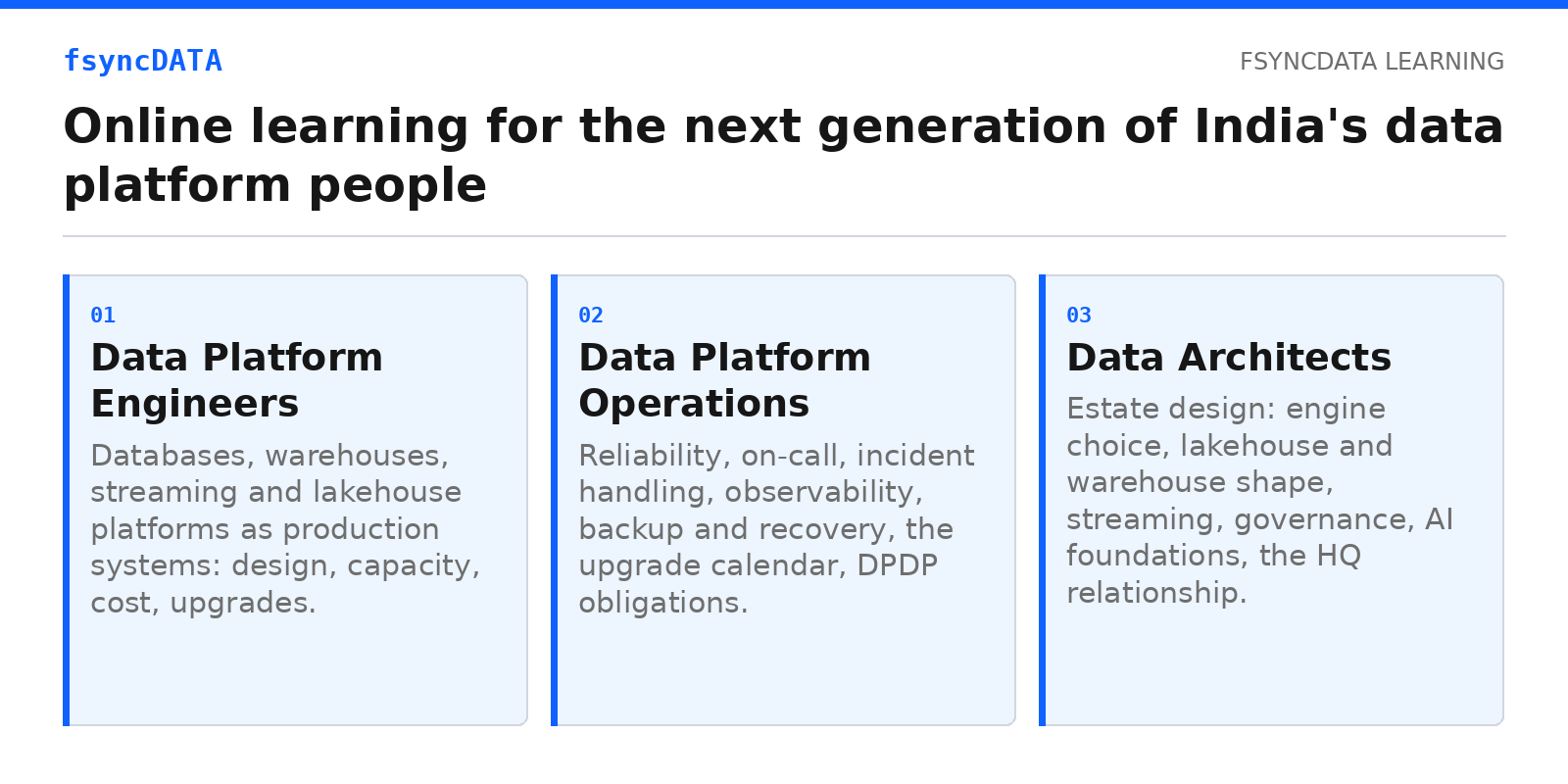
fsyncDATA Learning
Data Platform Engineer, Data Platform Operations, Data Architect. Online, for professionals and colleges.
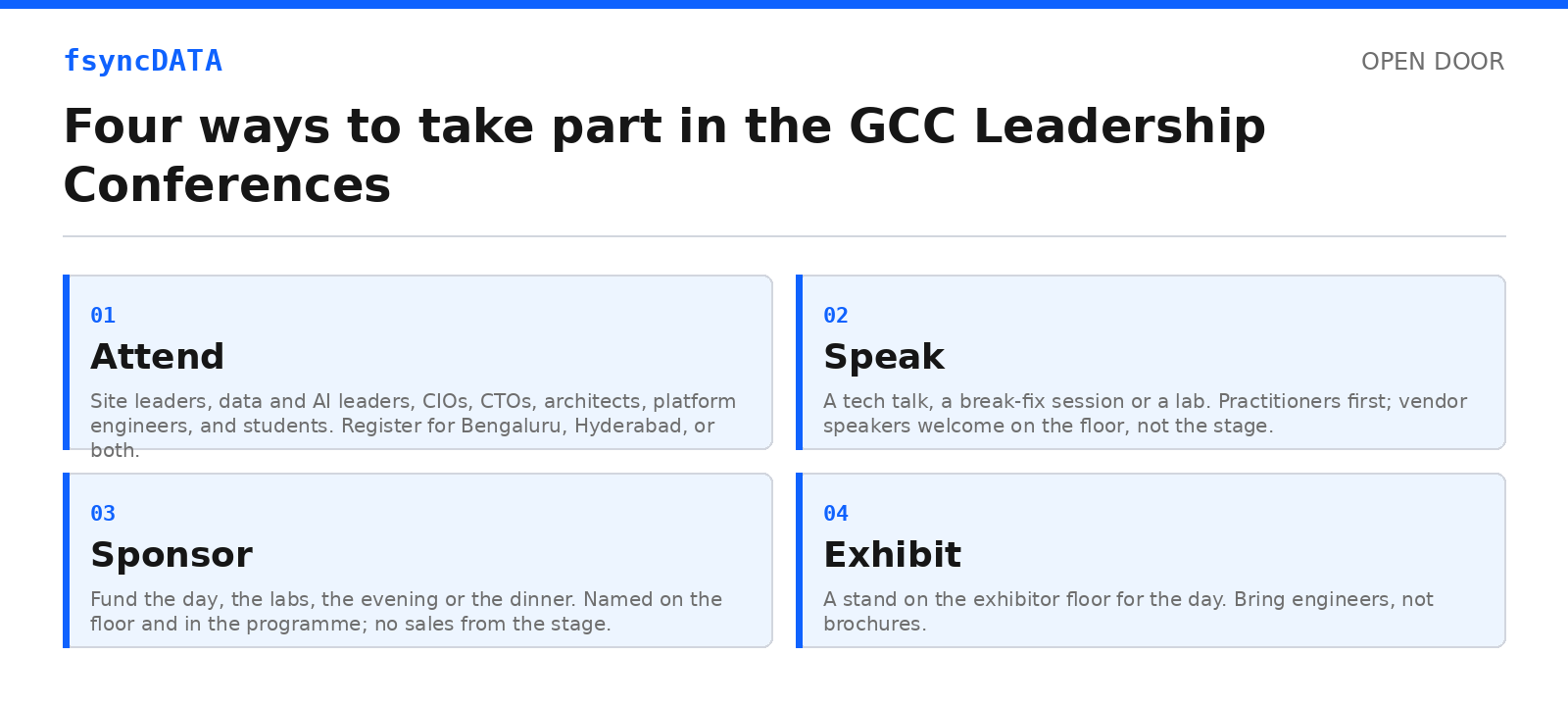
Take part
Attend, speak, sponsor or exhibit. Colleges enrol cohorts. Dates published when confirmed, not before.
Who holds the door
fsyncDATA is the GCC club of MinervaDB Inc. MinervaDB convenes it, funds the secretariat, platform and venues, and takes nothing back. Members run it through an elected council on which neither fsyncDATA nor MinervaDB has a seat or a veto.
For the record: MinervaDB Inc. and its sister company ChistaDATA provide database services. The charter binds both exactly as it binds every member. If any member receives a services approach from any of the three that references the club, a session or anything learned in one, the council publishes the breach to every member and may dissolve the club. A rule you cannot lose by is not a rule.
The rooms I learned most in were the ones where nobody was selling. I want to convene one, and I want the rules to stop me if I forget why.
Shiv Iyer, Founder and CEO, MinervaDB Inc.
Governance and data handling are described on the members’ council page.
Before you reply: the questions people ask first
Is this a sales funnel with better manners?
No, and the charter is written so that you can prove it. Rule 1 forbids any approach that references the club, by fsyncDATA, MinervaDB or ChistaDATA. A breach is published to every member by a council we do not sit on.
I am a DBA, not a CDO. Is this for me?
Yes. The Guilds exist for the people who run production. You are admitted for what you run, not for your title.
We run everything on RDS, Azure SQL or BigQuery.
Then you belong in the guild of the engine underneath, or in the Cloud Warehouse and Lakehouse Guild. Managed services are where most GCC estates live.
I cannot share our numbers.
Then bring the problem without them and listen. Under Chatham House, what is said may be used and who said it may not; the one-strike rule protects the people who do share.
How much time does it take?
About fifteen hours a year for a guild member and thirty for a Circle member. The contribution rule asks for one session, post-mortem, benchmark response or considered answer a year.
What does it cost, now and later?
Nothing, and there is no premium tier coming. fsyncDATA funds the secretariat, venues and hospitality outright, and the charter forbids sponsors.
More on the why members join page. Every message to the secretariat is answered by a person within two working days.
Apply, ask, or nominate someone better
Practitioners apply to a Guild. Leaders request a Circle invitation, and founding invitees may attend the November session as guests before they decide. Anyone may nominate a peer; the council treats a nomination from someone who could have taken the seat as the strongest recommendation there is.
In one paragraph. fsyncDATA, the GCC club of MinervaDB Inc., is a no-fee, no-sales members’ club for the people who run India’s Global Capability Center data estates. The Guilds bring together database architects, DBAs and database engineers across ten engine guilds; the Circle seats the CDOs, chief data architects and technology leaders who own those estates, in sixty founding seats. Monthly sessions with the numbers left in, quarterly deep dives, a 48-hour peer bench, a members-only benchmark, and an elected council that neither fsyncDATA nor MinervaDB sits on.
Market context: India hosts about 2,117 Global Capability Centers across 3,728 units, employing roughly 2.36 million people and generating US$98.4 billion in FY26, according to the Nasscom–Zinnov India GCC Landscape 2026. Every one of them runs on databases. This club exists for the people who run them.