A Circle seat at fsyncDATA is held by a person, filled by nomination and confirmed by the members’ council. There are sixty Circle seats, no fee, no sponsors and no selling, and every Circle seat comes with the same obligation: one real contribution a year. This note explains how a Circle seat is filled, who it is for, what members decide, and what the first ninety days in the Circle look like.
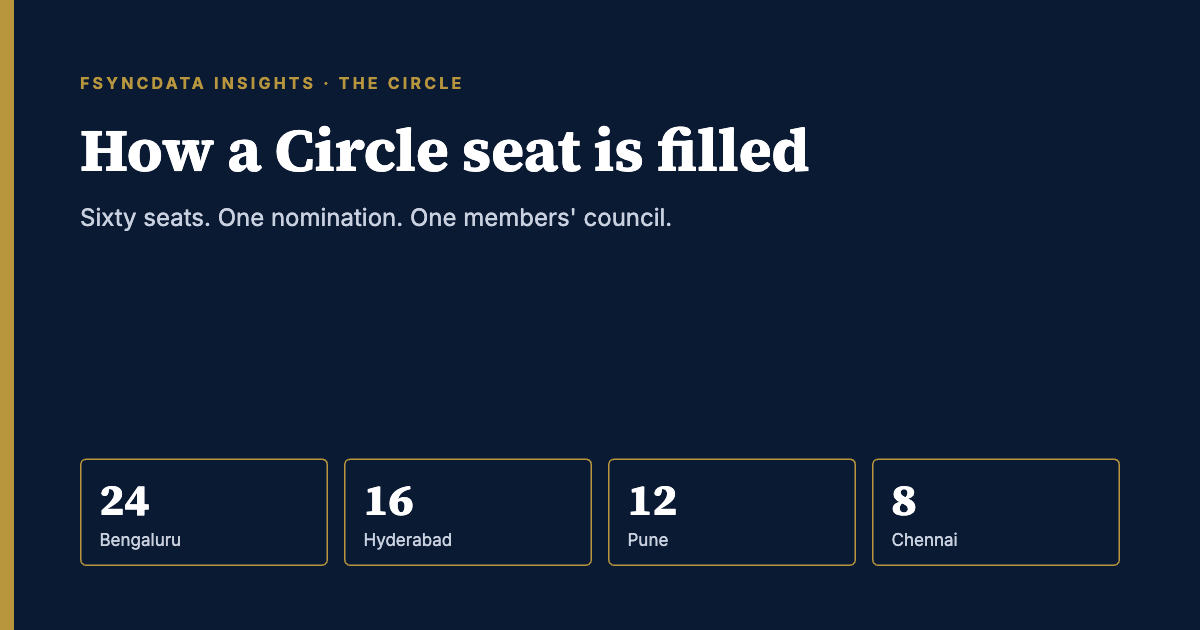
Table of Contents
What a Circle seat is
The fsyncDATA Circle is the invitation-only tier of fsyncDATA, the members’ club for the people who run India’s Global Capability Center data estates. It seats site leaders, chief data officers, chief data and analytics officers, chief AI officers, chief data scientists, CIOs, CTOs, principal database architects and heads of data platform. The ten engine Guilds sit beside it for the architects, DBAs and database engineers who run production.
A Circle seat belongs to the person, not the company. If a member moves to another center or to the parent’s data organisation, the Circle seat moves with them. If a member moves into a sales, pre-sales, partnerships or marketing role at a vendor, consultancy or analytics firm, they are thanked and released, because the charter does not bend for anyone.
Why sixty Circle seats
Sixty is the number at which a room can still know itself. Below it, the sector and stage mix that makes the Circle useful cannot be filled. Above it, a working session capped at forty starts to exclude people, and the member directory becomes a list rather than a set of people who have sat at the same table.
Sixty Circle seats also keep the GCC Data Platform Benchmark honest. Any benchmark cell with fewer than five responses is suppressed, and a room of sixty is large enough for most sector and stage cells to clear that bar.
How every Circle seat is composed
The Circle is composed by role, city and sector, with hard limits on concentration. No more than twelve Circle seats go to any one role. No more than two members come from any one company. No more than a third come from any one sector. Cities follow where India’s centers actually are.
| Dimension | Allocation across sixty Circle seats |
|---|---|
| Site leaders | 10 |
| Chief data officers, chief data and analytics officers, heads of data | 10 |
| CIOs, CTOs, chief AI officers, chief data scientists | 14 |
| Principal database architects and data architects | 14 |
| Heads of data platform and senior data platform leaders | 12 |
| Cities | Bengaluru 24, Hyderabad 16, Pune 12, Chennai 8 |
| Sectors | Technology, financial services, commerce, telecom, media and gaming, health, mobility and logistics, analytics centers; no more than a third from any one |
| Stages | Day-1 centers, scaling centers and portfolio owners, mixed deliberately |
The role mix is the point. Most rooms seat one role; the Circle seats the whole decision chain of a center’s data estate, so that the site leader hears what the principal architect knows about cost, and the architect hears what the site leader knows about the parent. The roles are described in full on who is in the room.
How a Circle seat is filled
Every Circle seat is filled the same way, and the convener has no shortcut through it.
- Nomination. A member nominates a person for what they run and decide, not for their title. Anyone may also request an invitation directly, and that request is treated as a self-nomination.
- A profile call. The secretariat holds a thirty-minute call: the estate you are accountable for, the three topics you can be asked about, the three you want to learn.
- Council approval. The members’ council approves each Circle seat against the composition limits above. fsyncDATA holds one nomination vote, like any member, and no veto.
- A guest session first. An invitee may attend one Circle working session as a guest before accepting, under the same Chatham House rule as members. Guests do not vote and are not recorded.
When the Circle is full, approved nominees go to a reserve list, in the order that keeps the composition limits intact, and are offered the next Circle seat that opens. Nobody is turned down without a reason, and nobody is told to wait without being told what for.
The council treats a nomination from someone who could have taken the Circle seat themselves as the strongest recommendation there is. If a colleague belongs in the room more than you do, say so.
What Circle members decide
The Circle is run by its members. At the annual assembly in Bengaluru each October, members:
- review and amend the charter;
- elect the five-person members’ council, no two from the same company or role;
- decide how many Circle seats open in the coming year, and how fast;
- approve the benchmark’s questions before the January survey;
- set the themes for the year’s working sessions and deep dives.
Two things members cannot amend, because they are the conditions under which fsyncDATA convenes the room: Rule 1, no selling, and the council’s power to find the convener in breach of it and dissolve the Circle.
What a Circle seat carries
- A monthly ninety-minute working session on one real leadership decision, told by the member who owns it, with the numbers left in.
- Quarterly deep dives that rotate through Bengaluru, Hyderabad, Pune and Chennai, in person and online.
- The 48-hour peer bench: a question routed to the three members best placed to answer it.
- Fortnightly office hours with principal engineers. Nothing is scoped, quoted or followed up.
- The members-only GCC Data Platform Benchmark and the reading room of anonymised summaries, post-mortems and reference designs.
- A vote at the annual assembly and the right to nominate.
Nothing commercial comes with a Circle seat, from anyone, ever. Members are never asked to recruit, sponsor, lend their names or logos, or appear in marketing. Members who prefer that even their membership is not mentioned outside the room may opt out of every directory field but role and city.
The price of a Circle seat is one contribution a year: a working session, a benchmark response, or standing availability for peers’ questions. Twelve working sessions, four deep dives and the office hours a member chooses add up to roughly thirty hours a year.
Your first ninety days in the Circle
| When | What happens |
|---|---|
| Week one | A thirty-minute profile call with the secretariat. |
| Weeks two to four | Three introductions chosen for complementarity: one in your role at a different stage, one in a different role at your stage, one in your sector. |
| Month two | Your first working session and your first question to the 48-hour bench. |
| Month three | Your contribution for the year agreed with the secretariat, and the reading room and benchmark open to you. |
The test the secretariat applies at twelve months is plain: does every member have three people in the Circle they would call before calling a vendor? If, after ninety days, the Circle is not what this page describes, leave. No explanation is required and none will be asked for.
Request a Circle seat or nominate a peer
Leaders request a Circle invitation. Practitioners apply to a Guild. Anyone may nominate a peer. The secretariat is reached at shiv@minervadb.com, and every message is answered by a person within two working days.
For the record: fsyncDATA is the GCC club of MinervaDB Inc., and a sister to ChistaDATA. The charter binds both companies exactly as it binds every member. If any member ever receives a services approach from fsyncDATA, MinervaDB or ChistaDATA that references the Circle, the council publishes the breach to all members and may dissolve the Circle.