Db2 z/OS has quietly become a GCC problem. Over the last three years, banks, insurers, airlines and retailers have moved database administration, performance engineering and change execution for their Db2 z/OS estates into India’s Global Capability Centers. The hand-over is happening at the worst possible moment in the platform’s lifecycle: Db2 12 for z/OS left standard support on 31 December 2025, Db2 13 is now the only supported release, and IBM has already published a list of object types that stop working at function level V13R1M511.
Our view, drawn from conversations with GCC site leaders and their HQ platform owners, is that the Db2 13 migration is the visible task and not the hard one. The hard part is that seven separate Db2 z/OS pressures arrive on the same team in the same 18 months, and most GCC operating models were written for steady-state run work. This analysis sets out those seven challenges, the evidence a GCC should collect for each, and a 90-day plan to put a Db2 z/OS estate on a controlled footing.
Scope and version pin. Everything here applies to Db2 for z/OS only, not Db2 for Linux, UNIX and Windows. Function-level statements are pinned to Db2 13 for z/OS up to and including V13R1M509 (FL 509, April 2026), the highest level we could confirm at the time of writing. SQL and utility examples are written for that level; confirm catalog column names and code values against the IBM documentation for your maintenance level before running them.
Key findings for GCC leadership
- Db2 12 is out of support. Estates still on Db2 12 for z/OS are either on an extended-support contract or carrying unsupported core systems. The Db2 13 migration is now a programme the GCC is expected to deliver, not observe.
- The second deadline is inside Db2 13. At V13R1M511, non-UTS table spaces, basic row format, hash-organised tables, index-controlled partitioning, 6-byte RBA/LRSN page sets, synonyms and SNA/VTAM can no longer be created or accessed. Object modernisation is a multi-quarter utility campaign.
- Skills are the binding constraint. In Kyndryl’s 2025 survey of 500 business and IT leaders, 70% said they struggle to find multi-skilled talent for mainframe and emerging technologies, and 74% rely on third-party providers for modernisation support.
- Cost and control are measured from HQ. MLC exposure, zIIP eligibility and cross-border privileged access are the three things a parent audit committee asks about first. Each needs evidence from SMF and the Db2 catalog, not a slide.
- Analytics demand is real and has prerequisites. Log-based change data capture off Db2 z/OS needs 10-byte RBA/LRSN and a licensed capture component. The same conversion work unblocks both the FL 511 gate and the analytics roadmap.
In this analysis
Why Db2 z/OS work is moving into GCCs now
India hosts more than 1,700 GCCs employing over 1.9 million people, with FY2024 revenue of USD 64.6 billion, according to the Nasscom and Zinnov landscape study published in September 2024. The early wave of these centres ran application support. The current wave owns platforms, and in banking, insurance and travel the most important platform is still a Db2 z/OS data sharing group sitting under core transaction processing.
The GCC mainframe footprint is not shrinking in these organisations. Kyndryl’s third State of Mainframe Modernization survey, published in September 2025, reported that 56% of organisations increased mainframe usage over the previous year and 80% had shifted their modernisation strategy in the same period. Parents are not exiting Db2 z/OS; they are moving the people who run it. That is the context in which a GCC mainframe team inherits a platform with a fixed lifecycle calendar and a shrinking pool of people who know its history.
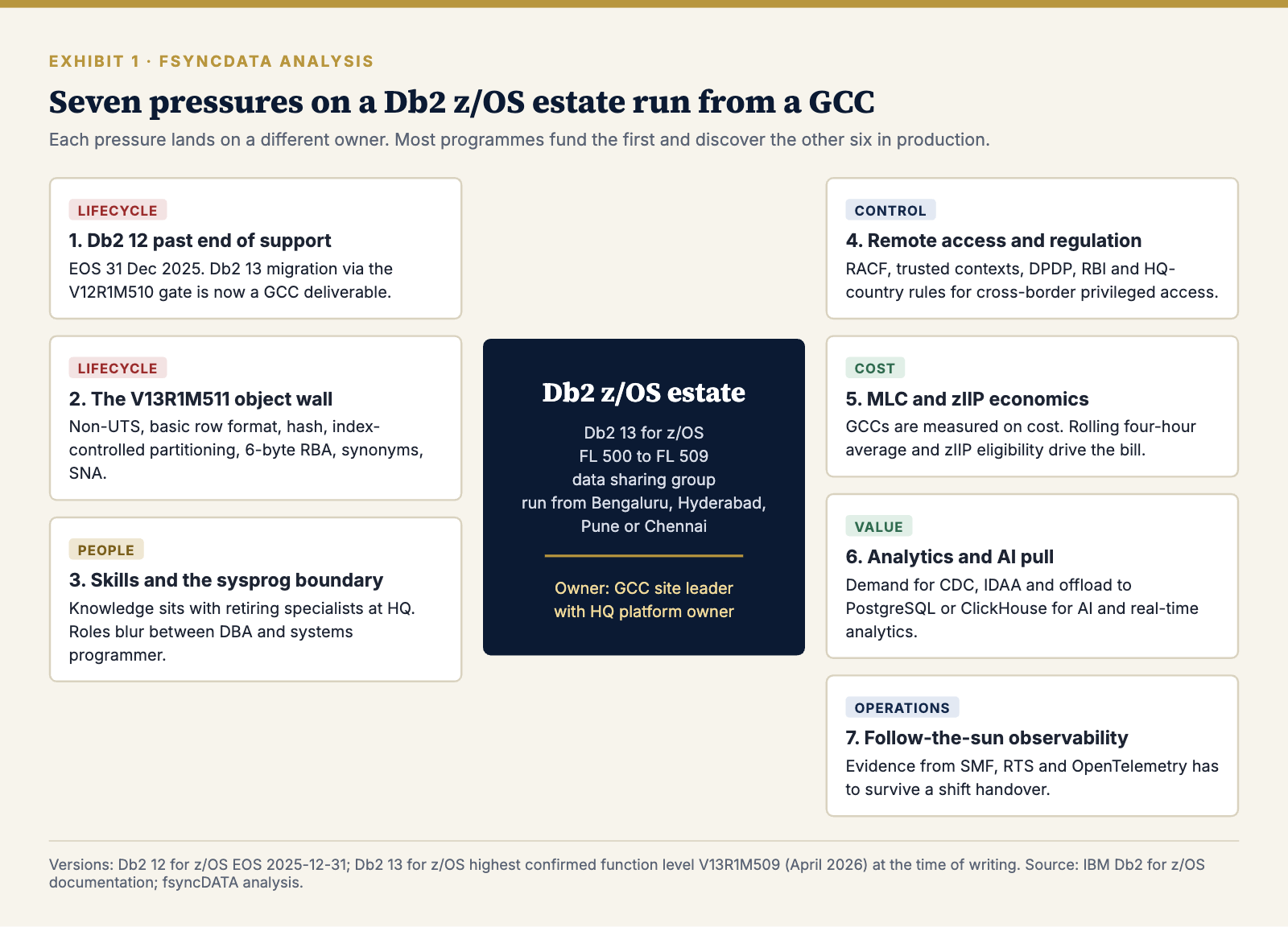
The seven Db2 z/OS challenges below are ordered by how early they bite, not by importance. The usual pattern is that the first two are funded, the third is acknowledged, and challenges four to seven are discovered during the first serious incident after the hand-over.
Challenge 1: Db2 12 is out of support, and Db2 13 migration is now a GCC deliverable
IBM ended support for Db2 12 for z/OS on 31 December 2025. Db2 13 for z/OS has been generally available since 31 May 2022, and IBM has said it does not expect to release the next version of Db2 for z/OS before 2028. For a GCC, that means the Db2 13 migration is the defining project of the next planning cycle, and the GCC team is accountable for most of the database-side work even when HQ systems programmers own SMP/E.
The mechanics are well documented. Every member of the data sharing group must be at Db2 12 function level V12R1M510 before migration, the fallback SPE must be applied across the group, and the DSNTIJPM premigration job must come back clean. Members then migrate one at a time to Db2 13 at function level 100, where coexistence and fallback are still possible. Activating V13R1M500 commits the catalog, and from that point there is no road back to Db2 12.
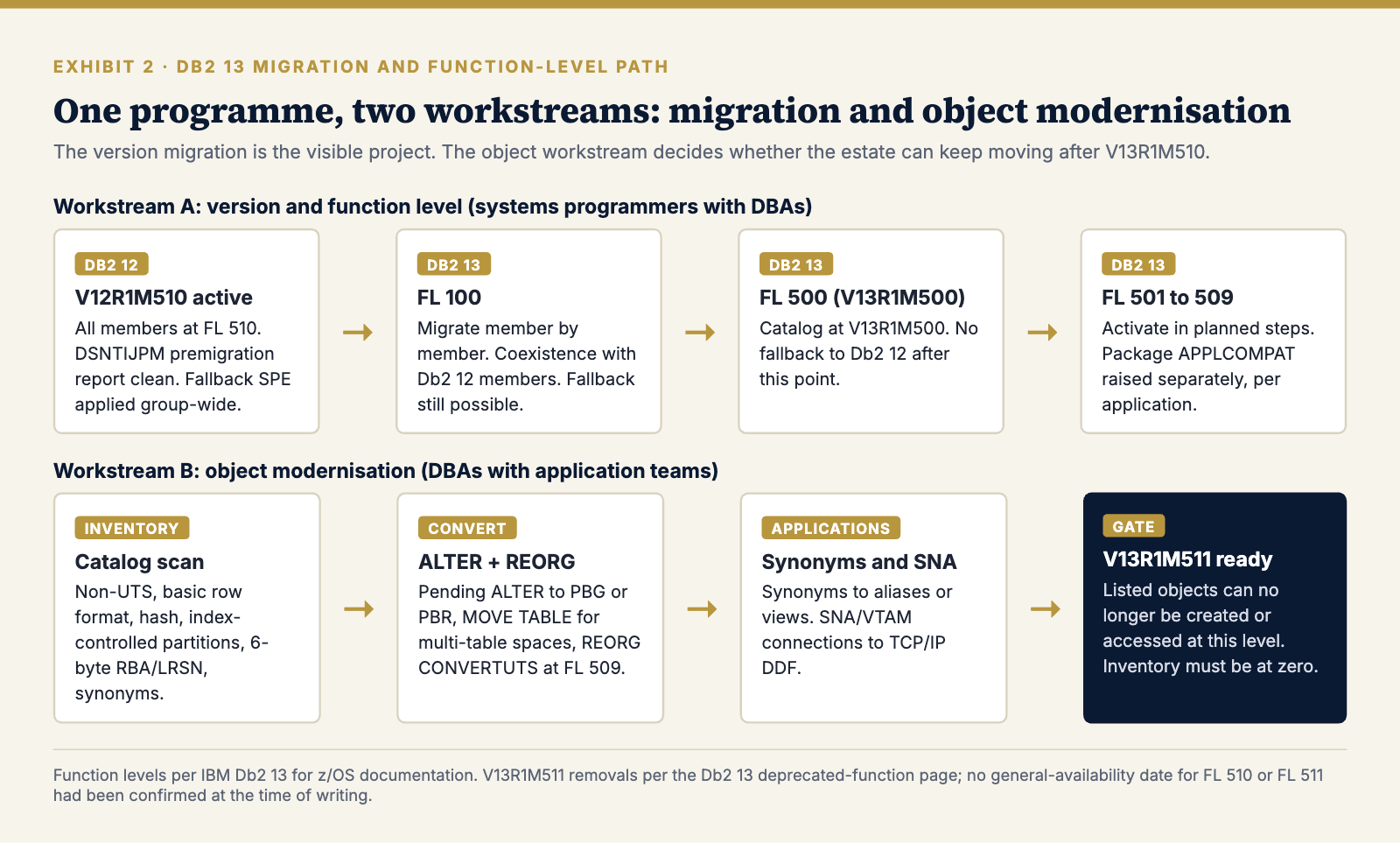
The first piece of Db2 z/OS evidence a GCC should capture is the current level of every member, in writing, before any planning meeting. One command gives it:
-DISPLAY GROUP DETAIL
-- Read from the DSN7100I output:
--   CURRENT FUNCTION LEVEL, HIGHEST ACTIVATED FUNCTION LEVEL,
--   HIGHEST POSSIBLE FUNCTION LEVEL, and the code level of each member.
-- Store the output with the change record; it is the baseline for every later step.
The trap that catches GCC Db2 z/OS teams is application compatibility. Raising the function level does not change how packages behave; APPLCOMPAT does, package by package. A Db2 13 migration that ends with thousands of packages still bound at V11R1 or V12R1M100 has moved the subsystem and left the applications behind. This query lists the packages that are actually in use and still bound below the Db2 13 baseline:
-- Db2 z/OS packages in active use, bound below Db2 13 application compatibility.
-- Read-only catalog query. Run with isolation UR to avoid catalog contention.
SELECT
    pk.COLLID          AS collection_id,
    pk.NAME            AS package_name,
    pk.APPLCOMPAT      AS applcompat_level,
    pk.LASTUSED        AS last_used_date,
    pk.BINDTIME        AS last_bind_time
FROM SYSIBM.SYSPACKAGE AS pk
WHERE pk.APPLCOMPAT < 'V13R1M500'
  AND pk.LASTUSED >= CURRENT DATE - 400 DAYS
ORDER BY pk.APPLCOMPAT, pk.COLLID, pk.NAME
WITH UR;
The 400-day window catches annual batch, which is the job that always surfaces on the first year-end after a migration. Packages with a LASTUSED date of 0001-01-01 have never run since Db2 began tracking usage; those are candidates for retirement rather than rebind, and every retired package is one less access path to regress.
Challenge 2: the V13R1M511 object wall inside Db2 13
This is the challenge most Db2 z/OS programmes have not yet costed. IBM’s list of deprecated function in Db2 13 states that, starting at function level V13R1M511, the following can no longer be created or accessed: non-UTS table spaces (simple, segmented and classic partitioned), tables in basic row format, hash-organised tables, index-controlled partitioning, page sets with basic 6-byte RBA or LRSN format, synonyms, and SNA/VTAM connectivity.
Read that carefully. It is a function-level gate inside Db2 13, not a next-version event in 2028. An estate that has not converted these objects cannot move past the level before it. For a GCC that has just inherited a 20-year-old Db2 z/OS subsystem, the inventory is usually larger than HQ expects, and part of it sits in the catalog and directory.
Building the inventory from the catalog
The query below gives a first-pass count by category. It is read-only and safe to run on production with isolation UR, but the code values are the part to check: confirm each TYPE, FORMAT and RBA_FORMAT value against the Db2 13 catalog reference for your maintenance level before you report numbers to HQ.
-- First-pass V13R1M511 readiness inventory for a Db2 z/OS subsystem.
-- Verify catalog code values against the Db2 13 catalog reference first.
SELECT 'NON_UTS_TABLESPACE' AS issue_type, ts.DBNAME AS db_name, ts.NAME AS object_name
FROM SYSIBM.SYSTABLESPACE AS ts
WHERE ts.TYPE NOT IN ('G', 'R', 'O', 'P')        -- G = PBG, R = PBR, O = LOB, P = XML
UNION ALL
SELECT 'BASIC_ROW_FORMAT', tp.DBNAME, tp.TSNAME
FROM SYSIBM.SYSTABLEPART AS tp
JOIN SYSIBM.SYSTABLESPACE AS ts
  ON ts.DBNAME = tp.DBNAME
 AND ts.NAME = tp.TSNAME
WHERE tp.FORMAT = ' '
  AND ts.TYPE NOT IN ('O', 'P')
UNION ALL
SELECT 'HASH_ORGANISED', ts.DBNAME, ts.NAME
FROM SYSIBM.SYSTABLESPACE AS ts
WHERE ts.ORGANIZATIONTYPE = 'H'
UNION ALL
SELECT 'INDEX_CONTROLLED_PARTITIONING', tb.DBNAME, tb.TSNAME
FROM SYSIBM.SYSTABLES AS tb
JOIN SYSIBM.SYSTABLESPACE AS ts
  ON ts.DBNAME = tb.DBNAME
 AND ts.NAME = tb.TSNAME
WHERE tb.TYPE = 'T'
  AND ts.PARTITIONS > 0
  AND tb.PARTKEYCOLNUM = 0
UNION ALL
SELECT 'BASIC_6_BYTE_RBA_TS', tp.DBNAME, tp.TSNAME
FROM SYSIBM.SYSTABLEPART AS tp
WHERE tp.RBA_FORMAT = 'B'
UNION ALL
SELECT 'BASIC_6_BYTE_RBA_IX', ip.IXCREATOR, ip.IXNAME
FROM SYSIBM.SYSINDEXPART AS ip
WHERE ip.RBA_FORMAT = 'B'
UNION ALL
SELECT 'SYNONYM', sy.CREATOR, sy.NAME
FROM SYSIBM.SYSSYNONYMS AS sy
WITH UR;
Wrap the query in a GROUP BY on issue_type for the steering committee and keep the detail rows for the DBA team. The count by category, refreshed weekly, is the single most useful Db2 z/OS progress metric for this workstream and the clearest signal of mainframe modernisation progress for HQ.
Converting objects without an outage
On Db2 z/OS, most single-table simple and segmented table spaces convert to partition-by-growth through a pending ALTER followed by an online REORG. Multi-table segmented spaces need ALTER TABLESPACE … MOVE TABLE into new PBG spaces first. At FL 509, IBM added REORG TABLESPACE with the CONVERTUTS option, which converts non-UTS table spaces to PBG, including the catalog and directory through the DSNTIJCR sample job. The sequence below shows the pattern with a verification step before and after.
-- STEP 0: verification before change. Record the current Db2 z/OS definition.
SELECT ts.DBNAME, ts.NAME, ts.TYPE, ts.SEGSIZE, ts.MAXPARTITIONS
FROM SYSIBM.SYSTABLESPACE AS ts
WHERE ts.DBNAME = 'DBPAY01'
  AND ts.NAME = 'TSCLAIM'
WITH UR;

-- STEP 1: pending definition change (no data movement yet).
ALTER TABLESPACE DBPAY01.TSCLAIM
    MAXPARTITIONS 4;

-- STEP 2: confirm the change is pending and nothing else is queued.
SELECT pd.DBNAME, pd.TSNAME, pd.OPTION_KEYWORD, pd.OPTION_VALUE, pd.CREATEDTS
FROM SYSIBM.SYSPENDINGDDL AS pd
WHERE pd.DBNAME = 'DBPAY01'
  AND pd.TSNAME = 'TSCLAIM'
WITH UR;
-- -DISPLAY DATABASE(DBPAY01) SPACENAM(TSCLAIM) ADVISORY should show AREOR.
//GCCUTS01 JOB (ACCT),'UTS CONVERSION',CLASS=A,MSGCLASS=X,NOTIFY=&SYSUID
//*--------------------------------------------------------------------
//* Materialise the pending change with an online REORG.
//* Preconditions: verified image copy taken, change window approved,
//* job tested on a cloned subsystem. Not for direct production use.
//*--------------------------------------------------------------------
//STEP1 EXEC DSNUPROC,SYSTEM=DB2P,UID='GCC.UTSCONV',UTPROC=''
//SYSIN DD *
TEMPLATE TCOPY
DSN(&DB..&TS..D&DATE..T&TIME.)
UNIT(SYSDA) SPACE(100,100) CYL
REORG TABLESPACE DBPAY01.TSCLAIM
SHRLEVEL CHANGE
COPYDDN(TCOPY)
STATISTICS TABLE(ALL) INDEX(ALL)
/*After the REORG, rerun the STEP 0 query. TYPE should read G for partition-by-growth, the SYSPENDINGDDL rows should be gone, and the advisory status should be cleared. Classic partitioned spaces follow a different path to partition-by-range, and index-controlled partitioning has to be converted to table-controlled first; both are well covered in the IBM documentation, and both deserve a dry run on a clone because they touch the partitioning key.
Challenge 3: skills, knowledge transfer and the systems-programmer boundary
The numbers from the Kyndryl survey match what we hear in GCC leadership rooms: 70% of organisations struggle to find people who can work across the mainframe and newer platforms, and 74% rely on third parties for modernisation support. In India the supply problem has a specific shape. There is a solid base of COBOL and CICS application engineers, a thinner layer of experienced Db2 z/OS DBAs, and very few people who have run a data sharing group through a version migration.
Db2 z/OS knowledge transfer from HQ is usually framed as documentation. It rarely is. The useful knowledge in a 20-year-old Db2 z/OS estate is in the reasons behind odd settings: why one buffer pool is page-fixed and another is not, why a particular table space is never reorganised during month-end, why a DSNZPARM value differs between members. A GCC that inherits the settings without the reasons will eventually change one of them for a good reason and cause an outage.
The second problem is the boundary between DBAs and systems programmers. On z/OS these are different disciplines with different access, and the line moves from one organisation to the next. When Db2 z/OS operations move to a GCC, nobody redraws it, and incidents stall while two teams in two time zones decide whose change it is.
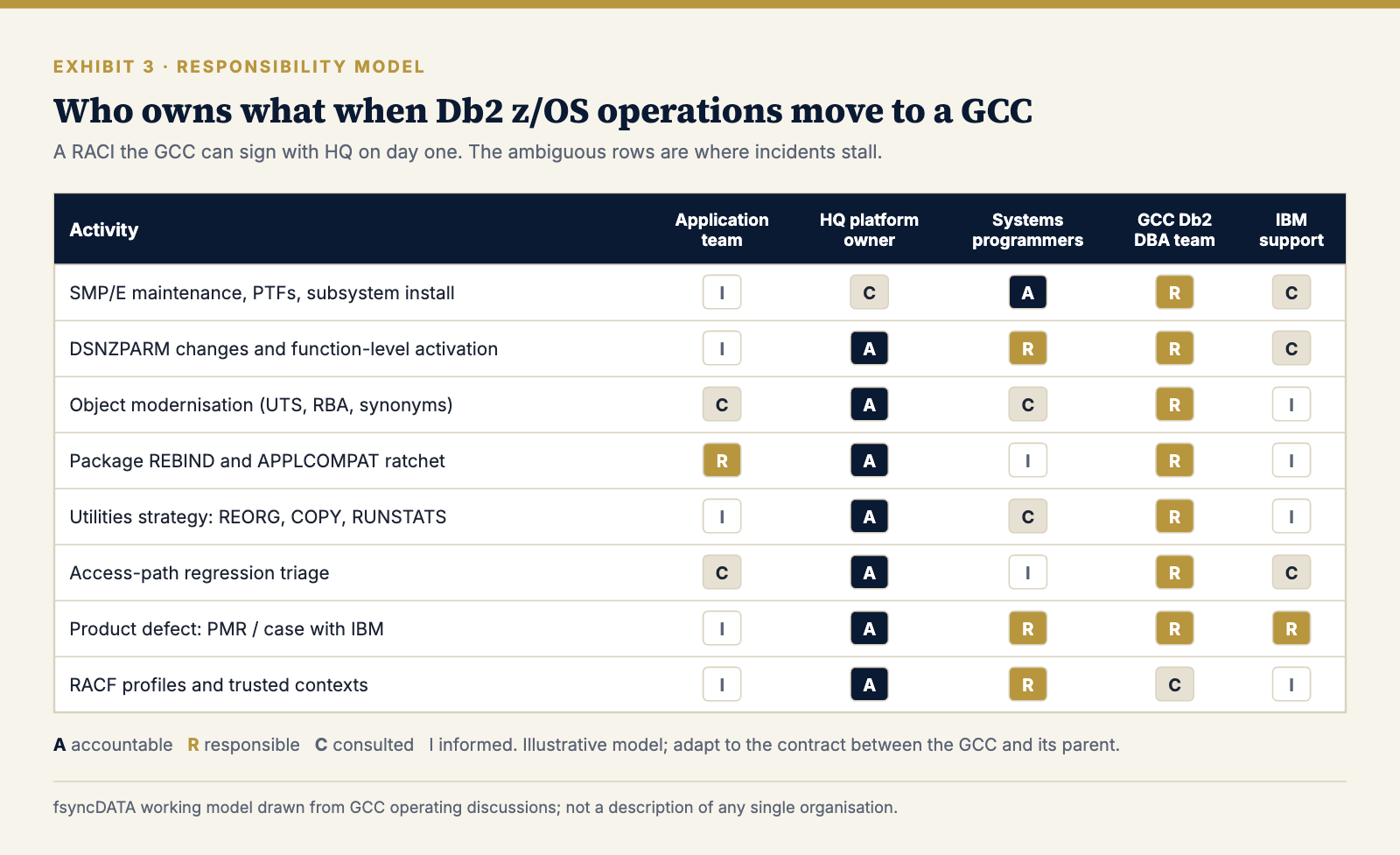
We recommend three practical controls. First, a signed RACI covering at least the eight activities in Exhibit 3. Second, a decision log in which every non-default DSNZPARM and buffer pool attribute carries the reason and the owner, captured during knowledge transfer, not after. Third, paired change windows for the first two quarters, with an HQ systems programmer and a GCC DBA on every Db2 z/OS change.
Challenge 4: remote access, RACF and regulatory scrutiny from India
Privileged Db2 z/OS access from India to a parent’s mainframe is the question every audit committee asks first. For a bank, the GCC sits under at least two regimes: the parent’s home regulator, such as DORA for EU financial entities since January 2025, and Indian law, including the Digital Personal Data Protection Act, 2023. Indian regulated entities add the RBI’s directions on outsourcing of IT services. None of these prohibit GCC operations; all of them expect the parent to prove who did what, from where, with which privilege.
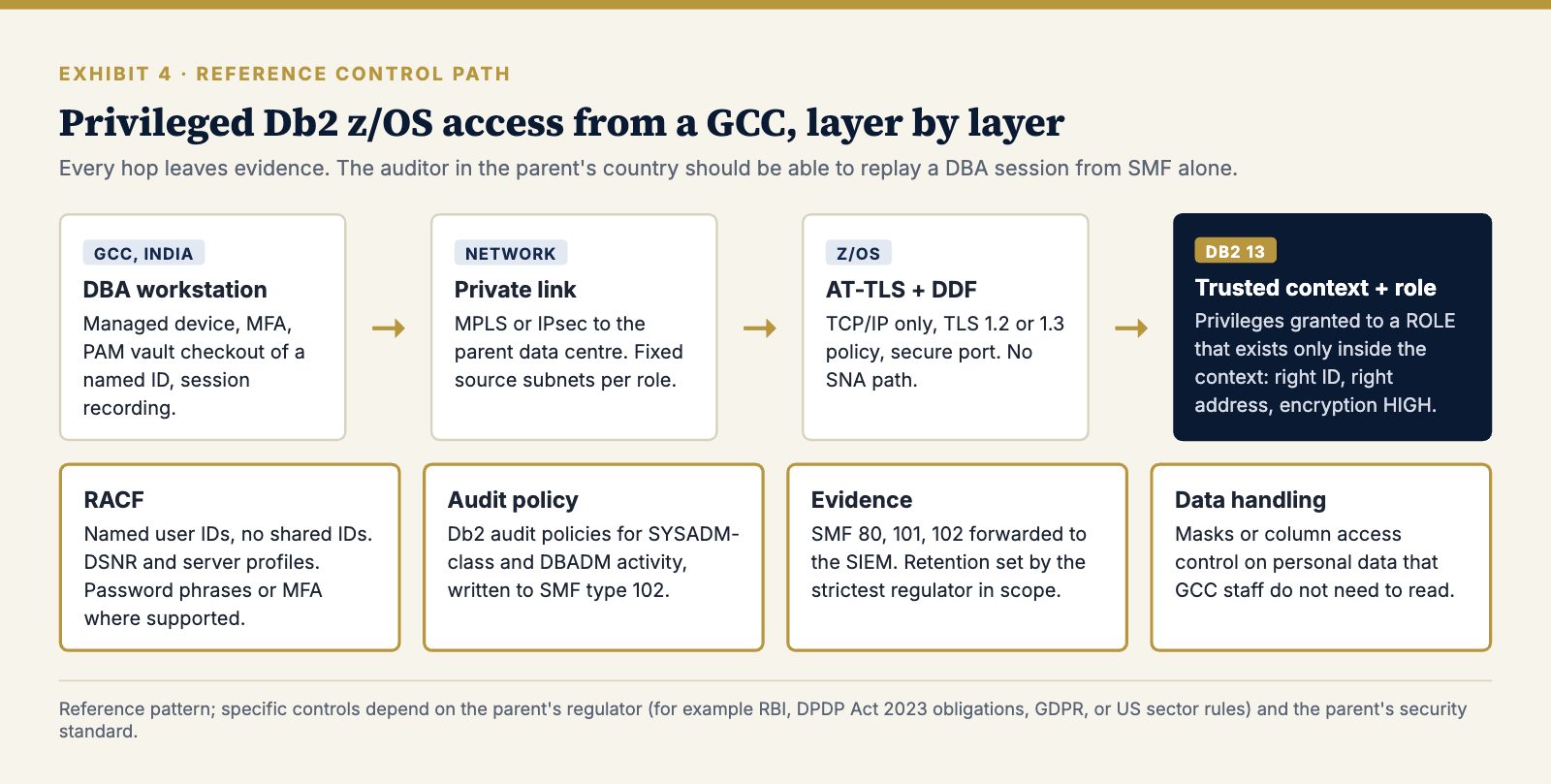
On Db2 z/OS the cleanest pattern combines RACF named IDs, TCP/IP-only DDF secured with AT-TLS, and trusted contexts that grant powerful privileges to a role only when the connection arrives from an approved address with strong encryption. Outside that context, the same user ID has no administrative authority at all.
-- Db2 z/OS role that carries change privileges. It exists only inside the trusted context.
CREATE ROLE gcc_dba_change;

GRANT DBADM ON DATABASE DBPAY01 TO ROLE gcc_dba_change;

-- Trusted context: privileges apply only from the approved jump hosts,
-- over an encrypted connection, for named and authenticated DBAs.
CREATE TRUSTED CONTEXT ctx_gcc_dba_blr
    BASED UPON CONNECTION USING SYSTEM AUTHID GCCJMP01
    ATTRIBUTES (ADDRESS '10.40.12.21',
                ADDRESS '10.40.12.22',
                ENCRYPTION 'HIGH')
    DEFAULT ROLE gcc_dba_change
    WITHOUT ROLE AS OBJECT OWNER
    ENABLE
    WITH USE FOR GCCDBA01 WITH AUTHENTICATION,
                 GCCDBA02 WITH AUTHENTICATION;

-- Validation after change: confirm the context and its attributes.
SELECT tc.NAME, tc.SYSTEMAUTHID, tc.DEFAULTROLE, tc.ENABLED
FROM SYSIBM.SYSCONTEXT AS tc
WHERE tc.NAME = 'CTX_GCC_DBA_BLR'
WITH UR;
The addresses, IDs and object names above are placeholders. Pair the trusted context with Db2 audit policies for SYSADM-class and DBADM activity written to SMF type 102, forward SMF 80, 101 and 102 to the parent’s SIEM, and set retention to the strictest regulator in scope. Test every new context on a non-production subsystem first; a misconfigured context can lock out the people who need to fix it.
Challenge 5: MLC cost pressure and zIIP economics
GCCs are funded on a cost case, and on the mainframe the cost case is dominated by software charges tied to CPU consumption, typically measured through the rolling four-hour average or a Tailored Fit Pricing consumption model. A GCC Db2 z/OS team that reduces general-purpose CPU in the peak window produces a saving the CFO can see. A team that only tunes average response time often does not.
Two levers matter most. The first is moving eligible work to zIIP engines. DDF-originated SQL, parallel query and many utility phases are partially zIIP-eligible, and APAR PH63832 added zIIP offload for the COPY utility in Db2 13. The second is finding the small number of statements that consume most of the general-purpose CPU. For dynamic SQL, the Db2 z/OS statement cache already holds that evidence:
-- Prerequisite: IFCID 318 collects statement cache statistics. Small overhead; measure it.
-START TRACE(MON) CLASS(1) IFCID(318)

-- Externalise the cache to DSN_STATEMENT_CACHE_TABLE under your SQLID.
EXPLAIN STMTCACHE ALL;

-- Top 25 Db2 z/OS dynamic statements by accumulated CPU since they entered the cache.
SELECT
    sc.COLLID                                           AS collection_id,
    sc.PROGRAM_NAME                                     AS program_name,
    sc.STAT_EXEC                                        AS executions,
    DEC(sc.STAT_CPU, 15, 3)                             AS cpu_seconds,
    DEC(sc.STAT_CPU * 1000 / NULLIF(sc.STAT_EXEC, 0), 15, 3) AS cpu_ms_per_exec,
    sc.STAT_GPAG                                        AS getpages,
    SUBSTR(sc.STMT_TEXT, 1, 120)                        AS statement_head
FROM DSN_STATEMENT_CACHE_TABLE AS sc
ORDER BY sc.STAT_CPU DESC
FETCH FIRST 25 ROWS ONLY;
Static SQL needs accounting data instead: class 1, 2 and 3 for elapsed and wait time, classes 7 and 8 for package-level attribution, written to SMF and reduced with your performance monitor. Report the zIIP-eligible portion separately from general-purpose CPU. Any cost figure that goes to HQ should state the measurement window, the trace classes and whether it is general-purpose or zIIP CPU; a mixed figure will not survive the first review by the parent’s capacity team.
-START TRACE(ACCTG) CLASS(1,2,3,7,8) DEST(SMF)
-- Confirm with -DISPLAY TRACE(ACCTG). Class 7 and 8 add overhead on very
-- high-volume packages; agree the collection window with capacity planning.
Challenge 6: the analytics and AI pull on mainframe data
Almost every GCC data organisation now carries an analytics or AI mandate, and the most valuable data for it often lives in Db2 z/OS. The business wants near-real-time feeds for fraud scoring, customer 360 and operational dashboards. The platform team wants to protect the transaction system and its MLC budget. Both are right, and the Db2 z/OS architecture has to serve both.
There are two broad routes. IBM Db2 Analytics Accelerator keeps the query on IBM Z and is often the right answer when the consumer is an existing mainframe application. Change data capture into Kafka, and from there into PostgreSQL for read services or ClickHouse for real-time analytics, suits new consumers built outside the mainframe. Many estates end up with both.
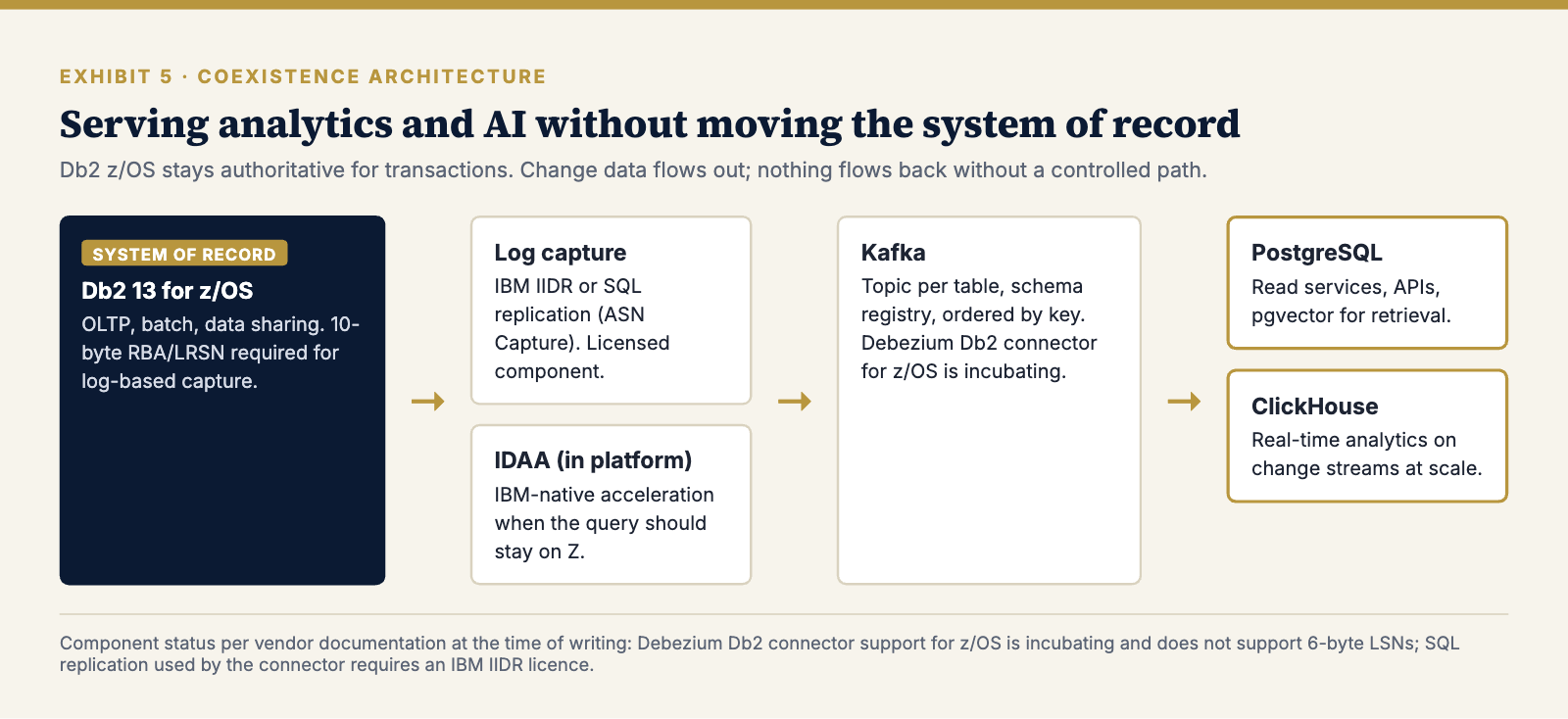
Two facts shape the CDC route, and both are easy to miss in a business case. The Debezium Db2 connector documentation lists Db2 for z/OS support as incubating and states that it cannot be used with Db2 for z/OS versions that use 6-byte LSNs. It also relies on SQL replication, which needs an IBM InfoSphere Data Replication licence. There is no licence-free log-based route off Db2 z/OS, and the 10-byte RBA/LRSN conversion from Challenge 2 is a prerequisite here as well.
That overlap is useful for mainframe modernisation. The Db2 z/OS conversion work that clears the V13R1M511 gate also unlocks the analytics roadmap, so the two belong in one programme with one budget. GCC leaders who present them separately tend to get the compliance work funded and the analytics work deferred.
Challenge 7: observability and follow-the-sun operations
A GCC Db2 z/OS team often runs the overnight shift for HQ, which means it handles the batch window, utility failures and the first response to performance incidents. The hand-over at the end of a shift is where evidence gets lost. The goal is a small set of signals that both teams read the same way, drawn from sources that already exist: SMF, real-time statistics, the catalog and, increasingly, OpenTelemetry.
Real-time statistics drive most Db2 z/OS housekeeping decisions. IBM’s DSNACCOX stored procedure applies its own rules; many sites also keep a transparent query so the GCC team can explain every recommendation. The thresholds below are illustrative and should be tuned to your estate:
-- Db2 z/OS REORG and image-copy candidates from real-time statistics.
-- Illustrative thresholds: 10% change since REORG, 7 days since last copy.
SELECT
    rts.DBNAME,
    rts.NAME,
    rts.PARTITION,
    rts.TOTALROWS,
    rts.REORGINSERTS + rts.REORGDELETES + rts.REORGUPDATES   AS changes_since_reorg,
    DEC(100.0 * (rts.REORGINSERTS + rts.REORGDELETES + rts.REORGUPDATES)
        / NULLIF(rts.TOTALROWS, 0), 9, 2)                      AS pct_changed,
    DEC(100.0 * rts.REORGUNCLUSTINS / NULLIF(rts.TOTALROWS, 0), 9, 2) AS pct_unclustered_inserts,
    rts.REORGLASTTIME,
    rts.COPYLASTTIME,
    rts.COPYUPDATEDPAGES
FROM SYSIBM.SYSTABLESPACESTATS AS rts
WHERE rts.TOTALROWS > 1000000
  AND (   (rts.REORGINSERTS + rts.REORGDELETES + rts.REORGUPDATES) > 0.10 * rts.TOTALROWS
       OR rts.COPYLASTTIME < CURRENT TIMESTAMP - 7 DAYS
       OR rts.COPYLASTTIME IS NULL)
ORDER BY pct_changed DESC
WITH UR;
-- At FL 509 with current maintenance, NSYNCREADIO adds object-level synchronous
-- read I/O to SYSTABLESPACESTATS and SYSINDEXSPACESTATS. Add it once present.
For distributed workloads, profile tables let the GCC put guardrails on new consumers, such as a reporting tool or an AI pipeline, without touching DSNZPARM. Start in warning mode, read the messages for a week, and only then move to exception mode.
-- Warn when the GCC reporting ID holds more than 40 concurrent DDF threads.
INSERT INTO SYSIBM.DSN_PROFILE_TABLE
    (PROFILEID, AUTHID, PROFILE_ENABLED, REMARKS)
VALUES
    (501, 'GCCRPT01', 'Y', 'GCC reporting workload guardrail');

INSERT INTO SYSIBM.DSN_PROFILE_ATTRIBUTES
    (PROFILEID, KEYWORDS, ATTRIBUTE1, ATTRIBUTE2, ATTRIBUTE3)
VALUES
    (501, 'MONITOR THREADS', 'WARNING', 40, NULL);

-START PROFILE
-DISPLAY PROFILE
-- Validation: check DSN_PROFILE_HISTORY and DSN_PROFILE_ATTRIBUTES_HISTORY
-- for rejected rows before relying on the profile.
Recent Db2 13 maintenance also added distributed tracing and OpenTelemetry support (APARs PH67971 and PH68073), so Db2 z/OS spans can land in the same observability stack the GCC already runs for its distributed platforms. That matters for incident handling across a shift change: one trace, one timeline, one owner. We cover the wider signal set in our practitioner guide to database observability.
Controlling access-path risk during the Db2 13 migration
One Db2 z/OS operational practice deserves its own section because it is where migrations most often go wrong in production. Every REBIND during the Db2 13 migration carries access-path risk. Plan management and access-path reuse make that risk reversible, which is the property a GCC team working at night needs most.
-- Rebind under Db2 13 compatibility, reusing the current access path where possible,
-- keeping previous and original copies for fallback, and capturing EXPLAIN output.
REBIND PACKAGE(PAYCOLL.CLMPKG01) -
       APPLCOMPAT(V13R1M509)     -
       APREUSE(WARN)             -
       APCOMPARE(WARN)           -
       PLANMGMT(EXTENDED)        -
       EXPLAIN(YES)

-- Rollback path if the package regresses: restore the previous copy.
REBIND PACKAGE(PAYCOLL.CLMPKG01) SWITCH(PREVIOUS)
Validate each rebind against accounting data for the package, compare CPU per commit and getpages per execution before and after, and keep the evidence with the change record. A rebind wave without a measured baseline is a hope, not a plan.
A Db2 z/OS maturity model for GCC teams
We propose the following four-level Db2 z/OS maturity model for GCC site leaders. It is deliberately short, and every cell can be evidenced from the catalog, SMF or a signed document.
| Dimension | Level 1: inherited | Level 2: controlled | Level 3: measured | Level 4: leading |
|---|---|---|---|---|
| Lifecycle | Db2 12 or Db2 13 at FL 100 | Db2 13 at FL 500 or above | FL 509, APPLCOMPAT ratchet under way | V13R1M511 inventory at zero |
| People | Named DBAs, no RACI | Signed RACI with HQ | Decision log for every non-default setting | GCC leads migration windows |
| Access control | Shared or generic IDs | Named RACF IDs, PAM | Trusted contexts and roles | SMF audit replayed by HQ |
| Cost | No CPU attribution | Monthly MLC report | Top statements by GP CPU and zIIP | Savings tracked against the cost case |
| Analytics | Batch extracts | IDAA or CDC pilot | 10-byte RBA, licensed capture | Governed real-time feeds |
| Operations | Ticket-driven | RTS-driven housekeeping | Profile guardrails, shift evidence pack | OpenTelemetry across platforms |
The first 90 days: what GCC leaders should commission
- Days 1 to 15: baseline. Capture -DISPLAY GROUP DETAIL for every member, the package APPLCOMPAT inventory and the V13R1M511 inventory. Publish the counts to HQ in a one-page Db2 z/OS status note.
- Days 15 to 30: agree ownership. Sign the RACI with HQ, start the DSNZPARM and buffer pool decision log, and schedule paired change windows.
- Days 30 to 45: secure access. Move privileged work to named RACF IDs, trusted contexts and roles. Confirm SMF 80, 101 and 102 reach the parent’s SIEM.
- Days 45 to 60: measure cost. Turn on the agreed accounting classes and IFCID 318, produce the top-25 statement report, and separate general-purpose from zIIP CPU.
- Days 60 to 75: plan conversion. Size the Db2 z/OS object modernisation campaign by category, sequence it around business calendars, and tie the RBA/LRSN conversion to the analytics roadmap.
- Days 75 to 90: prove reversibility. Run one complete rebind wave with PLANMGMT(EXTENDED) and a rehearsed SWITCH(PREVIOUS), and one REORG-based conversion on a clone, with before and after evidence.
Where this analysis stops
This piece covers Db2 z/OS only. It does not address Db2 for LUW, IMS or VSAM, each of which has its own GCC story. We have not quoted a date for function levels V13R1M510 or V13R1M511 because IBM had not published one at the time of writing. Licensing determinations for IIDR, IDAA and Tailored Fit Pricing belong with the parent’s IBM representative and counsel. The survey and market figures are cited from their publishers; they describe the market, not any single estate.
All SQL, commands and JCL above are examples. Test them on a non-production Db2 z/OS subsystem, take a verified image copy before any utility or ALTER, and keep a tested disaster recovery posture for the subsystem throughout the programme.
Continue the conversation
Db2 z/OS leaders and DBAs in India’s GCCs discuss exactly these problems in the fsyncDATA Oracle, Db2 and SAP HANA Guild, and site leaders bring the operating-model questions to the fsyncDATA Circle. If your team needs hands-on help with a Db2 13 migration, an object modernisation campaign or a mainframe cost review, our sister company runs a Db2 for z/OS consulting and support practice.
Sources
- IBM Documentation: Db2 13 for z/OS function levels
- IBM Documentation: Deprecated function in Db2 13 for z/OS
- IBM Documentation: Db2 12 for z/OS end of support
- IBM Documentation: Activate function level 510 in Db2 12
- IDUG: Important news regarding Db2 for z/OS versions
- Debezium documentation: Db2 connector
- Kyndryl: State of Mainframe Modernization survey, September 2025
- ThePrint: Nasscom and Zinnov GCC landscape study, September 2024