Update, 8 October 2026: fsyncDATA now runs in two tiers. The Circle described here remains the invitation-only tier for leaders, and ten engine Guilds are open to database architects, DBAs and database engineers. See the charter for the rules that bind both.
This is an invitation to GCC leaders in India: site leaders, chief data officers, chief data and analytics officers, chief AI officers, chief data scientists, CIOs, CTOs and principal database architects. It is addressed to the people who run the data estates of Global Capability Centers, and it asks for one thing: a reply.
The fsyncDATA GCC programme has three parts. The fsyncDATA Circle is a private club with sixty seats, no fee, no sponsors and no selling. The GCC leadership conferences are open-door days, four a year, alternating between Bengaluru and Hyderabad. fsyncDATA Learning is a set of online tracks for the engineers who will hold your role next.
What follows is the detail GCC leaders should have before they answer: the technical benefits, the professional ones, the opportunities the programme opens, what it costs, and where its limits are.
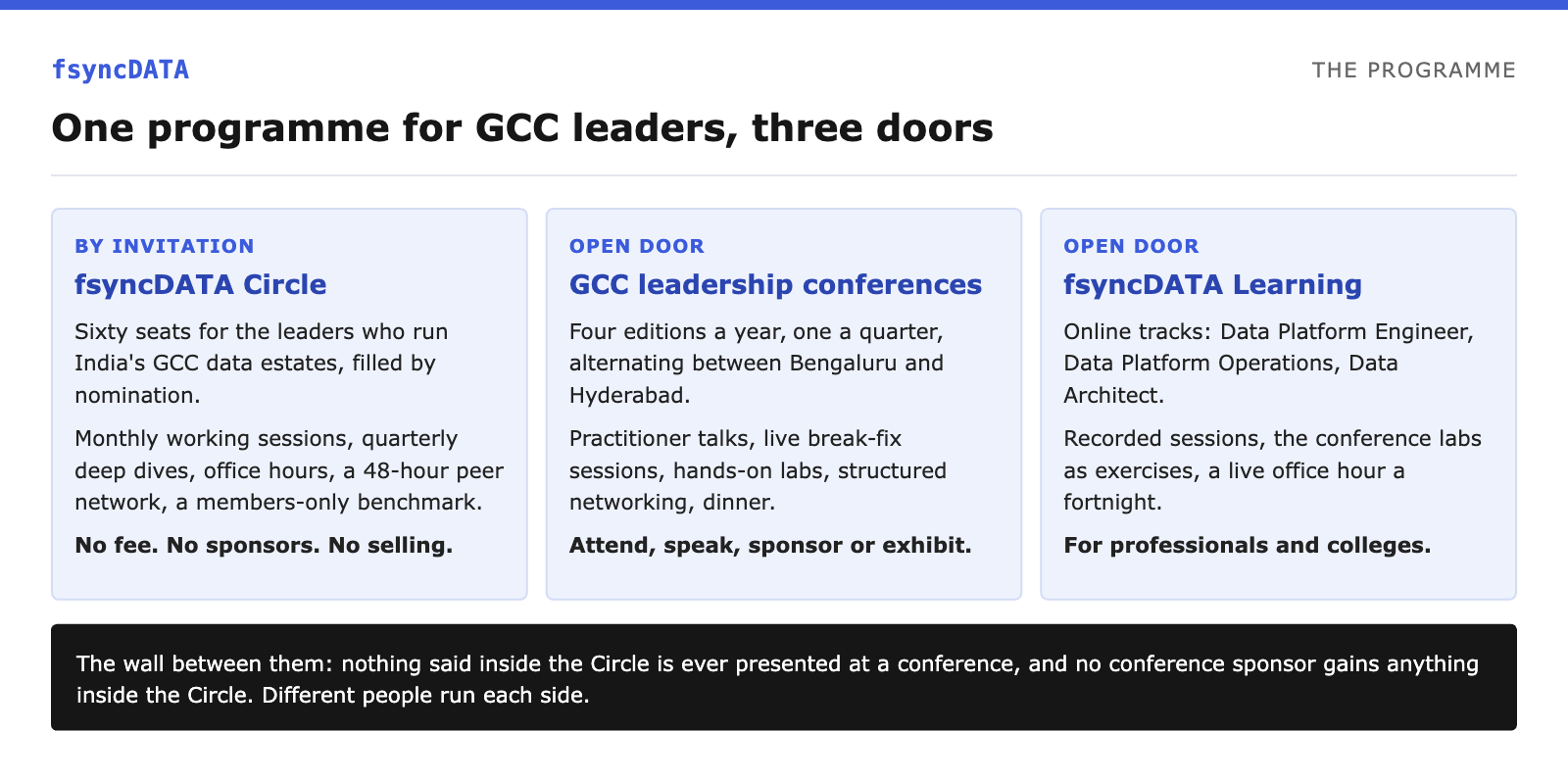
Table of Contents
Why GCC leaders, and why now
India hosts about 2,117 Global Capability Centers across 3,728 units. They employ roughly 2.36 million people and generated US$98.4 billion in FY26, according to the Nasscom–Zinnov India GCC Landscape 2026. Around 1,200 of those centers carry embedded AI and ML mandates, and every one of those mandates sits on a data platform.
The work has changed shape. Centers that once closed tickets now own platforms: reliability, data engineering, cloud architecture and AI pipelines for some of the largest enterprises in the world are decided in Bengaluru, Hyderabad, Pune and Chennai.
Several of those decisions now carry dates. Runtimes and database engines leave support through the first half of 2027. DPDP obligations for India-resident platforms fall due on 13 May 2027. Renewals, commits and mandate reviews arrive on their own calendars whether or not the estate is ready.
Most GCC leaders meet those dates alone. The leader who has already run the migration, read the invoice or sat through the audit is usually two kilometres away and unknown to them. The programme exists to close that distance, under rules that let people tell the truth.
The programme in three parts
The three parts serve different people and run under different rules. GCC leaders who want the private room join the Circle. Everyone, GCC leaders included, is welcome at the open door.
| Part | Who it is for | Format | Cost |
|---|---|---|---|
| fsyncDATA Circle | The leadership roles of a center’s data estate, by invitation | Monthly working sessions, quarterly deep dives, office hours, peer network, annual benchmark | No fee. One contribution a year |
| GCC leadership conferences | Anyone who runs, builds or aspires to run a capability center data platform | One full day a quarter: talks, break-fix sessions, labs, networking, dinner | Intended to be free or close to it for practitioners; terms published with the dates |
| fsyncDATA Learning | Working professionals and college cohorts | Three online tracks with recorded sessions, lab exercises and a fortnightly office hour | Announced when enrolment opens |
The separation matters. Nothing said inside the Circle is ever presented at a conference, and no conference sponsor gains anything inside the Circle. Different people run each side.
Technical benefits for GCC leaders
For GCC leaders the technical return is specific: decisions worked with their numbers, a benchmark built for India’s centers, direct access to principal engineers, and incidents handled in front of you instead of summarised afterwards.
Eight decisions, each with a date attached
The curriculum is the set of decisions a center will face in the next eighteen months. Each one runs as a working session, and each has a date.
| Theme | The decision on the table | When it bites |
|---|---|---|
| Portfolio ownership | Taking, and keeping, ownership of global platforms from HQ and outsourced towers | Every mandate review |
| Cost of the data layer | Why database and warehouse spend outruns data growth, and what reversed it | Every renewal and commit |
| Reliability and freshness | What time the numbers must be true, per region | Every month-end |
| End-of-support calendar | What is forced in 2027 and what is optional | Q1 to Q2 2027 |
| DPDP obligations | Retention, erasure, breach telemetry and residency design | 13 May 2027 |
| AI foundations | Vector, streaming and governance work that AI charters wait on | Every AI program review |
| Talent and attrition | What keeps a senior data engineer in a center | Every quarter |
| The HQ relationship | Earning a seat at the parent’s platform council | Every budget cycle |
A session is ninety minutes. One member brings a real decision with its numbers: twenty minutes of story, forty of questions, thirty of what the room would do. Attendance is capped at forty. There are no slides beyond the numbers.
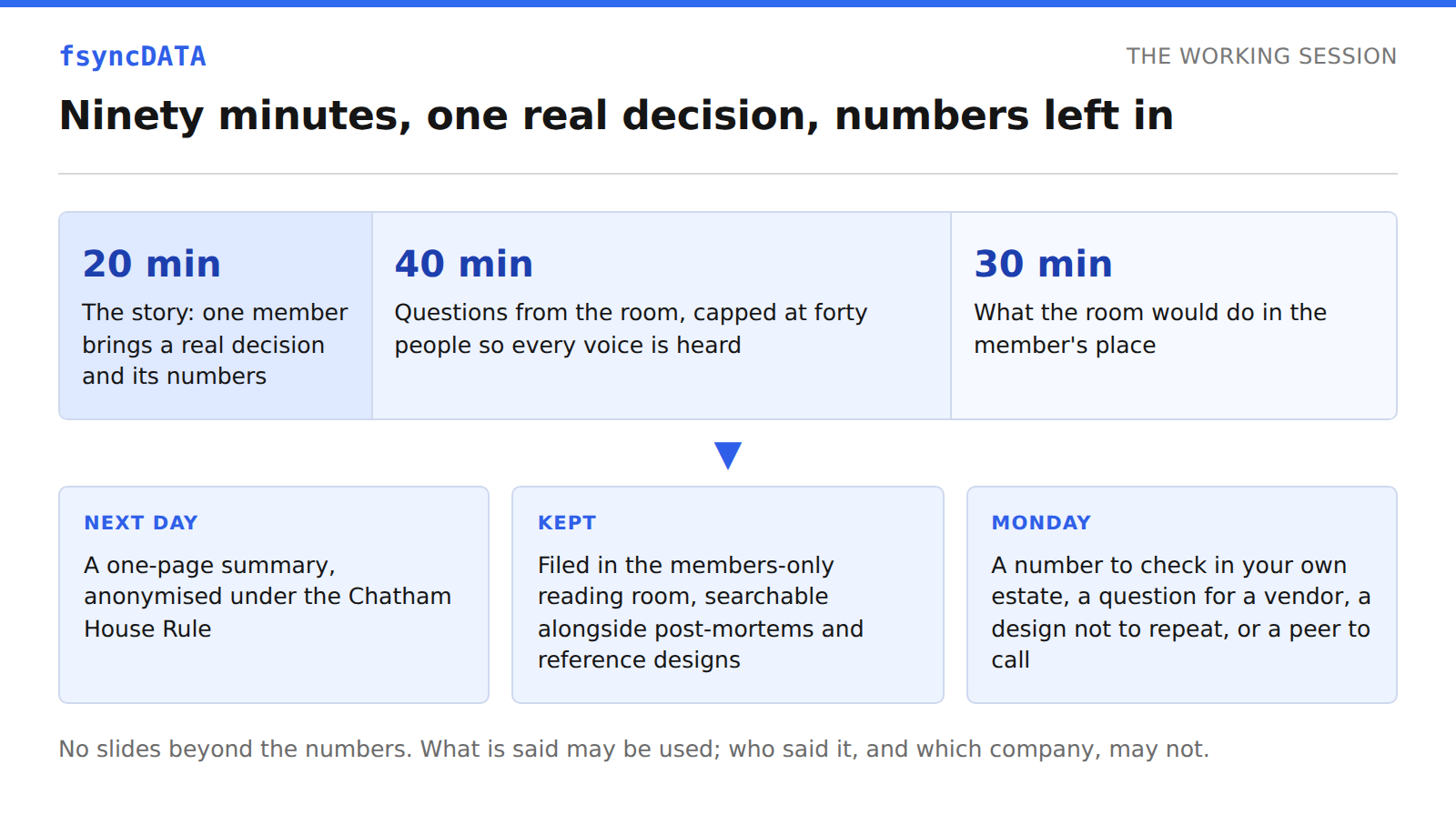
The next day an anonymised one-page summary goes to the reading room. What a member leaves with is small and usable: a number to check in their own estate, a question to put to a vendor, a design they will not repeat, or a peer to call.
A benchmark that answers “is that normal?”
Boards and parents ask that question, and few GCC leaders have an honest way to answer it for India. The GCC Data Platform Benchmark collects measures like these once a year:
- Cloud data spend as a share of the center’s cloud bill, and its growth against data growth
- Cost per terabyte processed, per platform, by estate size
- Freshness SLAs by region and how often they are missed
- Senior data engineer and DBA attrition, by city and sector
- Platform mix and migration intent for the coming year
- On-call load and incident counts per platform
- Share of centers owning the platform budget outright
- DPDP and AI-foundation readiness, self-assessed
The method is part of the benefit. Responses are held on India-resident infrastructure, then aggregated and anonymised before anyone sees results, fsyncDATA included. A cell with fewer than five responses is suppressed. Raw responses are deleted after aggregation, and the members’ council audits the process every year.
Principal engineers for an hour, and nothing follows
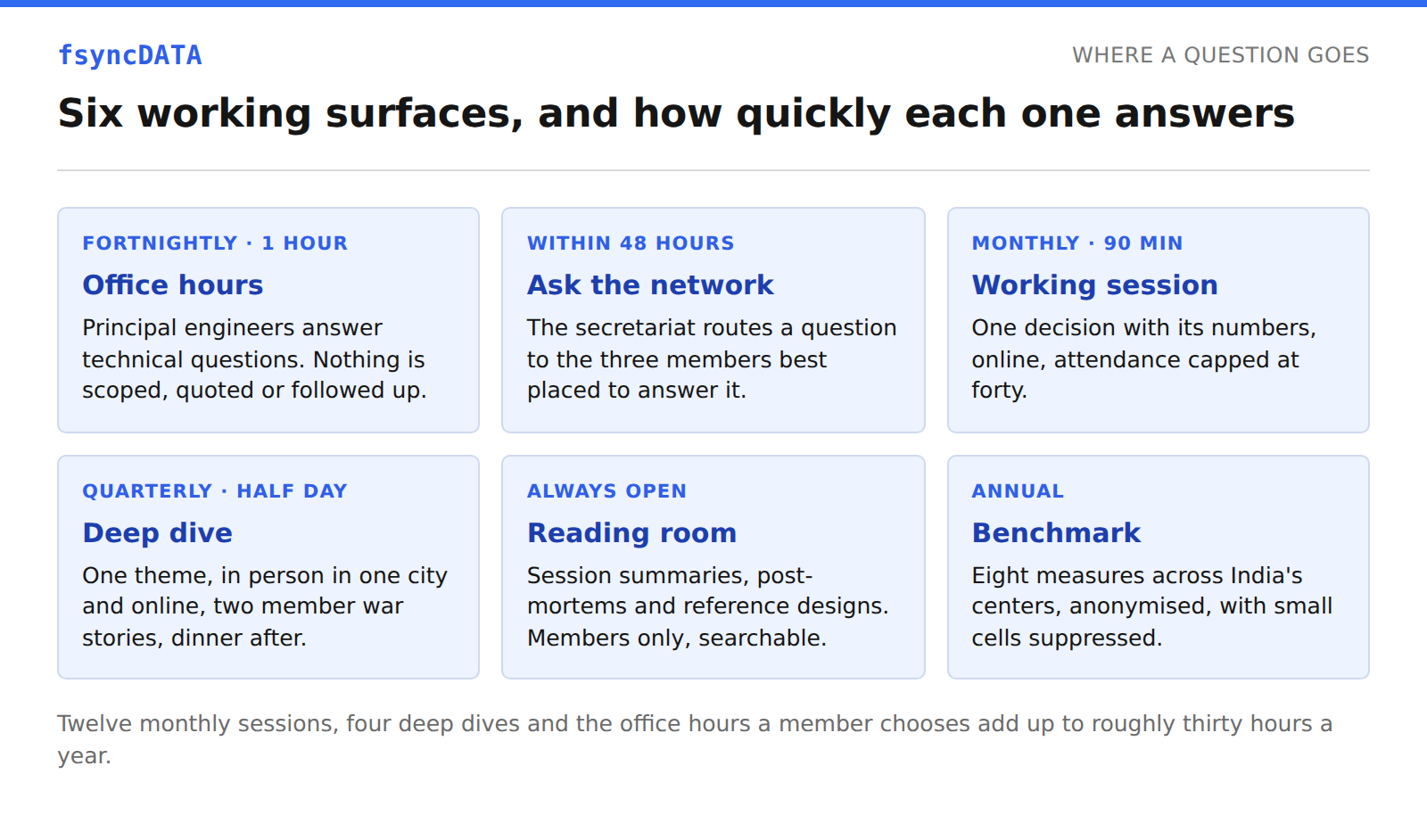
Every fortnight, principal engineers from fsyncDATA and MinervaDB hold office hours for the GCC leaders in the Circle. Questions are technical: an upgrade path, a replication topology, a cost line that does not add up. The questions and answers stay in the Circle. Nothing is scoped, quoted or followed up.
Incidents worked live, and labs you finish
The GCC leadership conferences add two formats a private room cannot hold. A break-fix session takes a real incident, anonymised where needed, and works it on stage for forty-five minutes: the alert, the first wrong hypothesis, the query that found it, the fix, the rollback that was ready, and the verification query that proved it.
Labs run ninety minutes with thirty seats, on infrastructure the conference provides. The first year’s list follows the 2027 calendar: a rolling major-version upgrade with rollback, a Kafka ZooKeeper-to-KRaft migration, a database FinOps review on a real bill, a replication and failover drill, DPDP retention and erasure design, and vector and streaming foundations for an AI charter.
For GCC leaders the labs have a second use. They are where your engineers, and the students you may hire, do the thing under supervision before they do it on your estate.
A reading room that keeps what the room learned
Session summaries, post-mortems and reference designs are filed in a members-only, searchable reading room. A leader who joins in month six can read what the room worked out in month one, with the numbers still in and the names taken out.
Professional benefits for GCC leaders
The professional return is harder to put in a table and tends to matter more over a career.
A peer network that is built, not left to the hallway
The peer network is run by the secretariat. A new member receives three introductions in the first month. A question posted to the network is routed to the three members best placed to answer, and answers arrive within 48 hours. Four cities hold quarterly dinners of twelve seats each.
The test we set for it is plain. At twelve months, a member should be able to name three peers they would call before they call a vendor.
A seat that belongs to you
Membership is personal. The seat belongs to the person, not the employer, and a member who changes company keeps it. A company cannot send a substitute. For GCC leaders whose careers will span several centers, the network moves with them.
The whole decision chain at one table
Most forums for GCC leaders seat one role, and each role agrees with itself. The Circle seats the full chain: the site leader with the HQ view, the CDO with the board’s questions, the chief AI officer with a charter to honour, the CIO with the vendor map, and the principal architect who knows what production does at 3 a.m. It is the conversation that is hard to have at work.
Standing with the parent
Two of the ten themes are about the relationship with HQ: taking platform ownership, and earning a seat at the parent’s platform council. Members hear how other centers did both, and the benchmark gives them a number to bring to the next budget cycle.
A stage for your work, on fair terms
The conference stage is for practitioners. Vendors speak from the floor and the labs. A practitioner committee reviews outlines and replies within three weeks. Accepted speakers get a preparation call, a slide review that removes nothing but logos, help anonymising an estate, and travel within India covered where the center is not funding it. Speakers keep their material and their recording rights.
A say in the rules
Members review and amend the charter at the annual assembly each October, elect the members’ council and decide how many seats open each year. The process is set out in how a Circle seat is filled.
Successors and hiring
The peer network includes successor visibility, so the people who will hold these roles next are known to the room. Partner colleges receive lab seats at each conference edition and the three learning tracks for a cohort. A final-year student who has upgraded a production-shaped cluster, watched it fail over and rolled it back has done something few graduates have touched.
What each role takes away
The same programme returns different things to different GCC leaders.
| Role | Technical return | Professional return |
|---|---|---|
| GCC site leaders | Benchmark figures on platform budget ownership; sessions on portfolio ownership with the numbers in | How other centers won platform ownership and kept it; a case to take to HQ |
| Chief data officers and chief data and analytics officers | What the platform needs before analytics and AI charters can be honoured; DPDP retention, erasure and breach-telemetry design | An honest answer when the board asks whether a number is normal |
| Chief AI officers and chief data scientists | Vector, streaming and governance foundations; the freshness and lineage that models depend on | What the foundations work really took elsewhere, before programme dates are promised |
| CIOs and CTOs | The end-of-support calendar, forced against optional; cost of the data layer by platform | How centers earn a seat at the parent’s platform council, and what to bring to it |
| Principal database architects and heads of data platform | Post-mortems, reference designs, live break-fix sessions, on-call and incident benchmarks, office hours | A bench of peers on a bad day; a stage for their work; visibility as the next leader |
Opportunities the programme opens
Beyond attending, there are roles for GCC leaders to take up.
- Bring a decision. Every member contributes at least one working session, benchmark response or considered answer a year. The member who brings the decision gets forty minutes of the room’s questions on their own problem.
- Stand for the council. Seven members, elected annually: five by the Circle and two by the guild stewards, no two from the same company. The council owns the charter, approves nominations, hears breaches and audits the benchmark. fsyncDATA has no seat and no veto.
- Nominate peers. Every seat is filled by a member’s nomination and the council’s approval.
- Speak, run a break-fix session or lead a lab at a conference edition: thirty, forty-five or ninety minutes.
- Join the practitioner committee. Six people from India’s capability centers, refreshed each year, choose the conference programme and the labs. Their selections are final.
- Bring a college. Partner colleges are asked for a faculty contact, a cohort that completes the track and honest feedback. They are not asked for a fee.
- Sponsor or exhibit at the conferences, on published terms that are the same for every sponsor. Sponsorship buys presence on the floor. It does not buy a stage slot, the attendee list or any route into the Circle.
What it costs GCC leaders
Time first. Twelve monthly sessions, four deep dives and the office hours a member chooses come to roughly thirty hours a year, which is less than one conference trip. Dates are set a year ahead on the Circle calendar.
Money: there is no membership fee. fsyncDATA funds the secretariat, the platform, the venues and the hospitality. The price of a seat is one contribution a year and the discipline to keep the charter.
The charter has six rules: no selling; the Chatham House Rule with one strike and no warning stage; personal seats; give to get; no sponsorships and no data sales; invitation only. They bind fsyncDATA, MinervaDB and ChistaDATA exactly as they bind every member.
What we do not promise
An invitation to GCC leaders should say where it stops.
- Conference dates are published only once the venue, the lab infrastructure and the first ten practitioner speakers are confirmed, and members hear first.
- The charter is the members’ to amend at each annual assembly, so the Circle described here can change by their vote.
- The benchmark has gaps. Any cell with fewer than five responses is suppressed, so small sectors and cities may show nothing.
- Seats are limited to twelve per role and two per company. Some qualified GCC leaders wait on the reserve list until a seat opens.
- The Circle is not open to anyone in a sales, pre-sales, partnerships or marketing role at a vendor, consultancy or analytics firm, our own group included.
- Nothing heard in a session or a lab is a recommendation for your estate. What worked on one platform must be tested on yours before it goes near production, behind a disaster-recovery posture you have tested.
Who convenes it, and what we get
A club convened by a company invites the obvious question from GCC leaders: what is in it for the convener? fsyncDATA gets a better-informed practice, because our principal engineers hear, under Chatham House, what India’s centers struggle with. We get the same benchmark report as every member, and a reputation for keeping a room safe.
We do not get member contact details for commercial use, attendance lists, directory exports, raw benchmark data, the right to mention the Circle in a sales conversation, or any say over the council’s decisions.
The test is written into the rules. If a member ever receives a services approach from fsyncDATA, MinervaDB or ChistaDATA that refers to the Circle, they report it to the members’ council, the council publishes the breach to every member, and the council may dissolve the Circle.
How GCC leaders can reply
There are three ways to answer: accept, ask, or nominate someone better. If you believe a colleague belongs in the room more than you do, nominate them. The council treats that as the highest recommendation a seat can receive.
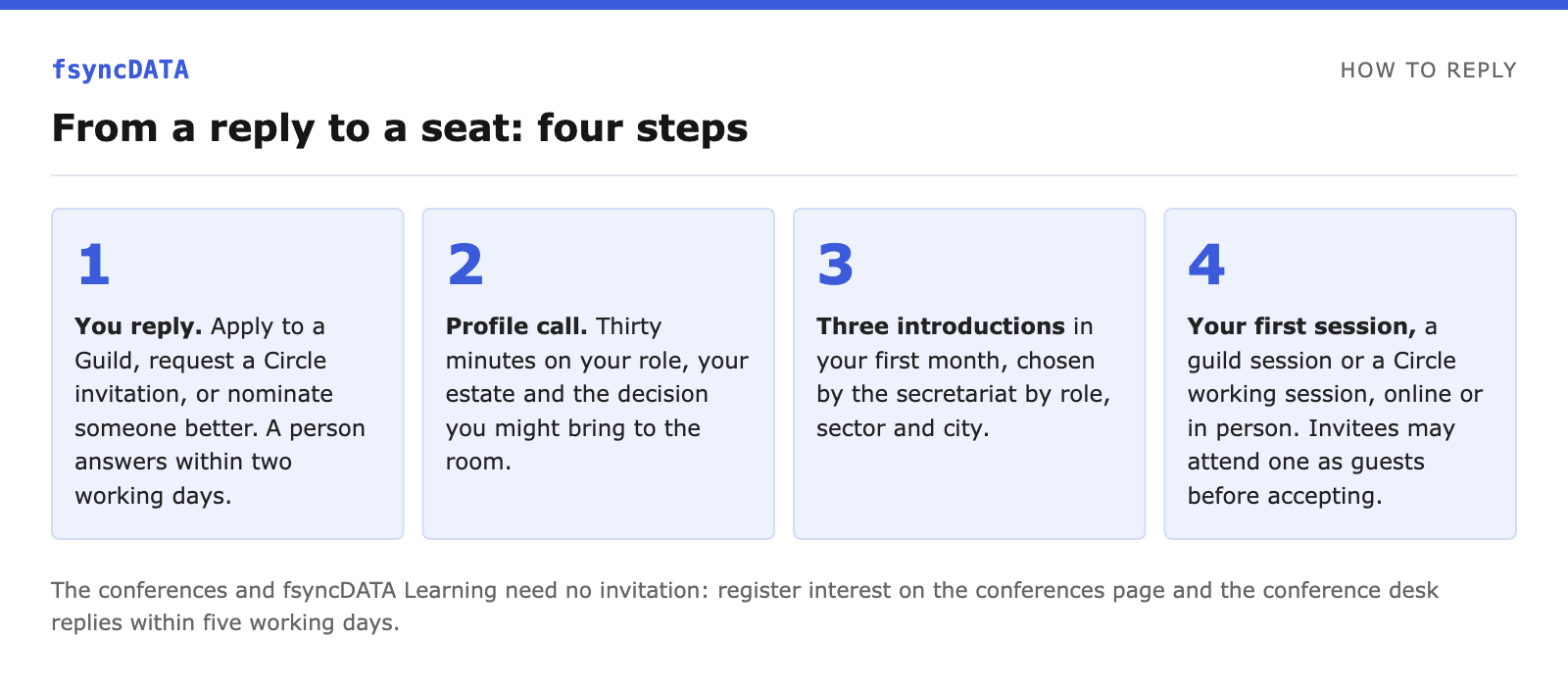
For the Circle, request an invitation. Seats are filled by nomination and the council’s approval, and invitees may attend one working session as guests before they accept.
For the conferences and fsyncDATA Learning no invitation is needed. Register interest as an attendee, speaker, sponsor, exhibitor or college, and the conference desk replies within five working days.
India’s capability centers now own the data platforms of some of the world’s largest enterprises. The GCC leaders who run them deserve a room built for them, and a public day where practitioners hold the stage. Both are open to you now.