A seat for chief data officers, and the leaders who hold the same mandate
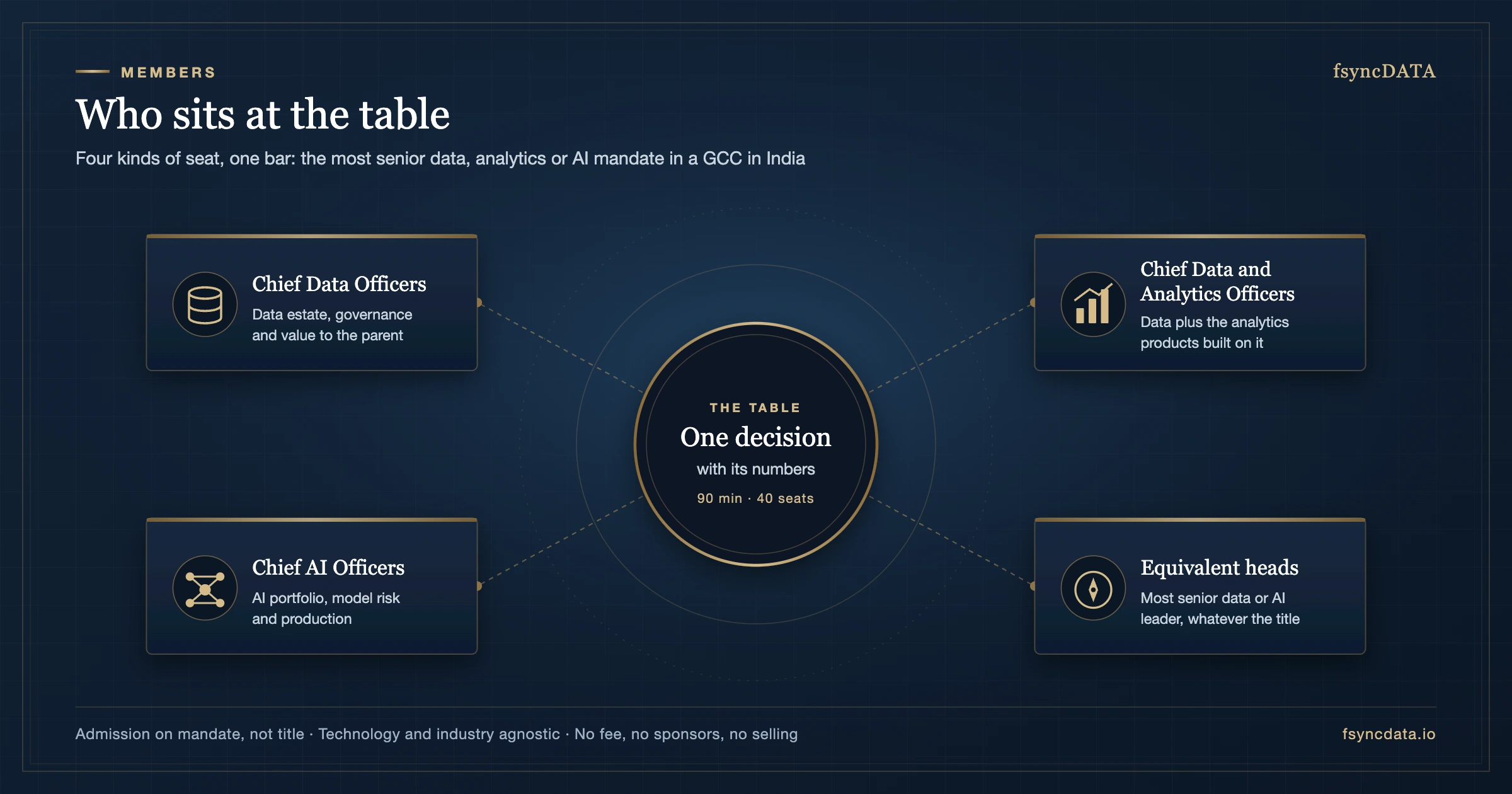
fsyncDATA admits chief data officers, chief data and analytics officers, chief AI officers and equivalent heads at India’s Global Capability Centers. The council admits on mandate, not on title: if you are the most senior person accountable for data, analytics or AI in a GCC in India, the club is built for you, whatever technology you run and whatever industry your parent serves.
Chief data officers, CDAOs, CAIOs and equivalent heads
Most centers do not use the parent’s titles. The council looks at what you are accountable for and to whom.
Chief Data Officers
Accountable for the data estate, its governance, quality and value to the parent.
- Data strategy and operating model
- Governance, privacy and DPDP readiness
- Platform roadmap and spend
Chief Data and Analytics Officers
Accountable for data and the analytics products built on it.
- Analytics product portfolio and adoption
- Self-service at scale
- Value reported to the business
Chief AI Officers
Accountable for the AI agenda, from use case to production.
- AI portfolio and funding gates
- Model risk and AI governance
- Build, buy or partner decisions
Equivalent heads
The single most senior data, analytics or AI leader of a center, whatever the title.
- Head of Data, VP Data and AI
- Head of Analytics, Head of AI
- India lead of a parent’s data or AI organisation
Why the club admits chief data officers on mandate, not title
In most parent companies the title Chief Data Officer belongs to one person at headquarters. The leader who runs the India data organisation may be called Head of Data, Vice President of Data Engineering, Director of Analytics or Site Lead for Data and AI, and still own more of the estate than anyone else in the group.
That is why the council does not read business cards. It asks three questions. What are you accountable for? Who do you answer to? Which decisions can you make without asking permission? Chief data officers with a global title and India heads with a local one often give the same answers, and both belong in the room.
The same applies to analytics and AI. Some centers have a chief data and analytics officer who owns both the platform and the products on it. Others have split the role, with a chief AI officer reporting to the CTO and a data leader reporting to the CIO. The club admits whoever sits at the top of each of those mandates in the center.
What the council will not do is admit on the strength of a title alone. A chief data officer of a small subsidiary with no team and no budget, or a consultant using the title for a client engagement, is not who the seat is for. The test is accountability, and the test is the same for everyone.
What the council looks for in chief data officers and their peers
Four tests, applied the same way to every request and every nomination.
- You hold the most senior data, analytics or AI mandate in a GCC in India, or lead the India arm of the parent’s data or AI organisation.
- You own decisions, budgets or a team, not only advice. A dotted line to a global CDO or CAIO is normal and welcome.
- You will contribute once a year: a decision brought to the table, an answer on the bench, or a benchmark response.
- You accept the club charter, including Chatham House with one strike and the ban on selling.
Technology and industry play no part in admission. Chief data officers from every stack and every sector sit together on purpose.
Who the seat is not for
The rules that keep the room candid also decide who cannot sit in it.
- Anyone in a sales, pre-sales, partnership or business development role, at any company.
- Consultants, advisers, investors, recruiters and analysts whose business is selling to GCCs, including those who once were chief data officers.
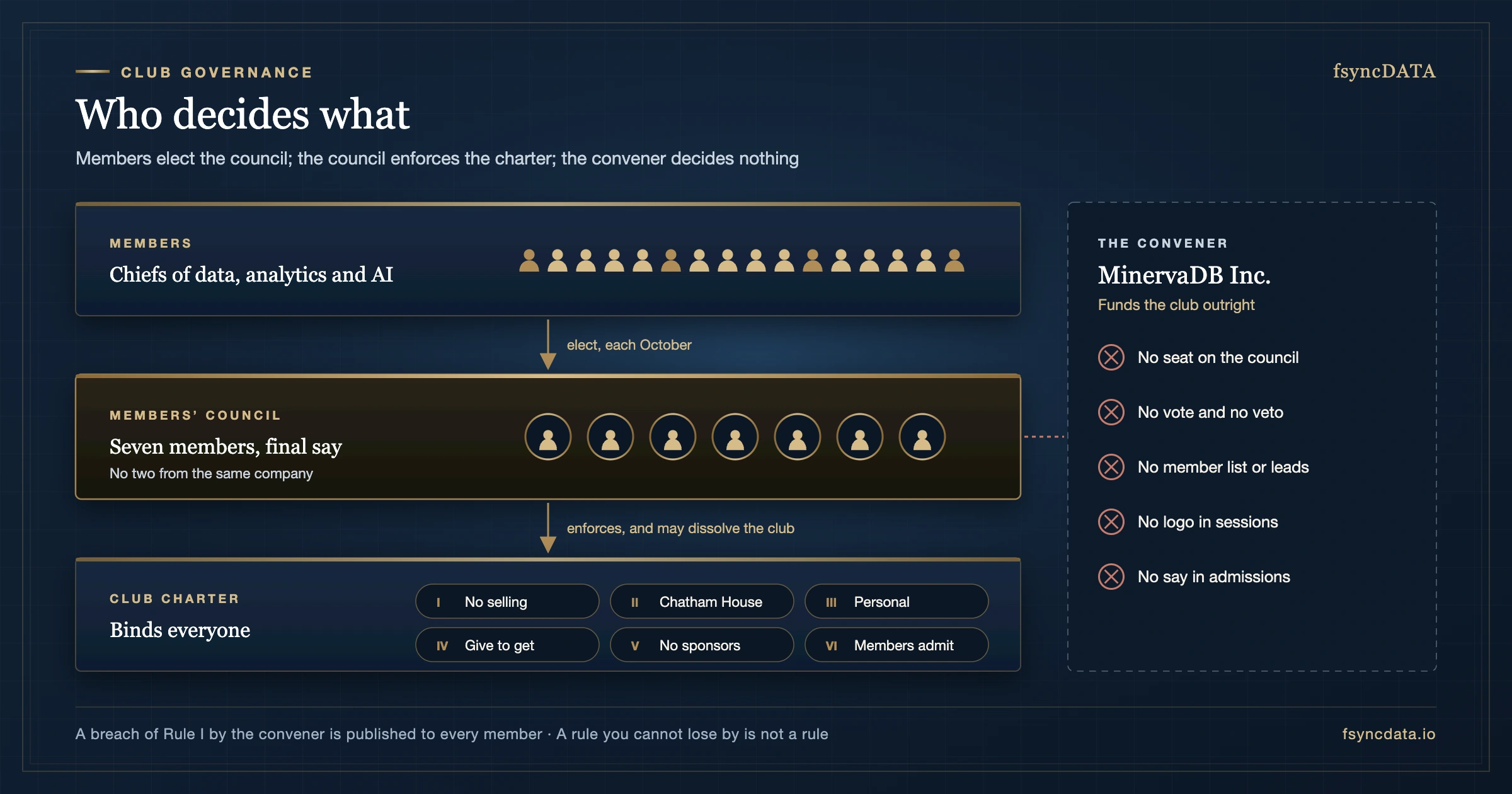
- Staff of fsyncDATA, MinervaDB Inc. and ChistaDATA. The convener has no seat.
- Deputies or nominees sent in a leader’s place. Seats are personal.
If you are unsure, ask the secretariat. A person answers within two working days, and asking does not count against you.
Three organisation shapes the council sees most often
These are illustrative patterns, not members. They show how the council decides who holds the most senior mandate in a center.
The single data leader
One leader runs data engineering, governance, analytics and the early AI work, and reports to the site head with a dotted line to the parent’s global CDO. Whatever the title, this person is the equivalent head, and the seat is theirs.
This shape is common in centers that are two to four years old, where the mandate grew faster than the titles did.
Split by data and AI
A head of data owns the platform and governance; a separate head of AI owns models, use cases and the AI portfolio. Both report to the CTO. Each holds the most senior mandate in their own area, so the council admits both.
This is the shape most likely to produce two members from one center.
Product-aligned analytics
Analytics teams sit inside business-line product groups, while a central platform team owns the estate. The council usually admits the platform owner, and asks whether one analytics leader holds a mandate across all the product groups.
If none does, the seat goes to the platform owner alone.
What each role takes from the table
The roles overlap, but the questions they bring do not. A data leader tends to ask about ownership: who decides what a customer record means, who pays for quality, and how to stop the parent from building a second platform in another region. An analytics leader asks about adoption: why one dashboard is used every morning and twenty others are ignored, and how to price self-service so that it is funded rather than tolerated.
An AI leader asks about risk and money. Which use cases survive contact with a model risk committee, how long a pilot can run before it must earn its keep, and who at headquarters will sign the decision to stop one. Equivalent heads often bring the hardest question of all: how to turn a delivery mandate into an ownership mandate without a fight with the parent.
Because every one of these questions is asked by someone who owns the answer, the conversation stays practical. Nobody is there to advise in the abstract. That is the difference members point to most often when they explain why they stay, and it is the reason the council is strict about who it admits.
What happens to what you tell the council
Admission involves sharing more about your mandate than most people put on a public profile. Here is how it is handled.
- Your request is read by the secretariat and the seven elected council members, and by nobody else.
- The company name is never shown in the member directory unless you opt in.
- A declined request is kept only long enough to answer a later one, and is never shared.
- Nothing you send is passed to MinervaDB, ChistaDATA or any vendor, for any purpose.
The same rules apply to nominations. If someone nominates you, the secretariat asks whether you want to know who it was before telling you. Many members say the nomination itself was the moment they took the club seriously, because it came from a peer who had nothing to gain from it.
The secretariat keeps admission records on infrastructure in India, under the same handling rules as the leadership benchmark. Access is limited to the people named above.
If you would rather not put details in writing, say so in your request. The secretariat will arrange the thirty-minute conversation first and take notes only with your agreement. The council has admitted leaders on the strength of that conversation alone, where the mandate was clear and a member was willing to vouch for it. What the council will not do is admit anyone it cannot verify holds the role, because every other member relies on that check having been made.
How chief data officers are admitted, step by step
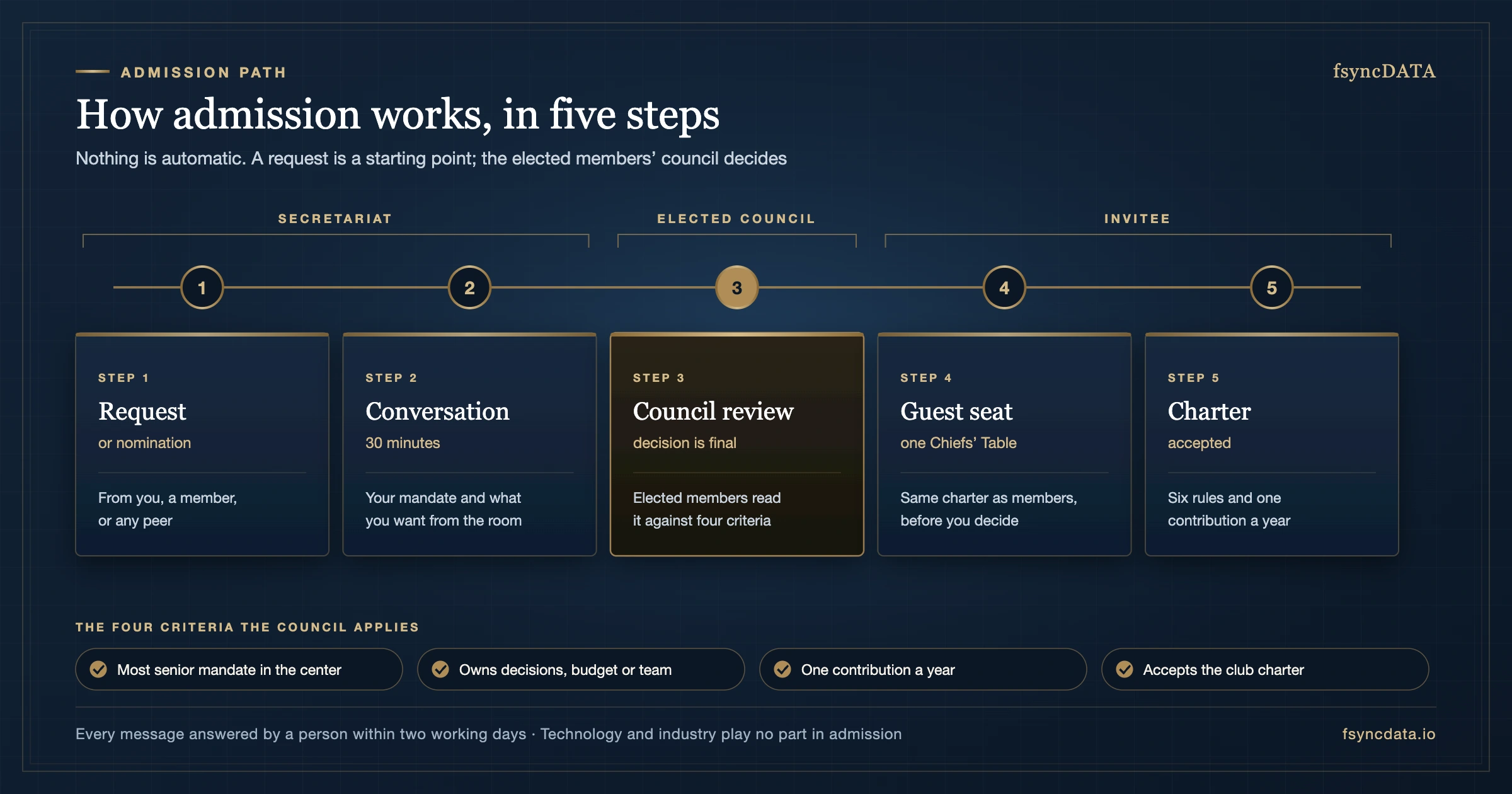
Nothing here is automatic. A request is a starting point; the elected members’ council decides, and its decision is final.
Request or nomination
Request an invitation yourself, or be nominated by a member or a peer. Both reach the secretariat, and both are read by a person.
A conversation
Thirty minutes with the secretariat on your mandate and what you want from the room. No sales staff take part, and nothing you say is recorded outside the club.
Council review
The elected members’ council reads the request against the four criteria and approves or declines. It does not have to give reasons, but it usually does.
One table as a guest
Invitees may sit in on one Chiefs’ Table before they decide, under the same charter as members.
Accept the charter
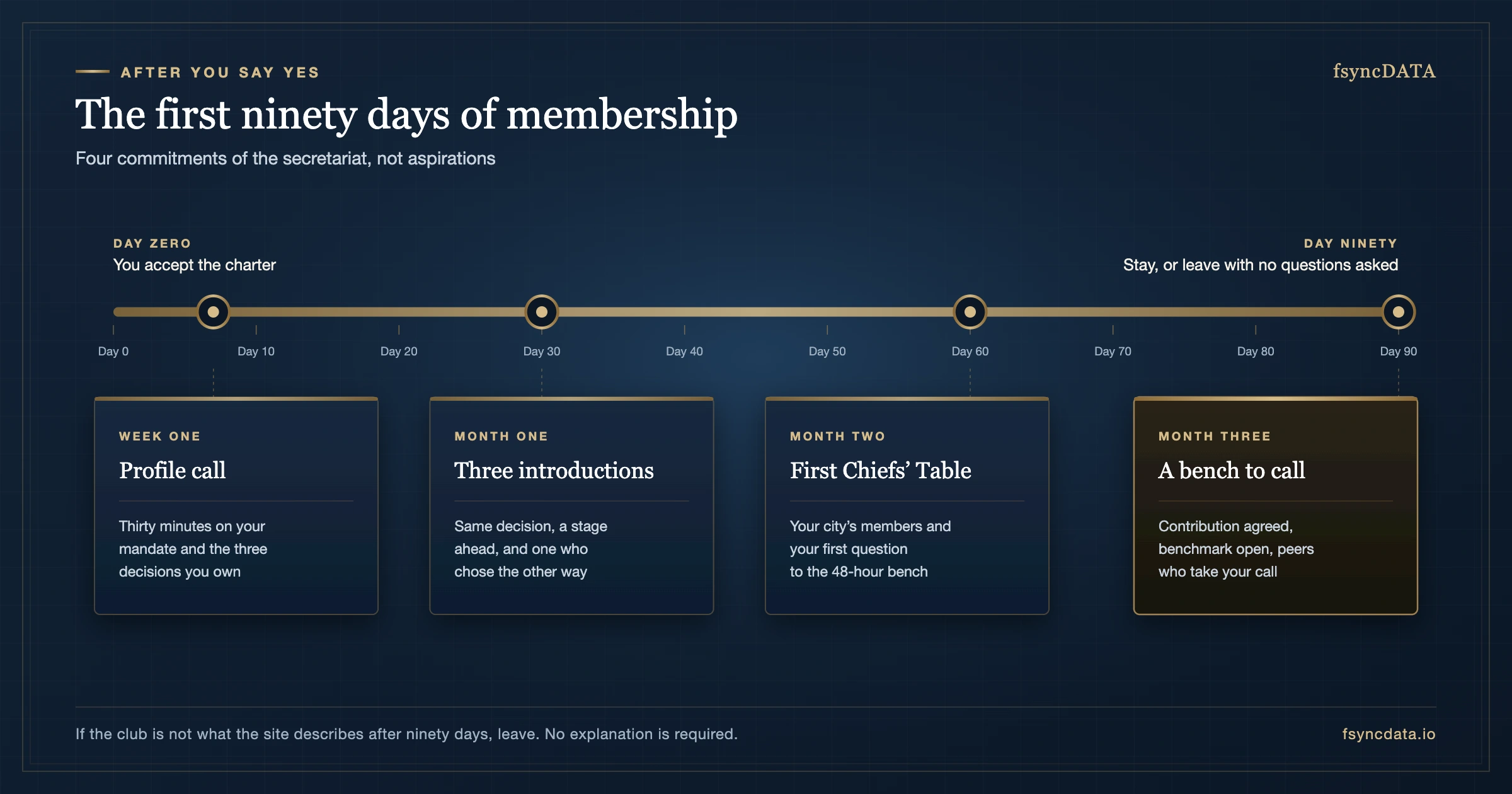
You accept the six rules and agree your contribution for the year. Your first ninety days begin.
Why chief data officers sit at one table as guests first
A seat is a commitment of time and candour. The club would rather you saw the room before you made it.
Every invitee may attend one Chiefs’ Table as a guest. You sit at the table, hear one member bring one decision with its numbers, and take part in the questions. You are bound by the club charter for that session exactly as a member is, which means Chatham House with one strike and no selling.
Most chief data officers decide within a week of that session. Some decide the room is not for them, and that is a good outcome too. A seat filled by someone who does not want it costs the other members more than an empty one.
If the timing of the next table does not suit you, the secretariat will offer the one after. There is no deadline on an invitation once the council has approved it, though the council may review it again after a year if your role has changed.
When chief data officers change roles
Membership is personal, so it follows the person. What it does not follow is a move into selling.
You move to another GCC
Membership moves with you. The council notes the change; nothing else is required.
You move to a parent or global role
You remain a member while you keep accountability for data, analytics or AI in India.
You move into a selling role
Membership lapses on the day you start. The club charter does not bend for former members.
Chief data officers move more often than most executives, and the club is designed for it. Because membership belongs to the leader rather than the employer, the trust you have built with your peers does not reset when your business card changes. Tell the secretariat when you move; the council simply updates its record.
What chief data officers give back each year
One contribution a year keeps the room useful for everyone in it.
- Bring one decision you own to a Chiefs’ Table, with its numbers
- Answer a peer’s question on the 48-hour bench
- Respond to the members-only leadership benchmark
- Host or co-host a quarterly deep dive in your city
Any one of these counts. Most members do more than one without being asked, because the value of the club comes from what chief data officers and their peers are willing to put on the table. A member who takes without giving for two years running is asked by the council whether the seat is still right for them.
What membership asks of chief data officers in time and money
Membership is free. There is no joining fee, no annual fee and no premium tier coming. MinervaDB Inc. funds the secretariat, platform, venues and hospitality outright, and the club charter forbids sponsors, so there is nobody else to pay for it either.
Time is the real cost. Members spend about thirty hours a year in the club: the monthly Chiefs’ Table when they can make it, one quarterly deep dive, the annual assembly in Bengaluru each October, and one contribution. Chief data officers tell the secretariat that the hours they spend on the bench save them more than that elsewhere, but that is for you to judge after ninety days.
Questions chief data officers ask about eligibility
I am a chief data officer at the parent, based outside India. Am I eligible?
The club is for leaders who hold the data, analytics or AI mandate in India. If you lead the India arm of the parent’s data organisation from outside the country, ask the secretariat; the council has admitted leaders in that position before when the India mandate is theirs.
Our center has a CDO and a CAIO. Can both join?
Yes. Each of them holds the most senior mandate for their own area. The council admits both, and they sit as equals with every other member.
I lead data engineering, not the whole data function.
Then the seat probably belongs to the person you report to. If nobody in the center holds a wider mandate than yours, you may be the equivalent head. Tell the secretariat how the organisation is drawn and the council will decide.
Can I nominate someone instead of applying myself?
Yes, and the council treats a nomination from someone who could have taken the seat as the strongest recommendation there is.
What if I am declined?
You may ask again after twelve months, or sooner if your mandate changes. A declined request is never shared outside the council and the secretariat.
Is the club governed by MinervaDB?
No. MinervaDB convenes and funds it. Members run it through an elected council on which MinervaDB has no seat and no veto. See club governance.
Request an invitation, or nominate chief data officers you respect
Leaders request an invitation; anyone may nominate a peer. Read the Chatham House Rule the club follows, and the club charter that adds a one-strike rule to it.
Every message to the secretariat is answered by a person within two working days.