The rules that protect the room, including from us
The fsyncDATA club charter is six rules that bind every member and the convener equally. They exist so that a chief can say what headquarters really thinks and what a programme really cost, without either sentence being used against them. They bind MinervaDB Inc., which convenes fsyncDATA, and its sister company ChistaDATA, exactly as they bind every member.
The six rules of the club charter
Short enough to remember, strict enough to matter. There are no exceptions and no warning stage.
- No selling. None.No pitches, demonstrations, recruiting approaches or follow-up emails to anyone met through the club. It binds members, fsyncDATA, MinervaDB Inc. and ChistaDATA alike.
- Chatham House, one strike.What is said may be used; who said it, and which company, may not. One attributed leak ends membership permanently. There is no warning stage.
- Membership is personal.It belongs to the leader, not the employer. A company cannot send a substitute, and a seat is never delegated to a deputy.
- Give to get.Each year every member brings at least one decision to the table, answers a peer on the bench, or responds to the benchmark.
- No sponsors, no data sales.The club takes no sponsorship money and sells no member data, lists or benchmark responses, to anyone, ever.
- Members admit members.Seats are filled by nomination or by request, and every admission is approved by the elected members’ council.
Why the club charter exists
A club is only as useful as what its members are willing to say in it. Most forums for senior data and AI leaders fail on that test, not because the people in them are guarded by nature, but because the room gives them good reasons to be. There is a vendor in the audience, a recording running, or a competitor who might repeat a number to the wrong person.
The club charter removes those reasons one by one. It bans selling, so nobody is in the room to win a deal. It applies Chatham House with a one-strike rule, so anything said can be used but never attributed. It makes membership personal, so nobody speaks for an employer. And it puts enforcement in the hands of an elected members’ council, so the convener cannot bend the rules in its own favour.
The result is a room where the numbers stay in. Members describe it as the one place where they can say what a decision really cost, and hear the same from peers. That is the whole value of the club, and the club charter is what protects it.
It is deliberately short. Six rules fit on one page and can be read in two minutes, which means every member can hold all of them in mind during a conversation. Longer codes of conduct tend to be read once at signing and forgotten; a short one is remembered because it is used.
It is also deliberately strict. A rule with a warning stage invites people to test where the line is. A rule with one strike asks them to stay well back from it. Members tell us that the strictness is what makes them comfortable, because it is the same for everyone in the room, including the people who pay for it.
What each rule of the club charter means in practice
I. No selling
No pitches, product demonstrations, “quick intros to what we do”, recruiting approaches or follow-up emails offering services to anyone met through the club. The rule applies to members, to fsyncDATA, and to MinervaDB Inc. and ChistaDATA. A member who works for a company that sells to GCCs may still be a member if their own role is not a selling one, but the rule follows them everywhere the club does.
II. Chatham House, one strike
What is said may be used; who said it, and which company, may not. One attributed leak, however small, ends membership permanently. There is no warning stage, because a warning would mean that one leak had already happened. Members are asked to think before repeating anything outside the room, and most simply do not.
III. Membership is personal
Membership belongs to a person, not an employer. A member who changes company keeps it. A company cannot send a substitute, and a seat is never delegated to a deputy. This is why members speak for themselves rather than for their organisation, and why the room stays candid.
IV. Give to get
Each year every member contributes at least one decision brought to a table, a considered answer on the bench, or a response to the leadership benchmark. The rule keeps the club from becoming an audience for a few speakers. Members who give nothing for two years are asked whether the seat is still right for them.
V. No sponsors, no data sales
The club takes no sponsorship money and sells no member data, lists or benchmark responses, to anyone, ever. MinervaDB funds the secretariat, venues and hospitality outright. Members may host a deep dive in their own office, but hosting buys nothing.
VI. Members admit members
Seats are filled by request or nomination, and every admission is approved by the elected members’ council. Neither fsyncDATA nor MinervaDB can admit anyone. The council admits on mandate, not title, and its decision is final.
Six situations members ask about
Rules are easiest to understand in use. These are illustrative situations, not records, with the answer the council has given when asked.
A supplier asks for an introduction
A member is asked by a supplier they trust to introduce them to other members. The answer is no. Members may tell peers on the bench what they use and why, and a peer may then contact the supplier directly. The introduction itself is a sales approach through the club, and Rule I forbids it.
A member joins a vendor
A member leaves a GCC to lead data at a company that sells to GCCs. Their membership lapses on the day they start, because the role is now a selling one. They are thanked for their contribution and their summaries stay in the reading room, anonymised as before.
A figure for the board
A member wants to show their board how their AI spend compares with peers. They may use the aggregated benchmark figure and say it comes from a members-only benchmark of India’s centers. They may not name the club’s members or suggest which centers responded.
A deputy wants to attend
A member cannot attend a table and asks whether their deputy may go instead. The answer is no; seats are personal. The member may read the summary the next day, and the deputy may be nominated in their own right if they hold an eligible mandate elsewhere.
A story told at dinner
A member hears a striking story at a deep dive and wants to repeat it at an industry event. They may tell the story without any detail that identifies the person, the company or the city. If the story cannot be told without those details, it stays in the room.
A recruiter in the network
A member is asked by their own talent team to share the names of other members they have met. They decline. The directory is for members to reach each other, and using it to recruit breaches both the spirit of Rule I and the conduct the council expects.
How the club charter is enforced
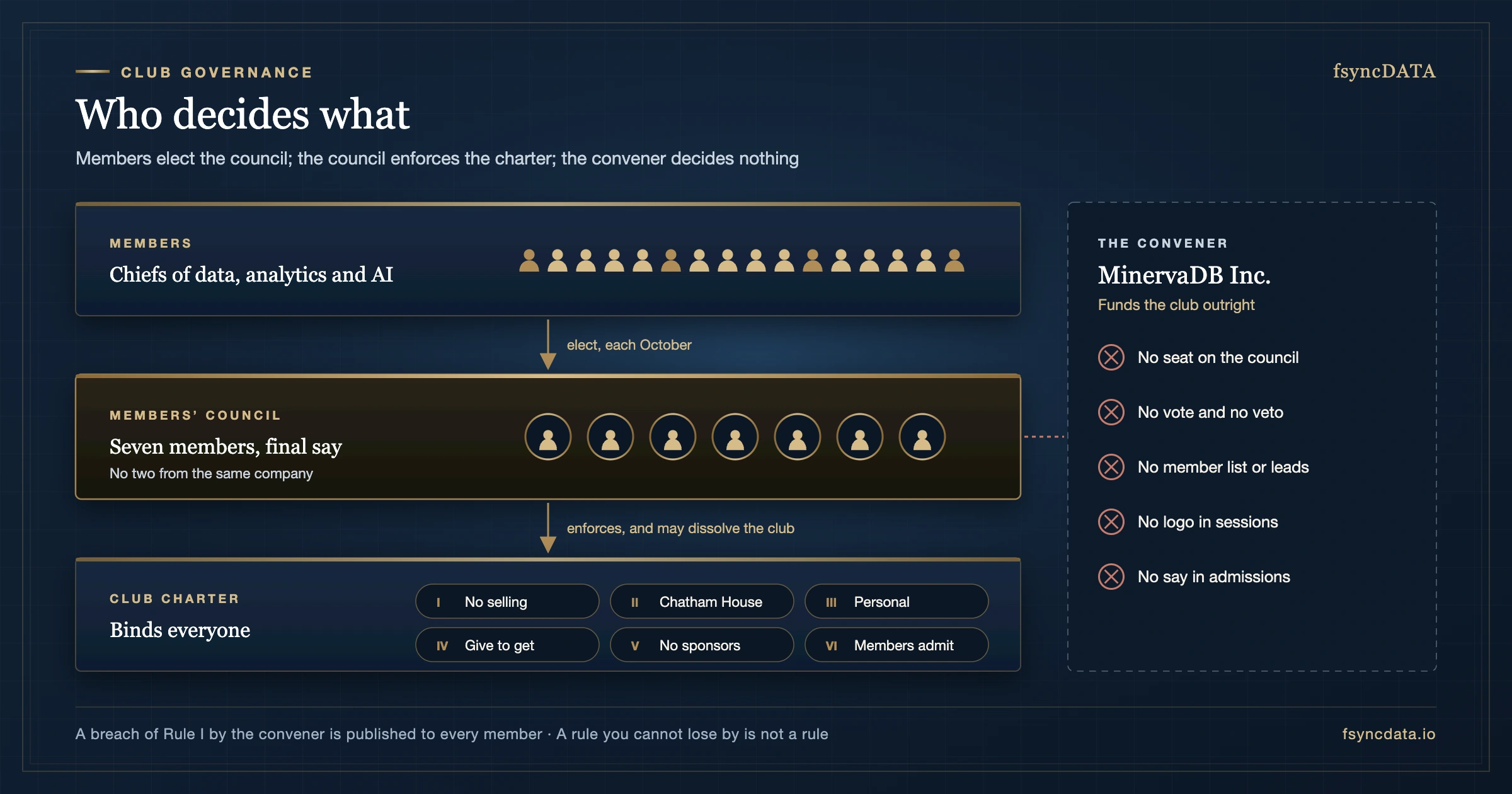
Enforcement belongs to the elected members’ council, not to fsyncDATA. The council hears any complaint and its decision is final.
A complaint
Any member may raise a complaint with the council directly, without going through the secretariat.
The council hears it
The council asks the member concerned for their account and then decides. Neither fsyncDATA nor MinervaDB takes part.
A decision
If the club charter was breached, membership ends. There is no warning stage and no appeal beyond the council.
Publication
A breach of Rule I by fsyncDATA, MinervaDB or ChistaDATA is published to every member, and the council may dissolve the club.
The Chatham House Rule, with one difference
The club charter follows the Chatham House Rule as published by Chatham House.
Under the Chatham House Rule, participants are free to use the information they receive, but neither the identity nor the affiliation of the speaker, nor that of any other participant, may be revealed. It has protected candid discussion for a century.
The club charter adds one difference: there is no warning stage. In many forums a first breach earns a reminder. In fsyncDATA, one attributed leak, however small, ends membership permanently. Members accept this when they join, and it is the reason others trust them with numbers they would not share anywhere else.
In practice, members use what they hear all the time. They take a peer’s approach to a funding gate back to their own center, or quote a benchmark figure to their board. What they never do is say where it came from.
Conduct in the room
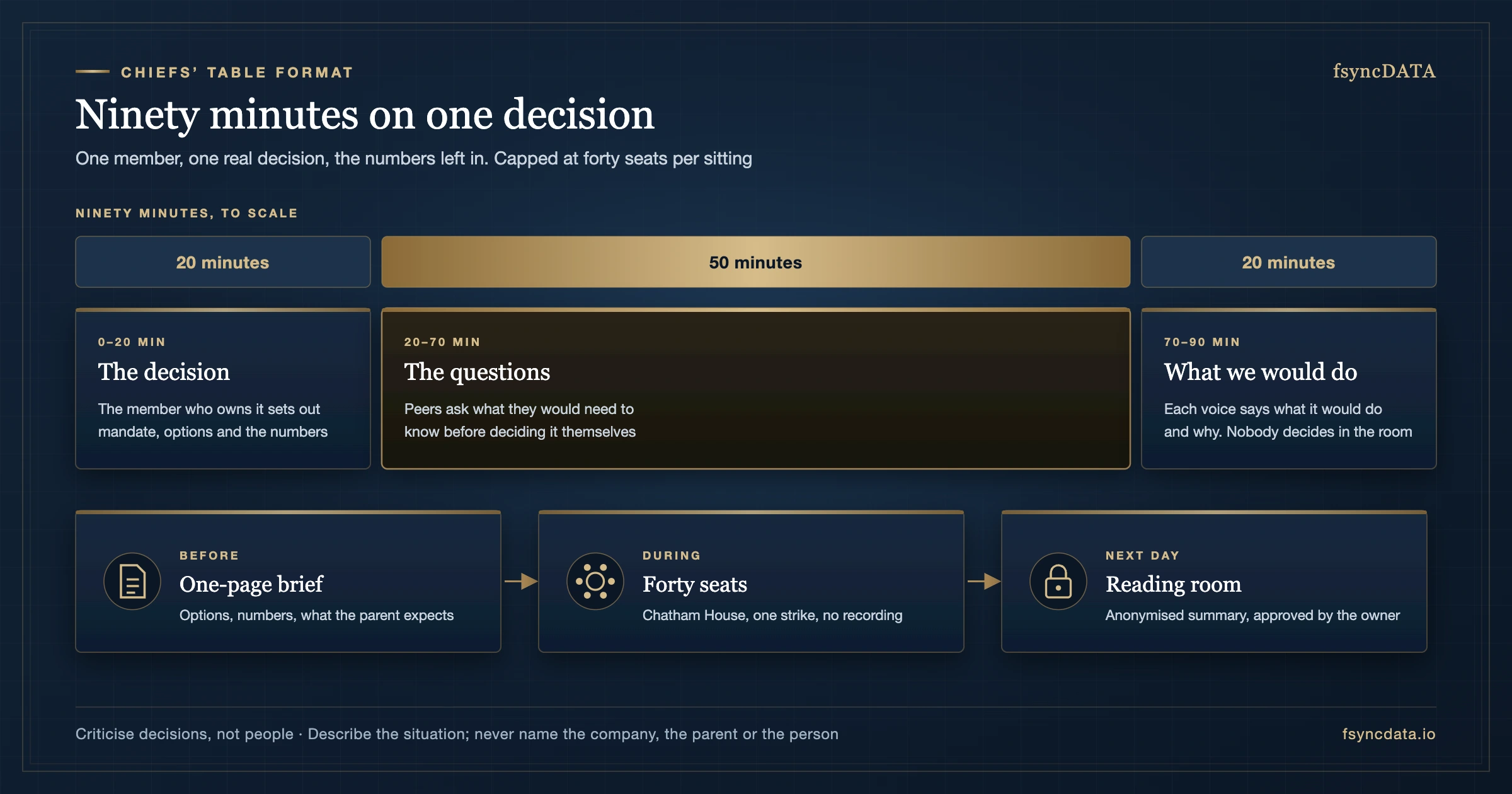
Four habits the club charter asks of every member at every session.
- Criticise decisions, not people.
- Describe the situation; never name the company, the parent or the person.
- No screenshots or recordings of tables, deep dives or the reading room.
- The secretariat never gives a member’s contact details to anyone acting for a vendor.
How the club charter binds the convener
MinervaDB Inc. and ChistaDATA provide database services. That is exactly why the rules bind them more tightly than anyone.
MinervaDB convenes fsyncDATA and funds it outright. It takes nothing back: no member list, no leads, no logo in sessions and no say in admissions. If any member receives a services approach from fsyncDATA, MinervaDB or ChistaDATA that references the club, a table or anything learned in one, the council publishes the breach to every member and may dissolve the club and take its member directory with it.
A rule you cannot lose by is not a rule. The club charter is written so that the convener can lose by it, publicly, and members can see that it would.
“The rooms I learned most in were the ones where nobody was selling. fsyncDATA is that room, and its rules bind me as tightly as they bind anyone in it.”
Shiv Iyer, Founder and CEO, MinervaDB Inc.
How the club charter shapes admission
Rule VI puts admission in members’ hands. Every new member accepts the club charter before their first ninety days begin.
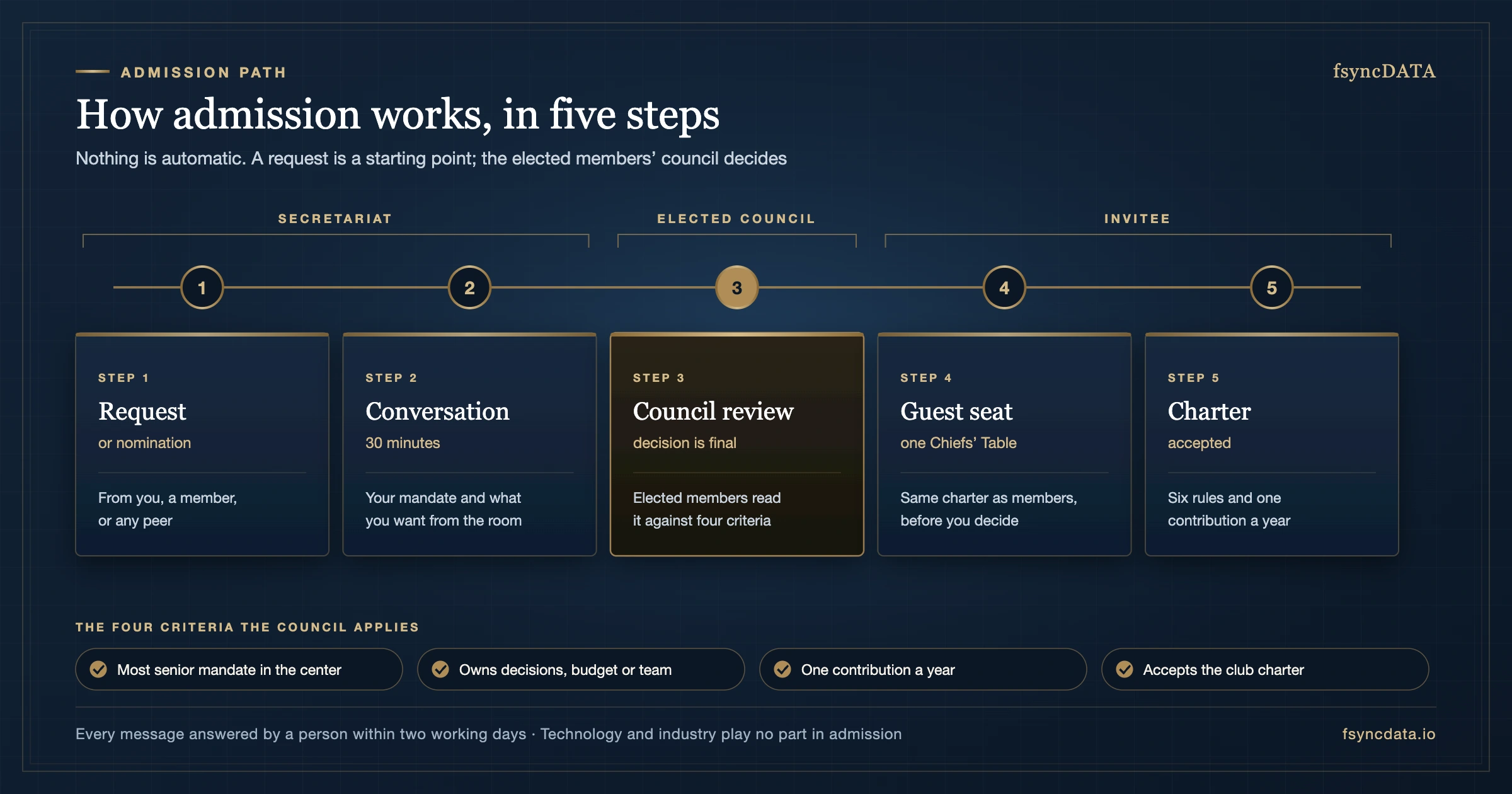
Invitees may sit in on one Chiefs’ Table before they decide, and they are bound by the club charter for that session exactly as a member is. Most people say that one session was enough to understand why the rules are strict.
If an invitee decides not to join, nothing changes for them except that they may not attend another table. What they heard as a guest remains covered by the same rules, for good.
How the club charter protects benchmark responses
Rule V means benchmark data is never sold or shown to a sponsor. There are no sponsors.
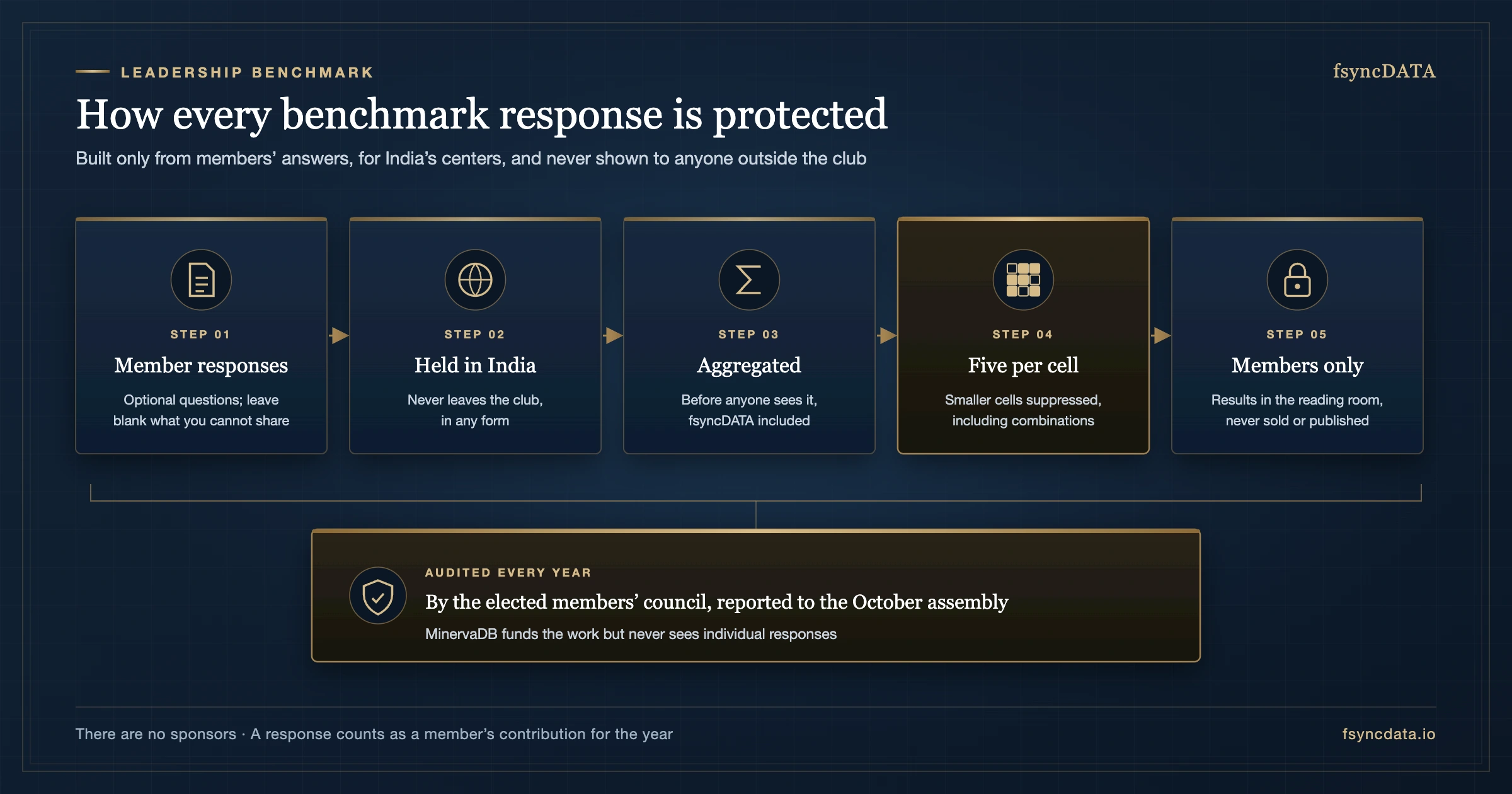
The council audits the benchmark each year and reports to the annual assembly. A response counts as a member’s contribution under Rule IV. Read how it works on the leadership benchmark page.
How members amend the club charter
The rules belong to the members. Only members can change them, and only in the open.
Any member may propose an amendment to the club charter. Proposals are circulated to every member before the annual assembly in Bengaluru each October, and are debated and voted on there. The council may propose amendments too, but it votes as members do, with no extra weight.
Neither fsyncDATA nor MinervaDB may propose or veto an amendment. The convener is told the result in the same way as everyone else. If an amendment ever weakened the rules that bind the convener, the convener would have no way to stop it, and that is how it should be.
Amendments so far have tended to tighten rather than loosen. That is not a requirement, and members are free to vote the other way. But the people who rely most on the rules are the members who share the most, and they are also the ones most likely to turn up and vote at the assembly.
What the club charter means for your data
What we hold
Your name, role, contact details and the profile you agree to share. Company names appear in the directory only if you opt in.
What we publish
Anonymised summaries in the members’ reading room, approved first by the member who brought the decision.
What we never do
Sell, license or share member data with any vendor, including the convener. See the privacy policy.
Questions about the club charter
Does the club charter apply outside sessions?
Yes. Rule I and Rule II follow members everywhere the club does: a conversation that began at a table is still covered when it continues by phone a month later.
What counts as selling?
Any approach that offers a product, a service or a job to someone met through the club. Answering a question on the bench with what you use and why is not selling; following up with a proposal is.
Can I mention that I am a member?
Yes. Membership is not secret. What is protected is who said what, and the identity of other members.
What if I repeat something without the name?
That is exactly what the club charter allows. Use what you hear; never say where it came from or who said it.
Who enforces the rules against MinervaDB?
The elected council, which MinervaDB does not sit on. A breach is published to every member and may end the club. See club governance.
What if I am unsure whether something is allowed?
Ask the secretariat or any council member before you act. Asking is never a breach, and the answer is given in confidence. Most questions are about the same few situations, which is why they are set out on this page.
Can the rules change?
Yes, by members, at the annual assembly. The convener has no vote and no veto.
Accept the club charter, and take a seat
Leaders request an invitation; invitees may sit in on one Chiefs’ Table as guests before they decide. Anyone may nominate a peer.
Every message to the secretariat is answered by a person within two working days.