The GCC Data and AI Leadership Benchmark
Every GCC data and AI leader is eventually asked “is that normal?” by a parent board. The leadership benchmark answers it for India’s centers specifically, from the members who run them, aggregated so that no one can be identified, and nobody outside the club ever sees it.
Six areas the leadership benchmark measures
Each area is chosen because members are asked about it by their parent, and because no public survey answers it for India’s centers.
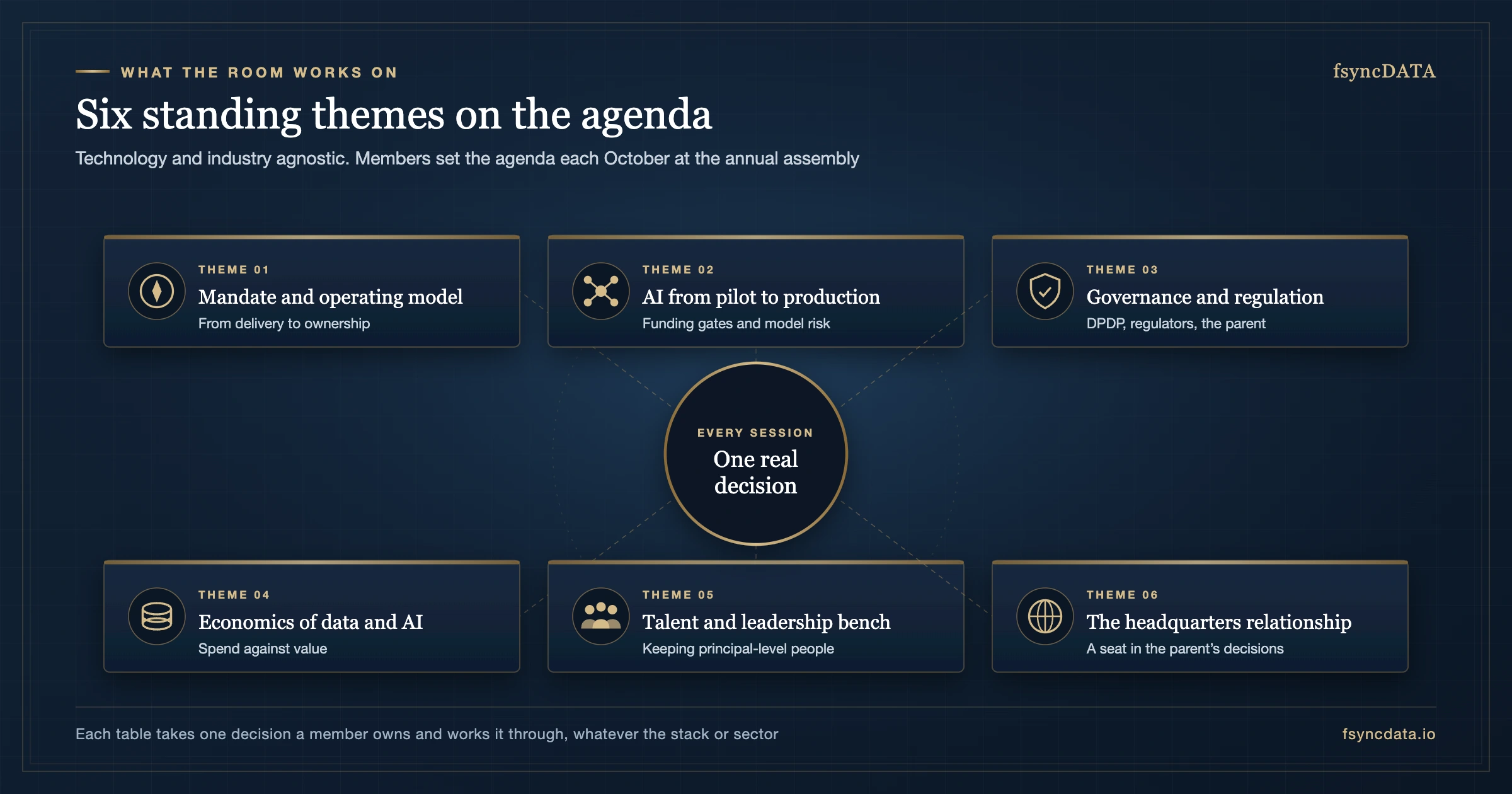
Mandate
Whether the center owns decisions or delivers them, and how that is shifting.
- Scope of the India mandate against the parent’s
- Reporting lines and decision rights
- How the mandate changed in the last year
Organisation
How centers are built, and how hard it is to keep the people who lead them.
- Size and shape of data, analytics and AI teams
- Senior talent attrition by city and sector
- Leadership bench and succession
Economics
What the estate costs, and how leaders prove it is worth it.
- Platform and AI spend against data growth
- How value is measured and reported
- Renewal and vendor concentration exposure
AI in production
How far AI has moved from experiment to operation, and who carries the risk.
- Use cases in production against pilots
- Funding gates and kill criteria
- Model risk ownership
Governance
How centers meet obligations from India and from the parent’s jurisdictions.
- DPDP readiness
- Data ownership and quality accountability
- Obligations inherited from the parent
Outlook
What the room is about to face, so the agenda can follow it.
- The three decisions members expect to own next year
- Where members expect the mandate to grow
Why members built a leadership benchmark of their own
Public surveys of capability centers tend to measure the sector: how many centers, how many people, how much revenue. They rarely measure the job of the person who leads data and AI inside one. That is the question a parent board asks, and it is the one a member most needs to answer with a number.
Analyst reports that do try are usually global, sponsored, or built from interviews with a few dozen companies in several countries. They cannot tell a leader in Pune what their peers in Pune spend, or how many AI use cases a center of their size has in production. The leadership benchmark is narrower and, for that reason, more useful.
It is also honest about what it is. It is built only from members’ own responses, it covers India’s centers only, and it publishes nothing where too few members answered to protect them. It is a tool for members to put beside their own figures, not a market study.
That honesty matters to the people who use it. A member who takes a figure to a parent board needs to be able to say exactly where it came from and what it covers. A narrow, well-described figure survives that conversation; a broad, vague one does not, however impressive it looks on a slide.
How the leadership benchmark protects every response
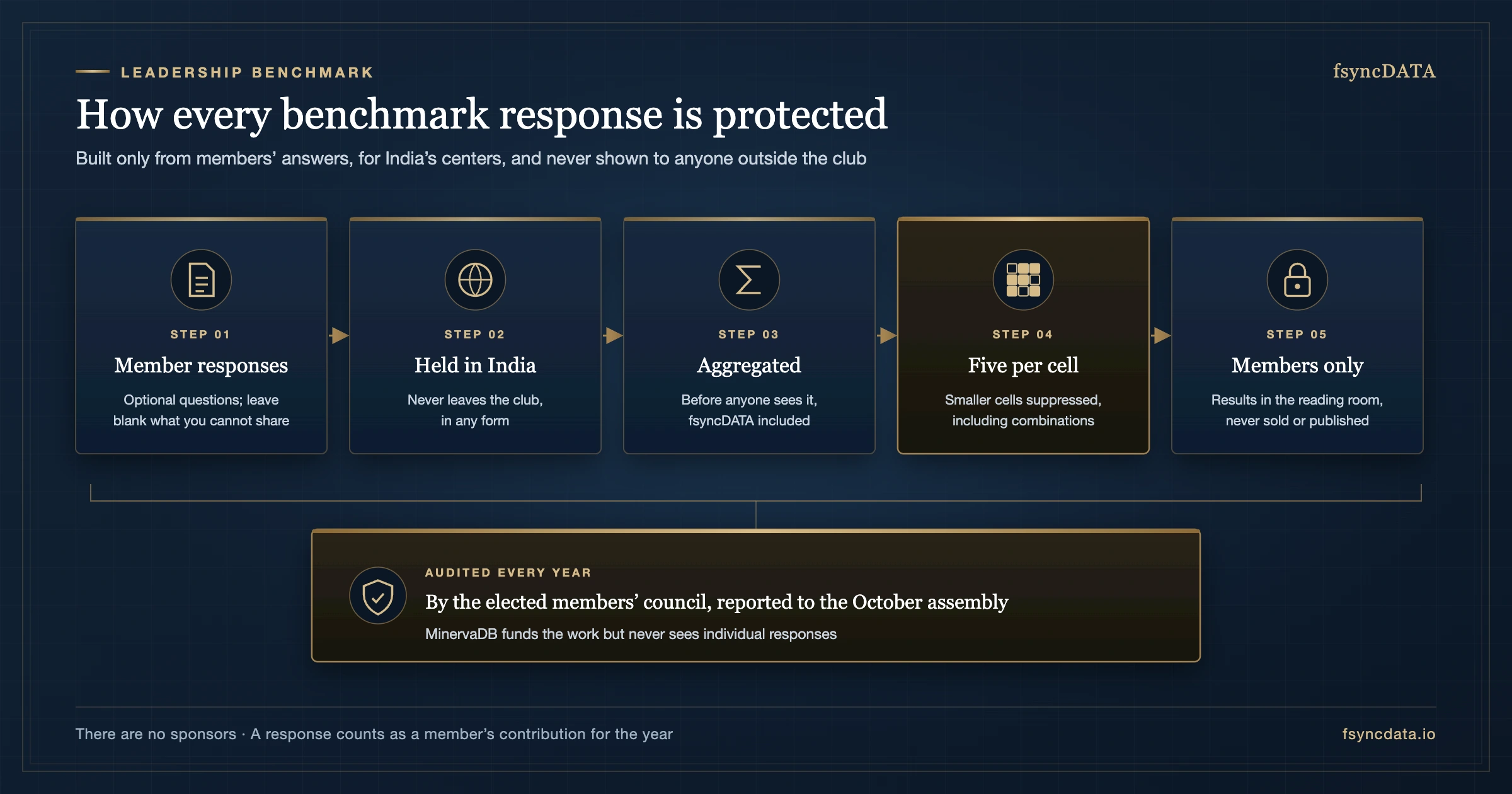
Aggregated and anonymised before anyone, fsyncDATA included, sees results.
- Aggregated and anonymised before anyone, fsyncDATA included, sees results.
- Minimum five responses per cell; smaller cells are suppressed.
- Held in India and shared only with members.
- Never sold, licensed or shown to a sponsor. There are no sponsors.
- Audited each year by the members’ council.
- A response counts as a member’s contribution for the year.
Why the leadership benchmark suppresses small cells
A cell is any combination of answers that the results could be broken down by: a city, a sector, a stage of center. The rule is simple and it is never relaxed.
If fewer than five members answered a question within a cell, that cell is not shown. A leader who is the only CAIO in a particular sector in Chennai, for example, would be identifiable from a cell of one or two. Suppressing it protects them, even though it means the benchmark shows less.
The rule applies to every cut of the data, including combinations. If a result could be narrowed to fewer than five members by combining two published figures, one of them is withheld. The council checks this before results are released, as part of its audit.
Members sometimes ask for a narrower cut than the rule allows. The answer is always no, including for the member who asks. The same rule that protects others protects you.
As membership grows, more cells reach the threshold and the results become richer. The first years will show less than later ones, and the council has chosen to accept that rather than lower the bar. Members who joined early tend to agree; they are the ones whose answers the rule protected while the club was small.
How members respond to the leadership benchmark
Once a year. The secretariat helps with any question you are unsure how to answer.
The questionnaire opens
Every member receives a link. Responses are held in India.
You answer what you can
Leave blank anything you cannot share. A blank answer is always better than a guess, and it never counts against your contribution.
Responses are combined
Results are computed only for cells with five or more responses. Smaller cells are suppressed before anyone sees them.
The council checks the results
The elected council reviews the method and the suppression before release, and reports to the annual assembly.
Members receive the results
Results go to members only, through the reading room. Nothing is published outside the club.
How results are broken down
The leadership benchmark is cut by the dimensions members say matter most, where cells are large enough to publish.
| Dimension | How it is cut |
|---|---|
| City | Bengaluru, Hyderabad, Pune, Chennai and elsewhere in India, where cells allow |
| Sector | Technology, financial services, commerce, telecom, media, health, industrial, mobility and logistics |
| Center stage | Day-1 centers, scaling centers and long-established portfolio owners |
| Role | Chief data officers, chief data and analytics officers, chief AI officers and equivalent heads |
Using leadership benchmark figures with your board
The figures are yours to use. Where they came from is not yours to share in detail.
- You may quote an aggregated figure and say it comes from a members-only benchmark of India’s capability centers.
- You may not name members, suggest which centers responded, or publish the results outside your own organisation.
- You may compare your own figure with the range, and say where you sit in it.
- If you are unsure, ask the secretariat before you present.
These rules follow from the club charter, in particular Rule II on attribution and Rule V on data sales. They are what allow members to answer honestly.
Who checks the leadership benchmark
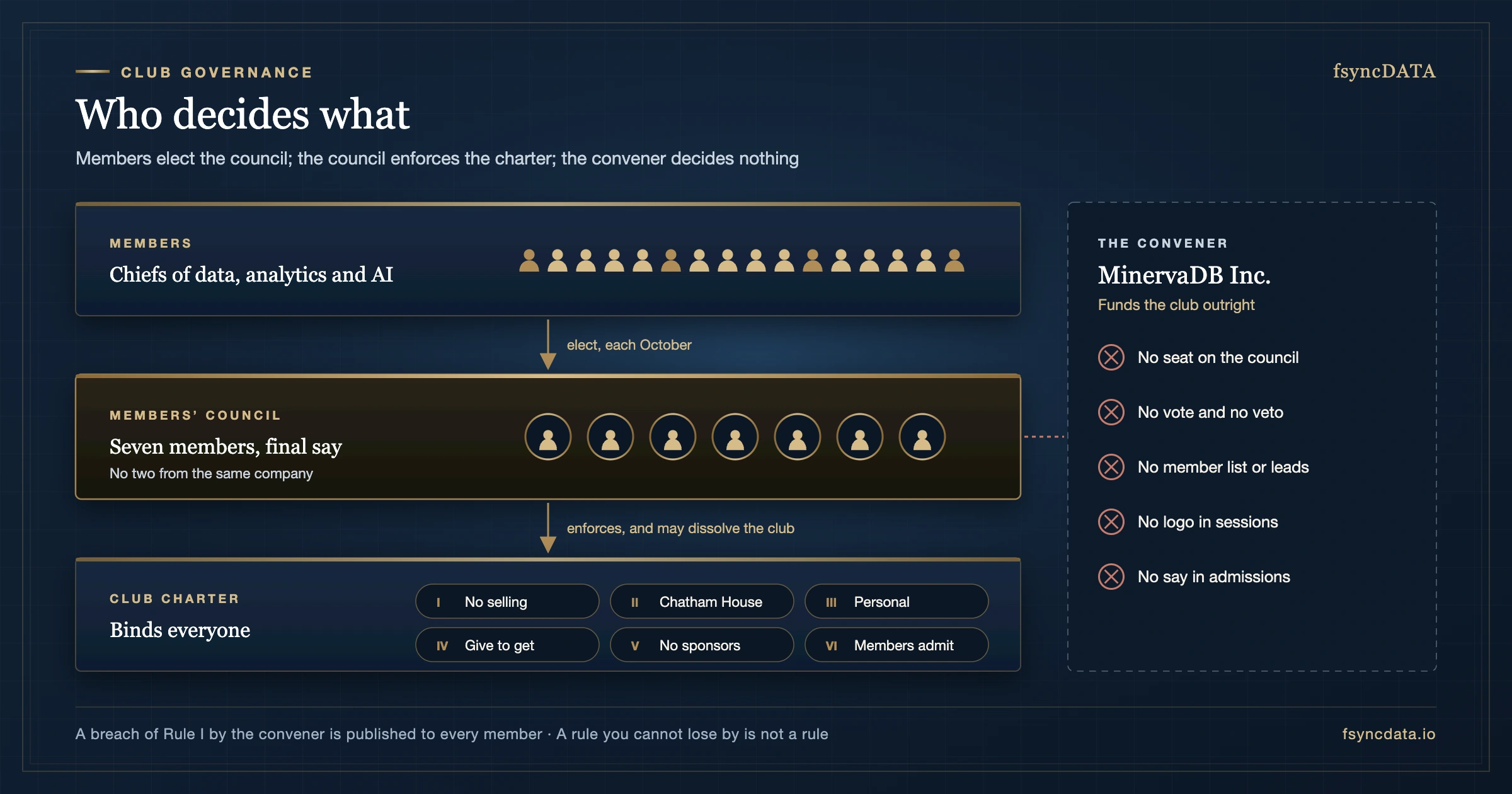
The elected members’ council audits the benchmark every year. The convener has no role in the audit and no access to individual responses.
The council reviews three things before results are released: that the method matches what members were told, that every published cell meets the five-response rule, and that nothing in the results could identify a member or a center. It reports its findings to the annual assembly in Bengaluru each October.
MinervaDB funds the work but takes nothing back. It does not see individual responses, does not receive the results in any form members do not, and may not use them in any way. If it did, the council would publish the breach to every member under the club charter.
What the leadership benchmark is not
A benchmark is only useful if its readers know its limits. These are ours.
Not a market survey
It covers members only. Members are the most senior data, analytics and AI leaders of their centers, but they are not a random sample of every GCC in India, and the results should not be read as if they were.
Self-reported
Every figure comes from a member’s own answer. The secretariat does not verify responses against company records, and the council does not ask it to. Honest answers depend on trust, which is why the protections exist.
Partial by design
Some cells will always be empty because too few members answered within them. The benchmark shows less rather than risk identifying anyone. Members who want a figure that is not shown can ask the bench instead.
Where a cell is empty, the reading room says so plainly rather than hiding the gap, so that members know the question was asked and simply did not reach the threshold.
Not for sale
The results are never published, sold, licensed or shown to anyone outside the club. That limits their reach, and it is the reason members are willing to contribute to them.
How the questions are chosen each year
The questionnaire changes a little every year, and only with members’ agreement.
Most questions stay the same from year to year, because a figure is more useful when it can be compared with the year before. A few change each year to follow what members are deciding. At the annual assembly, members name the three decisions they expect to own in the coming year; the council looks for questions that would help with the most common of them.
New questions are tested with a handful of members before they go to everyone, to make sure they can be answered without revealing more than a member is comfortable sharing. Questions that members find too sensitive to answer honestly are dropped, because a question that produces guesses is worse than no question at all.
The council publishes the final questionnaire to members before it opens, so that nobody is surprised by what they are asked. Members may propose a question at any time by writing to the secretariat. Proposals that would help several members with a decision they share are the most likely to be adopted.
Reading one result
- The question
- How many AI use cases does your center run in production, and how many pilots?
- What a member sees
- For their segment, the middle of the membership and the spread around it, for both production and pilots, and the ratio between them.
- How a member uses it
- A member whose ratio of pilots to production is far above the spread takes that to their board as evidence for a funding gate, without naming any other center.
Board questions the leadership benchmark is built to answer
These are the questions members say they are asked most often by a parent board or a global executive.
- Is our data and AI organisation the right size for a center like ours?
- Do other centers own the platform, or only run it for the parent?
- How much of our AI work is in production compared with peers?
- Is our senior attrition unusual for our city and sector?
- Who signs off model risk in other centers: the center or headquarters?
- How ready are peers for the DPDP Act and its Rules?
- What share of peers report value in revenue terms rather than activity?
Each of these maps to one of the six areas the leadership benchmark measures. Where cells are large enough, the answer is a range you can place your own figure in. Where they are not, the bench is the next best place to ask.
What members receive from the leadership benchmark
Members receive the results through the reading room, for every area and every segment where cells are large enough to publish. Each result shows where the middle of the membership sits and how wide the spread is, so that a member can place their own figure in context rather than against a single average.
The secretariat answers any question about how to read the results. Members who did not respond still see the results; the leadership benchmark is not a reward for contribution, though responding is the easiest contribution to make.
Members often bring a result to a Chiefs’ Table when it bears on a decision they own. That table runs under the club charter like any other, and its summary reaches the reading room the next day.
Where the leadership benchmark fits in the year
The benchmark runs once a year, alongside the weekly bench, monthly tables, quarterly deep dives and the October assembly.
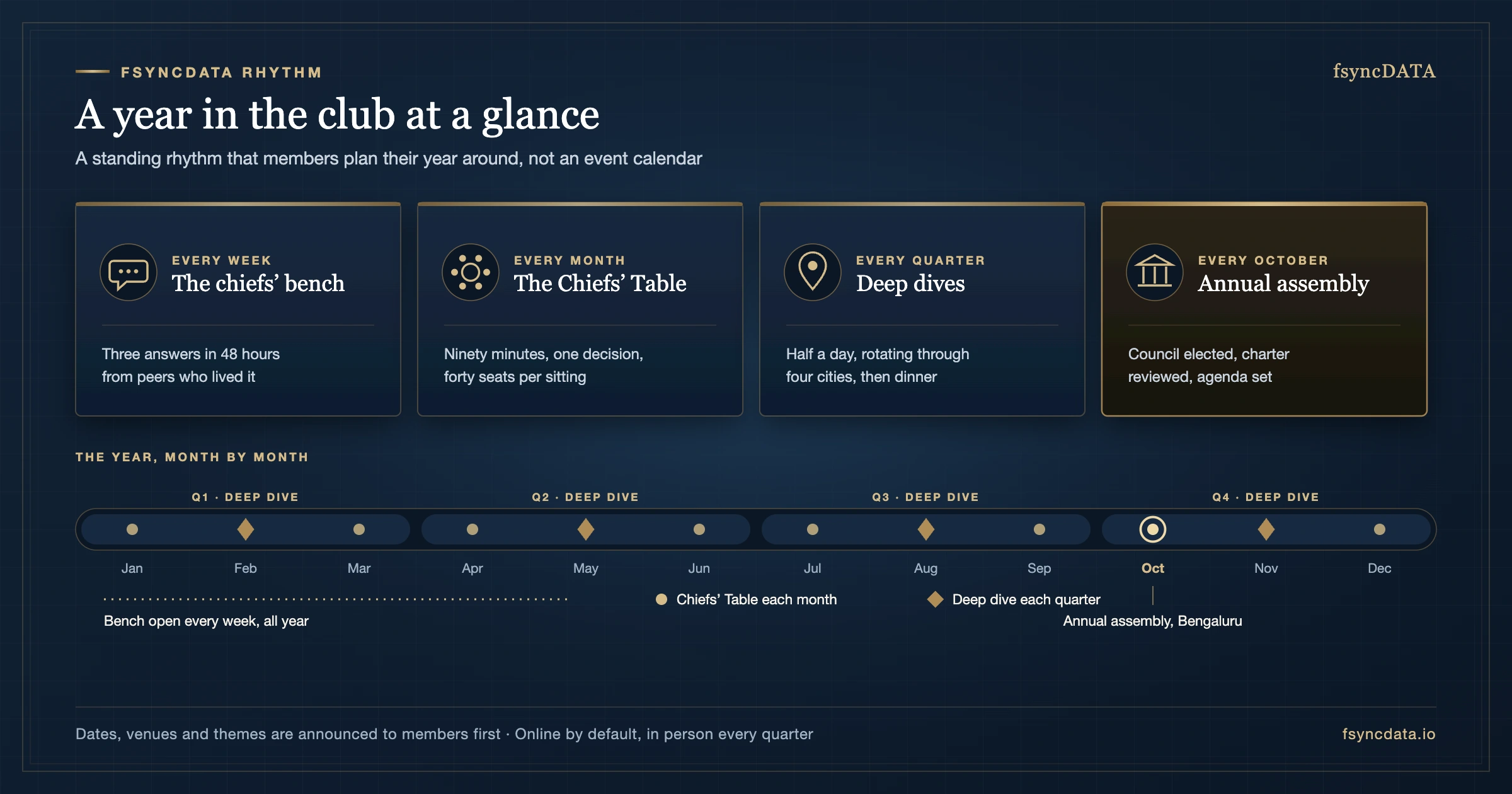
The results shape what the club works on next. Where members’ answers differ widely, the council often proposes a deep dive on that theme, because a wide spread usually means members are making the same decision in very different ways. See the leadership sessions page for the full rhythm.
Questions about the leadership benchmark
Who can see my individual answers?
Nobody in identifiable form. Results are aggregated before anyone, fsyncDATA included, sees them, and cells with fewer than five responses are suppressed.
Do I have to answer every question?
No. Leave blank anything you cannot share. A partial response is still a contribution.
Can non-members buy the results?
No. The leadership benchmark is never sold, licensed or shown to anyone outside the club. There are no sponsors.
Can I share results inside my company?
Yes, with your own leadership and board, as aggregated figures described as a members-only benchmark of India’s centers. Do not name members or publish the results.
Who audits it?
The elected members’ council, which reports to the annual assembly. MinervaDB has no role in the audit. See club governance.
How long are responses kept?
Individual responses are kept only as long as they are needed to produce and audit the year’s results and to compare with the following year. They are held in India and never leave the club in any form.
Why India only?
Because the club exists for India’s centers, and a narrower benchmark is more useful than a global one for the questions members are asked. For sector-level figures, the industry body’s research is at nasscom.in.
Request an invitation, and add your voice to the leadership benchmark
Leaders request an invitation; invitees may sit in on one Chiefs’ Table as guests before they decide. Anyone may nominate a peer.
Every message to the secretariat is answered by a person within two working days.