Leadership sessions through the year
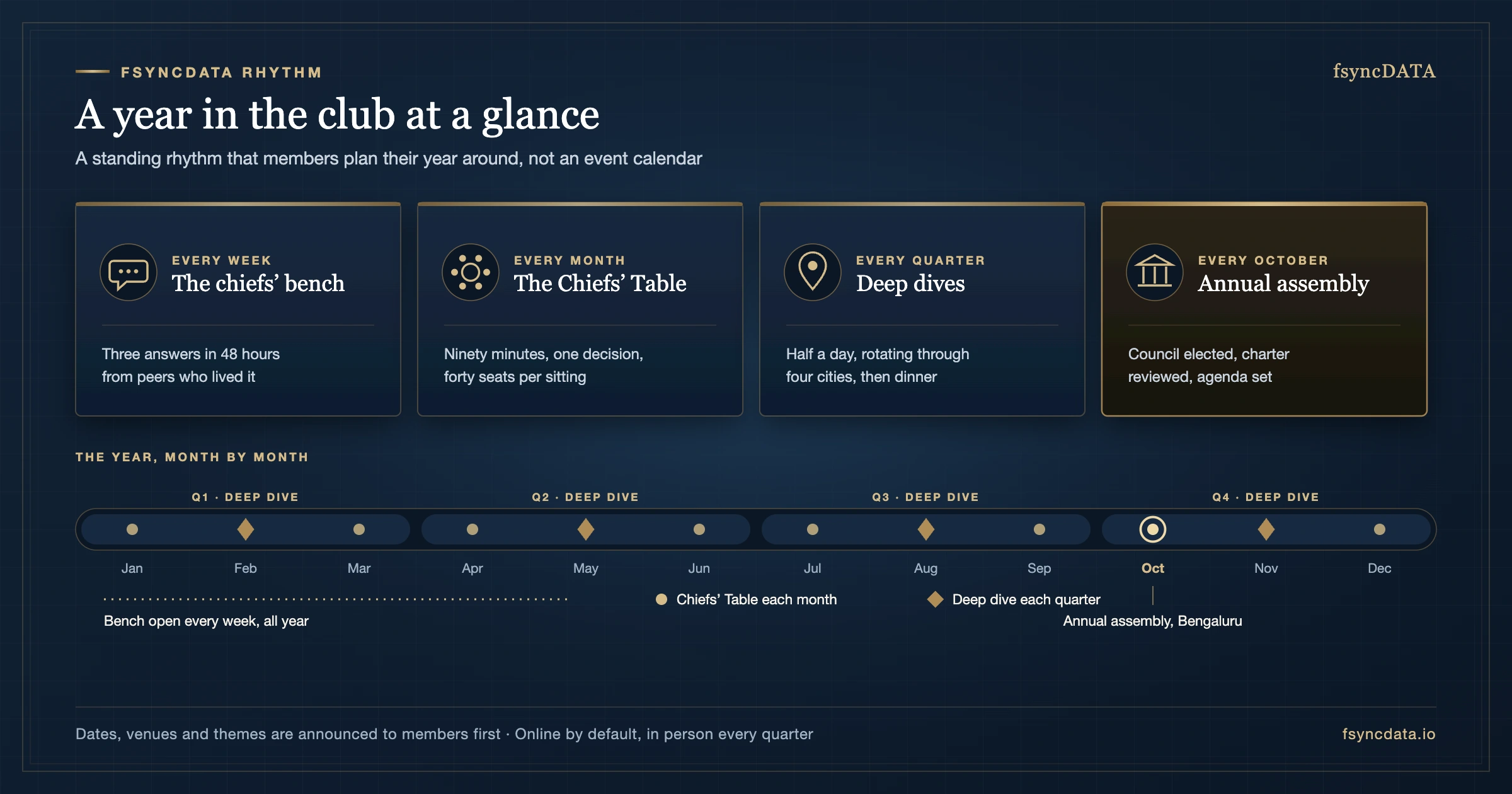
fsyncDATA runs leadership sessions to a standing rhythm that members plan their year around: a bench that answers every week, a Chiefs’ Table every month, deep dives every quarter and an assembly every October. Dates, venues and themes are announced to members first; this page sets out the shape of the year and how each session works.
The four kinds of leadership sessions
Weekly, monthly, quarterly and yearly. Each has a different job, and together they keep the club in session all year.
The chiefs’ bench
A question put to the bench is answered by three members who have faced it, within 48 hours. Questions are routed by the secretariat; answers stay in confidence.
The Chiefs’ Table
Ninety minutes, capped at forty seats per sitting. One member brings one leadership decision with its numbers. Online, with a city sitting when members ask.
Deep dives
Half a day on one agenda theme, rotating through Bengaluru, Hyderabad, Pune and Chennai, with dinner afterwards.
The leadership benchmark
The members-only benchmark runs once a year; results are released to members only.
The annual assembly
In Bengaluru. Members review the club charter, elect the council and set the agenda for the coming year.
The Chiefs’ Table: the core of our leadership sessions
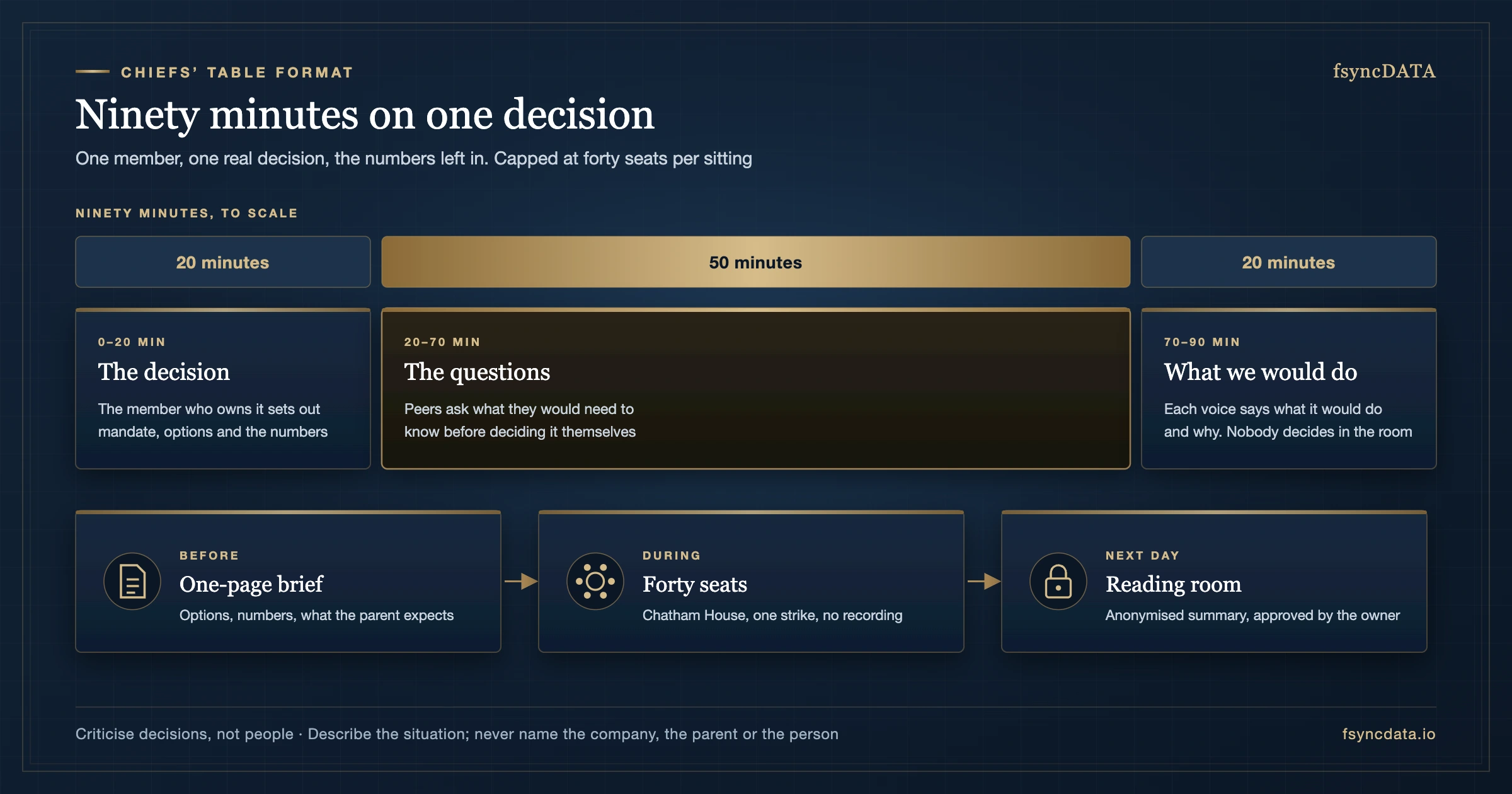
Ninety minutes on one decision. The format is fixed, so the conversation never has to be.
The Chiefs’ Table is the leadership session members value most. One member brings a decision they own and have not yet made. They share a one-page brief in advance with the options, the numbers and what the parent expects, so that the table spends its time on questions rather than context.
The session runs in three parts. Twenty minutes for the member to set out the decision. Fifty minutes of questions from the rest of the table, asked as if each person had to make the call themselves. Twenty minutes in which every voice says what it would do and why. The member who brought the decision is not asked to decide in the room.
Tables are capped at forty seats per sitting so that everyone can speak. They run online by default, with a city sitting in Bengaluru, Hyderabad, Pune or Chennai when enough members in that city ask for one. Like all our leadership sessions, they are never recorded.
Deep dives: in-person leadership sessions in four cities
Half a day on one theme from the agenda, rotating through the four cities, followed by dinner.
Deep dives are the leadership sessions where members spend the most time together. Each takes one of the six standing themes and works through it from several angles: two or three members bring related decisions, the room compares them, and the afternoon ends with a short written view of what the members present would do. The theme for each deep dive is chosen by the council from the agenda members set in October.
Deep dives rotate between cities so that members in each can attend at least one a year without travelling. Members from other cities are welcome at any of them, and the secretariat arranges hospitality for those who travel. Hosting is offered by members in their own offices; a host gains nothing beyond the chance to welcome peers.
Bengaluru
The largest concentration of GCC data and AI leadership in India, and home of the annual assembly each October.
Hyderabad
A fast-growing cluster of centers with large analytics and AI mandates across financial services, health and technology.
Pune
Strong in engineering, automotive and industrial centers, where plant and sensor data meet enterprise analytics.
Chennai
Deep in financial services, logistics and manufacturing, with long-established centers and mature data estates.
The annual assembly in Bengaluru
The one gathering every member is asked to attend if they can, because it is where the club governs itself.
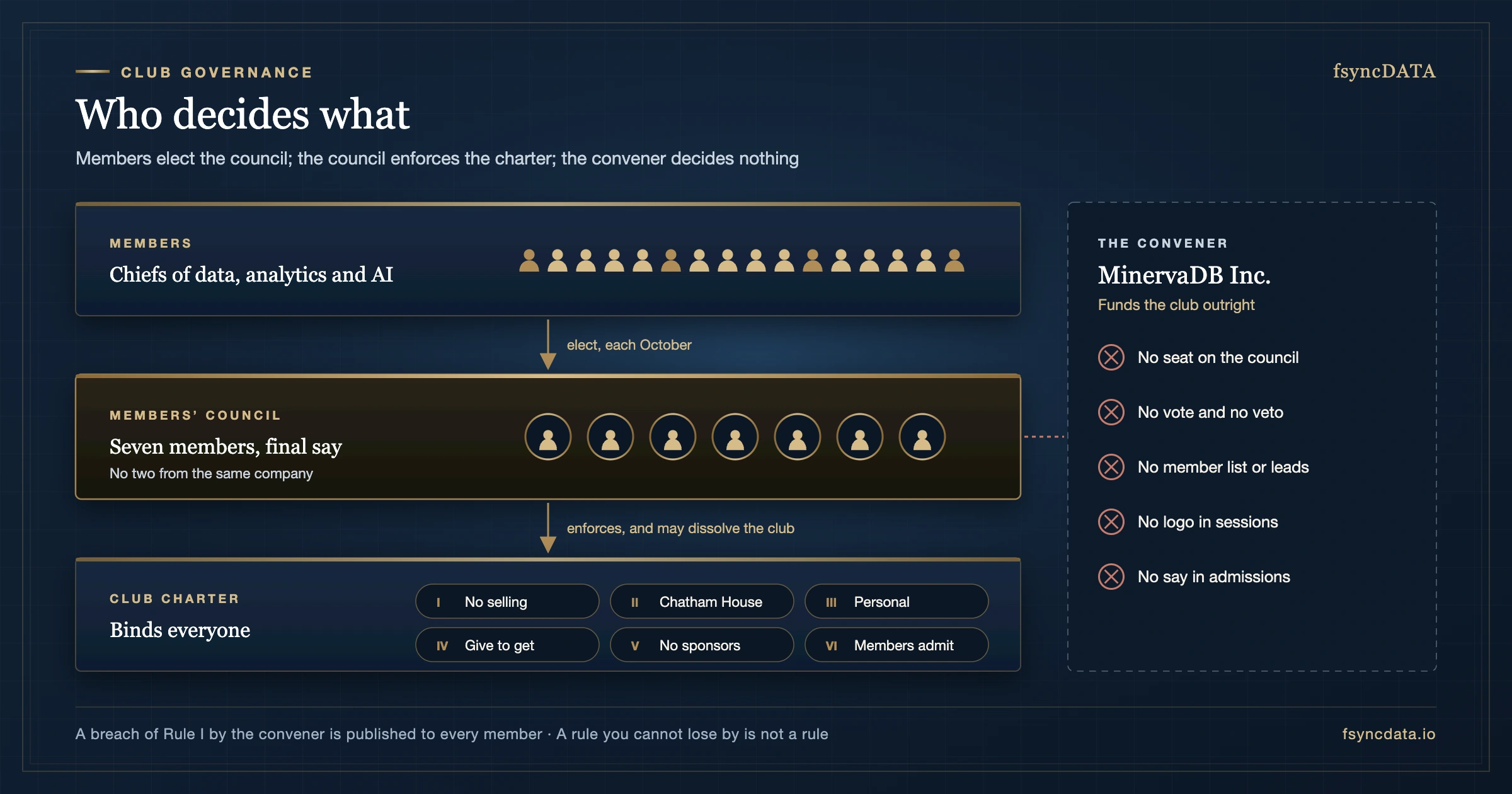
The annual assembly takes place in Bengaluru each October. It is part working session and part governance. Members review the club charter and may amend it; they elect the seven members of the council for the coming year; and they set the agenda that will shape the next twelve months of leadership sessions.
The assembly also hears the council’s report on the year: how many requests and nominations it received, how many it approved, whether any breach of the charter was raised, and what the audit of the leadership benchmark found. The convener reports on what it spent and confirms that it received nothing back, as the charter requires.
The day ends with dinner. It is the one evening of the year when most members are in the same room, and for many it is where the introductions that matter most are made.
How the agenda for leadership sessions is set
Members choose what the club works on. The six standing themes are the starting point, not the limit.
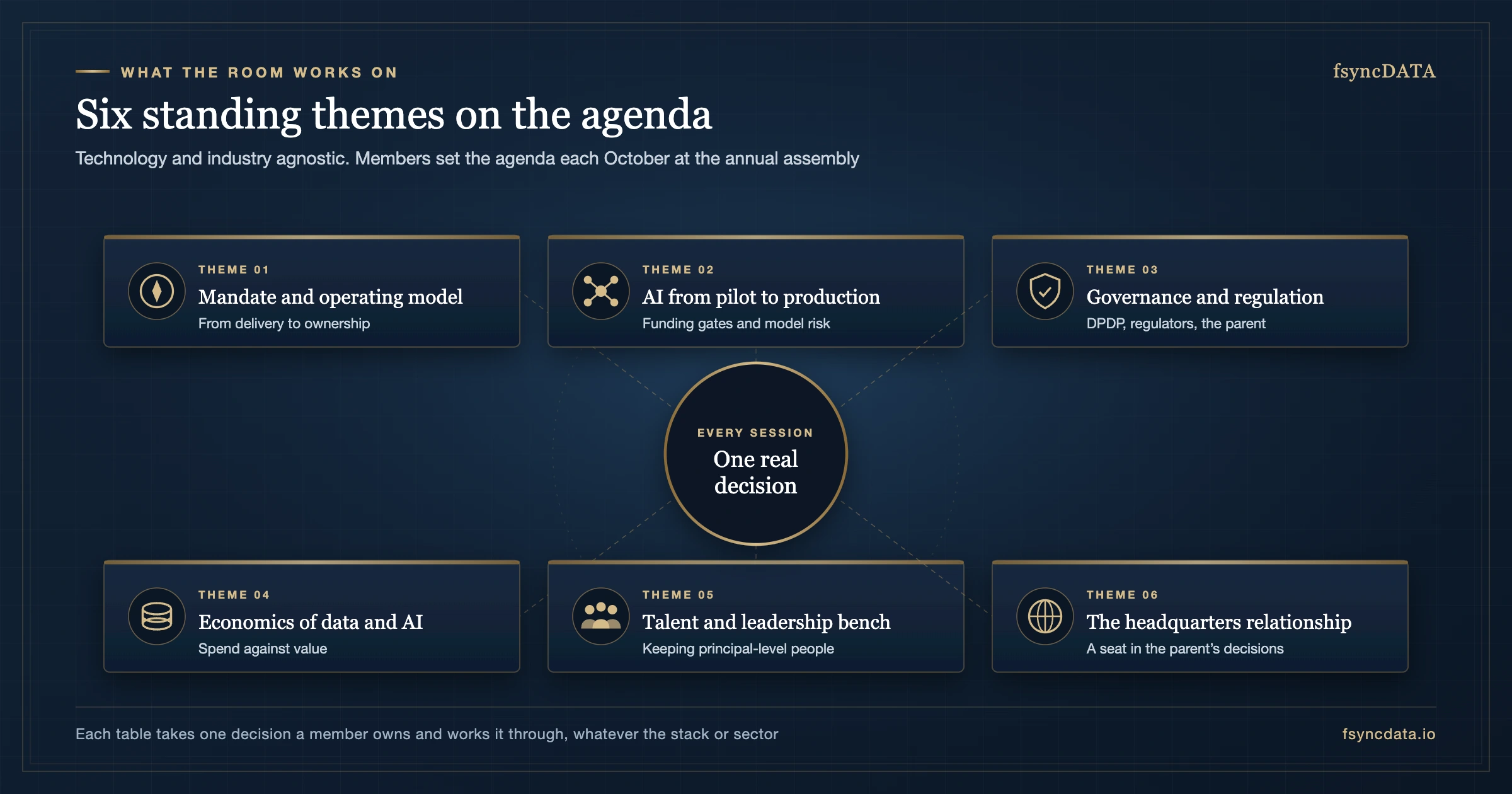
At the annual assembly, each member names the three decisions they expect to own in the coming year. The council groups them into themes and ranks them by how many members face each one. The themes with the most demand become the subjects of the quarterly deep dives, and the individual decisions become candidates for the monthly tables.
Between assemblies, any member may propose a decision for a table. The secretariat schedules proposals in the order received, giving priority to decisions with a deadline. That is how the leadership sessions stay tied to what members are actually doing rather than to what is fashionable.
How to bring a decision to one of our leadership sessions
Most members bring at least one decision in their first year. The secretariat helps with every step.
Propose the decision
Tell the secretariat what you are deciding, by when, and why you want the table’s view. One paragraph is enough.
Write the brief
One page: the mandate, the options, the numbers that matter, what the parent expects. Remove anything that would identify your company if you prefer.
Set it out in twenty minutes
No slides required. The table has read the brief; use the time for what is not on the page.
Read the summary, then decide
The summary reaches the reading room the next day. Tell the next table what you decided, and what happened.
Rules that apply in every one of our leadership sessions
The club charter applies to every session, in person or online.
- Criticise decisions, not people.
- Describe the situation; never name the company, the parent or the person.
- No screenshots or recordings of tables, deep dives or the reading room.
- The Chatham House Rule applies, with one difference: there is no warning stage.
- No selling, recruiting or follow-up approaches, by anyone, including the convener.
The chiefs’ bench between leadership sessions
Not every question can wait for the next table. The bench is how members get an answer in days.
The bench is the part of the club that runs between leadership sessions. A member writes a question to the secretariat, which routes it to members who have faced the same situation. Three of them answer within 48 hours, by name and in confidence. If the question needs a conversation rather than a written answer, the secretariat arranges a call.
Members use the bench for questions that are too specific or too urgent for a table: what a peer paid at renewal, how another center worded a policy for the parent’s audit committee, or whether anyone has tried a particular operating model and regretted it. The answers are not summarised in the reading room unless the member who asked agrees.
Answering on the bench counts as a member’s contribution for the year, and many members find it the easiest way to give back. It takes ten minutes to answer a question you have already lived through, and it can save a peer months.
What leadership sessions leave behind
Every table and deep dive ends in a one-page summary, anonymised, in the members’ reading room the next day.
The reading room is where the club keeps its memory. Each summary records the decision brought, the questions the room asked, what the room would do, and what the member checked or decided afterwards. Names, companies, cities and identifying figures are removed before anything is published, and the member who brought the decision approves the summary first.
Over time the reading room becomes a library of real decisions taken by people in the same position as you. Members use it to prepare for their own leadership sessions, to brief their teams, and to show a parent board that a proposal has been tested against peers. It is visible to signed-in members only and is never shared outside the club.
Centralising analytics teams that sit inside business lines
- The decision brought
- A chief data and analytics officer runs a central platform while analytics teams sit inside four business-line product groups. The parent wants one view of analytics spend and value. Options: centralise the teams, federate with a common standard, or leave the structure and centralise only the reporting.
- What the room asked
- Who owns metric definitions today. Which product groups would lose capability if their analysts moved. Whether the parent wants control or visibility.
- What the room would do
- Federate with a common standard and a shared funding line for the platform, and centralise only reporting for the first year, with a review at the next annual assembly.
How leadership sessions run online and in person
Most of the club runs online. The in-person sessions are where trust is built.
The monthly table runs online by default, which lets members in any city take part and keeps the cost of attending to ninety minutes. When enough members in one city ask, the secretariat arranges a city sitting in a member’s office, with the remote members joining as usual.
Deep dives and the annual assembly are in person. They are where members meet properly, often for the first time, and where the introductions that matter most tend to happen. The secretariat funds venues and hospitality; members pay only for their own travel.
Whether online or in person, our leadership sessions follow the same charter and the same format. A member who has only ever joined online is as much a member as one who has attended every deep dive.
A typical year, quarter by quarter
The rhythm is fixed; the content changes with what members are deciding. This is how the year often falls; exact dates are announced to members first.
| Quarter | What happens | Decisions members often bring |
|---|---|---|
| January to March | A Chiefs’ Table each month and the first deep dive of the year | Decisions on budgets and operating plans for the new financial year |
| April to June | A table each month and the second deep dive | Decisions on reorganisations, renewals and the first AI production gates of the year |
| July to September | A table each month and the third deep dive | Decisions on talent, succession and mid-year course corrections |
| October to December | The annual assembly in Bengaluru, a table each month, and the fourth deep dive | Decisions on the coming year’s mandate and the story told to the parent board |
The pattern follows the planning cycle most parent companies run. Members tend to bring budget and structure decisions early in the year, talent decisions in the middle, and mandate decisions towards the end, when they are preparing the next year’s story for headquarters.
Not every member attends every session. A member who listens well is as valuable as one who brings a decision, and the club asks only that each member gives something back once a year. Many members find that a year of listening is what prepares them to bring their own decision with confidence the following year.
Members who join part way through the year start with whatever is next in the rhythm. There is no induction course to wait for and no cohort to fit into. The profile call in your first week is enough for the secretariat to place you at the right table and to make your first introductions, and your first question to the bench can go in the same day.
If a quarter is too busy, say so. The secretariat would rather hear that a member is stepping back for a few months than see an empty seat at a table that someone else could have used. Stepping back does not affect membership, and the reading room keeps you in touch with what you missed.
Questions about leadership sessions
Are dates published?
Dates, venues and themes are announced to members first. The shape of the year on this page does not change: a weekly bench, a monthly table, a quarterly deep dive and an October assembly.
Can guests attend leadership sessions?
Invitees whose request the council has approved may sit in on one Chiefs’ Table before they decide. Beyond that, sessions are for members only.
Are sessions recorded?
Never. No recordings, transcripts or screenshots. The anonymised summary in the reading room is the only record.
How many leadership sessions must I attend?
None are compulsory. Most members attend the table when they can, one deep dive and the assembly, which comes to about thirty hours a year.
Can I propose a topic?
Yes. Any member may propose a decision for a table at any time, and every member names three decisions at the annual assembly.
What language and time zone do sessions use?
Sessions run in English and in Indian Standard Time. Online tables are usually held in the late afternoon, which suits members in India and leaves room before calls with headquarters in Europe or the Americas. The secretariat moves a session when most of the seats at it ask for a different slot.
Who runs the sessions?
The secretariat organises them and the council sets the themes. Neither MinervaDB nor any vendor has a role in the content.
Take a seat at the next leadership sessions
Leaders request an invitation; invitees may sit in on one Chiefs’ Table as guests before they decide. Anyone may nominate a peer.
Every message to the secretariat is answered by a person within two working days.