Why data and AI leaders join fsyncDATA
GCC data and AI leaders join for three things a conference cannot give them: peers who own the same kind of decision, the numbers that every talk removes from the slide, and a bench to call before the decision is made rather than after. This page sets out what members take home, what it asks of them, and what the club will never do.
Seven reasons data and AI leaders give for joining
We asked what keeps members coming back. These are the answers that came up most often, in their order of frequency.
A peer group at the same altitude
Most data and AI leaders in India’s GCCs have no peer inside their own company. The people at their level are at headquarters, in another time zone and with a different mandate. The club gives them a group of equals who own the same kind of decision in the same market.
Numbers nobody puts on a slide
Under Chatham House with a one-strike rule, members say what a programme really cost, how long it really took and what the parent really thought of it. That is the information that decides whether your own plan is realistic.
A bench before the decision
Put a question to the bench and three members who have faced it answer within 48 hours. Most data and AI leaders use it before a board paper, a renewal or a reorganisation, when a second opinion still changes something.
A view across industries
A bank, a retailer, a pharma center and a software company face the same governance and talent problems under different rules. Seeing all four in one room is the fastest way to tell what is universal from what is local.
A benchmark the parent will believe
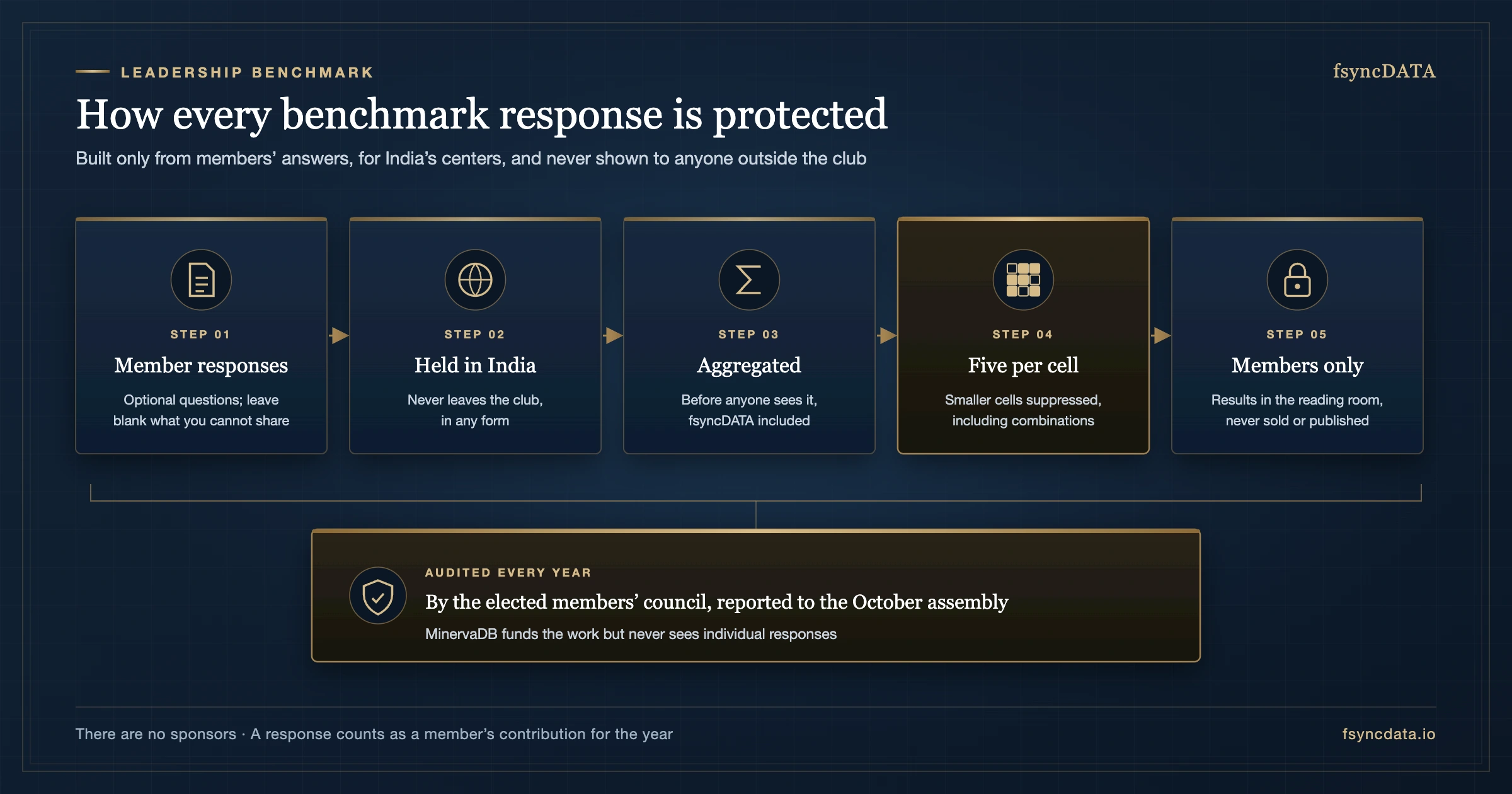
The members-only leadership benchmark answers “is that normal?” with figures from India’s centers specifically, aggregated so no single member can be identified.
Introductions with a reason
The secretariat makes introductions when there is a reason for them: a peer facing the same decision, one a stage ahead, one who chose the other way. Nobody is introduced so that someone can sell to them.
A room with no agenda but yours
No sponsors, no vendor keynotes, no product roadmaps. The agenda is set by members each October, and every session is built around a decision a member actually owns.
What each kind of data and AI leader brings home
Chief Data Officers
- How peers split ownership with the parent’s global CDO, and how they got the split changed
- What a defensible governance and DPDP programme costs and who pays for it
- How others report data value to a board that thinks in revenue
Chief Data and Analytics Officers
- Which analytics products the business actually adopted, and why the rest stalled
- How peers fund self-service without losing control of definitions
- What a credible value story looks like after the second year
Chief AI Officers
- Funding gates and kill criteria that peers have made stick
- Who signs off model risk, and how others drew the line with headquarters
- What it really costs to keep an AI system in production
Equivalent heads
- A room of leaders at the same altitude, whatever your title
- Introductions to chiefs who have already made the move you are considering
- A view of how mandates grow from delivery to ownership
Three returns for data and AI leaders, all year
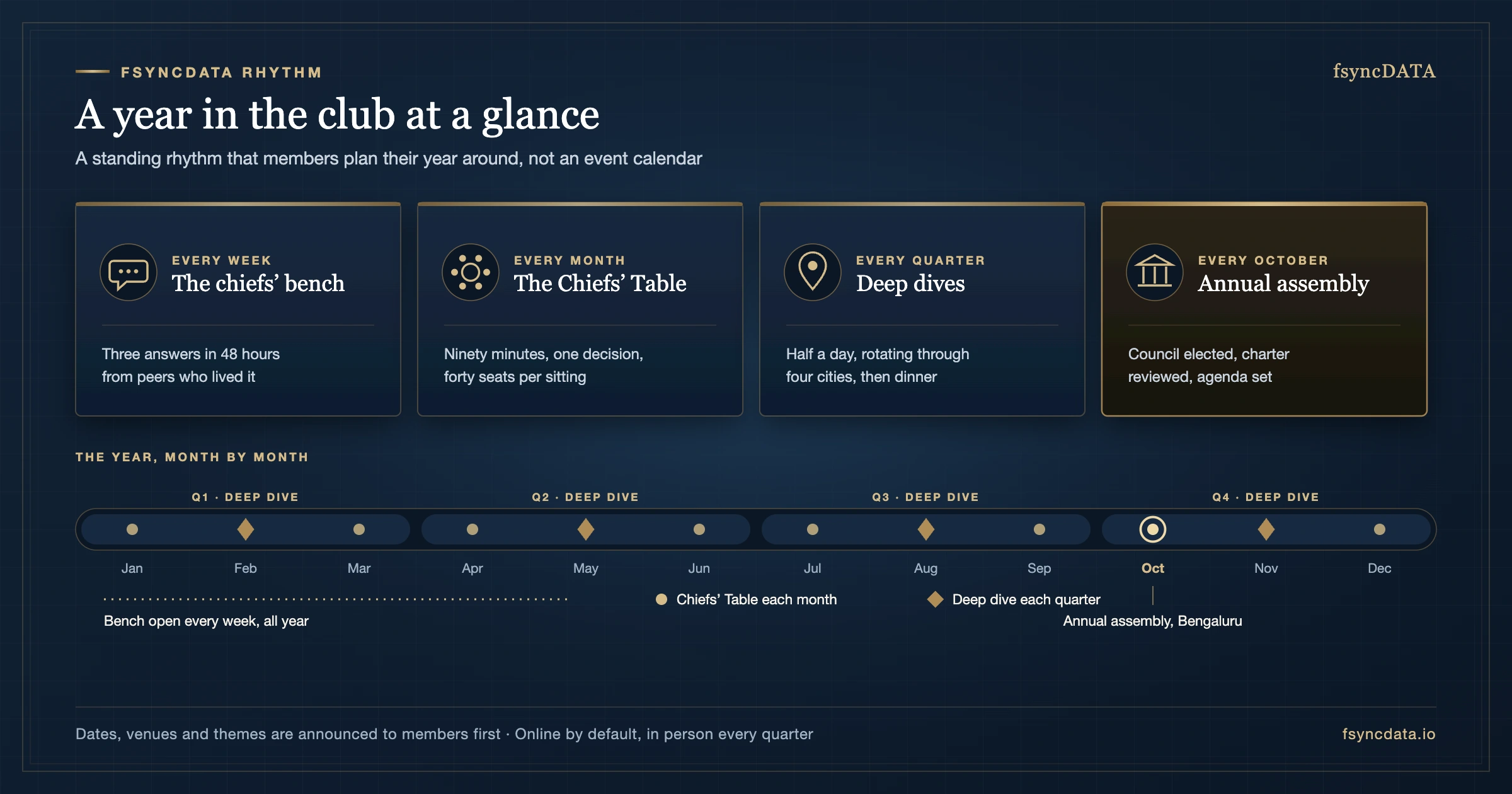
The club is not an event you attend. It is a standing rhythm that members plan their year around.
Network
- The 48-hour chiefs’ bench
- Three introductions in the first month, each with a reason
- Members in Bengaluru, Hyderabad, Pune and Chennai
- A directory of peers who take the call
Learn
- A Chiefs’ Table each month on one real decision
- Quarterly deep dives in four cities
- The members’ reading room of table summaries
Decide
- The members-only leadership benchmark
- Peer review of a decision before you take it to the parent
- A view across every industry the GCCs serve
What a Chiefs’ Table gives data and AI leaders
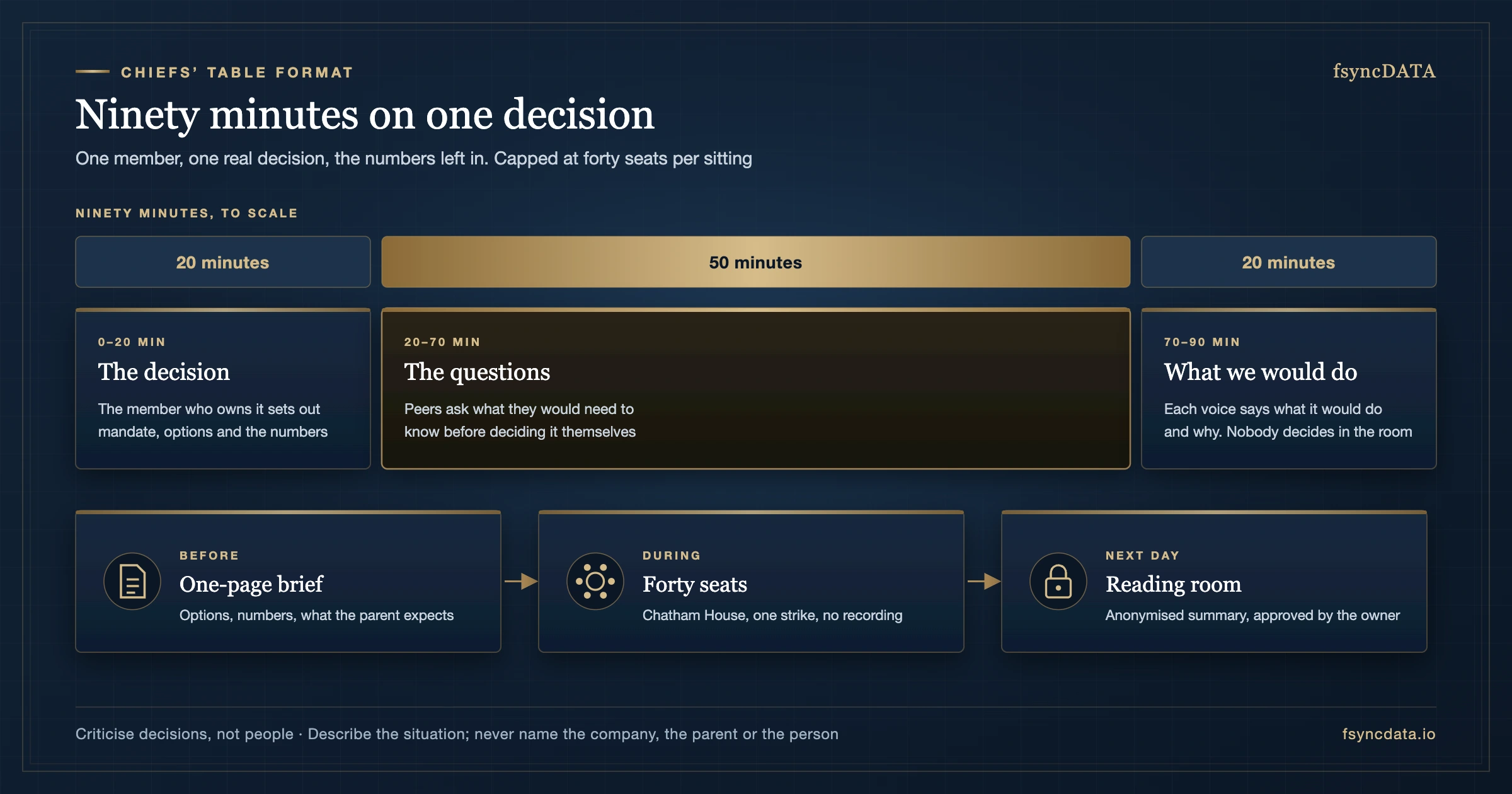
Ninety minutes, one decision, one member who owns it. Capped at forty seats so that everyone at the table can speak.
The monthly Chiefs’ Table is the centre of the club. One member brings a decision they have not yet made, with the numbers that matter: the budget, the options, what the parent expects and by when. For twenty minutes they set it out. For fifty minutes the other data and AI leaders at the table ask the questions they would need answered before deciding. For the last twenty, each voice says what it would do and why.
What makes it useful is that nobody is performing. There is no audience, no slide deck for a vendor to photograph and no recording. The member who brought the decision leaves with a dozen informed opinions from people who have faced something similar, and the rest leave with a case they can compare against their own.
The next day a one-page summary reaches the members’ reading room, with names, companies and identifying figures removed. Data and AI leaders who could not attend read it on the way to their own meetings, and many say it is the most useful page they read that month.
How data and AI leaders use the 48-hour bench
The bench is the part of the club members use most, and the part they talk about least.
Any member can put a question to the bench. The secretariat routes it to members who have faced the same situation, and three of them answer within 48 hours, by name and in confidence. Questions range from the strategic to the very specific: how to structure a data office that reports to two executives, what a peer paid for a platform renewal in the last year, or how another center handled a regulator’s request for model documentation.
Because the answers come from data and AI leaders who own the same kind of decision, they tend to be short and practical. Nobody on the bench is trying to win a deal or a follow-up meeting. If the question needs more than a written answer, the secretariat arranges a call between the people involved.
The bench is also where members first test whether the club is worth their time. Most new members put their first question within six weeks, and most say the answer was the moment the club became part of how they work rather than something on their calendar.
A benchmark built by data and AI leaders, for them
The leadership benchmark gives members a number to put beside their own. It covers mandate, organisation, economics, AI in production and governance across India’s centers.
About thirty hours a year, and one contribution
Membership is free. Time is the real cost, and it is modest.
Attend the monthly table when you can, one deep dive and the annual assembly in Bengaluru each October. Once a year, give something back: bring a decision to the table, answer a peer on the bench, or respond to the benchmark.
Most data and AI leaders find that the hours on the bench save them more than that elsewhere, but that is for you to judge. If after ninety days the club is not what this page describes, leave. No explanation is required.
The first ninety days for new data and AI leaders
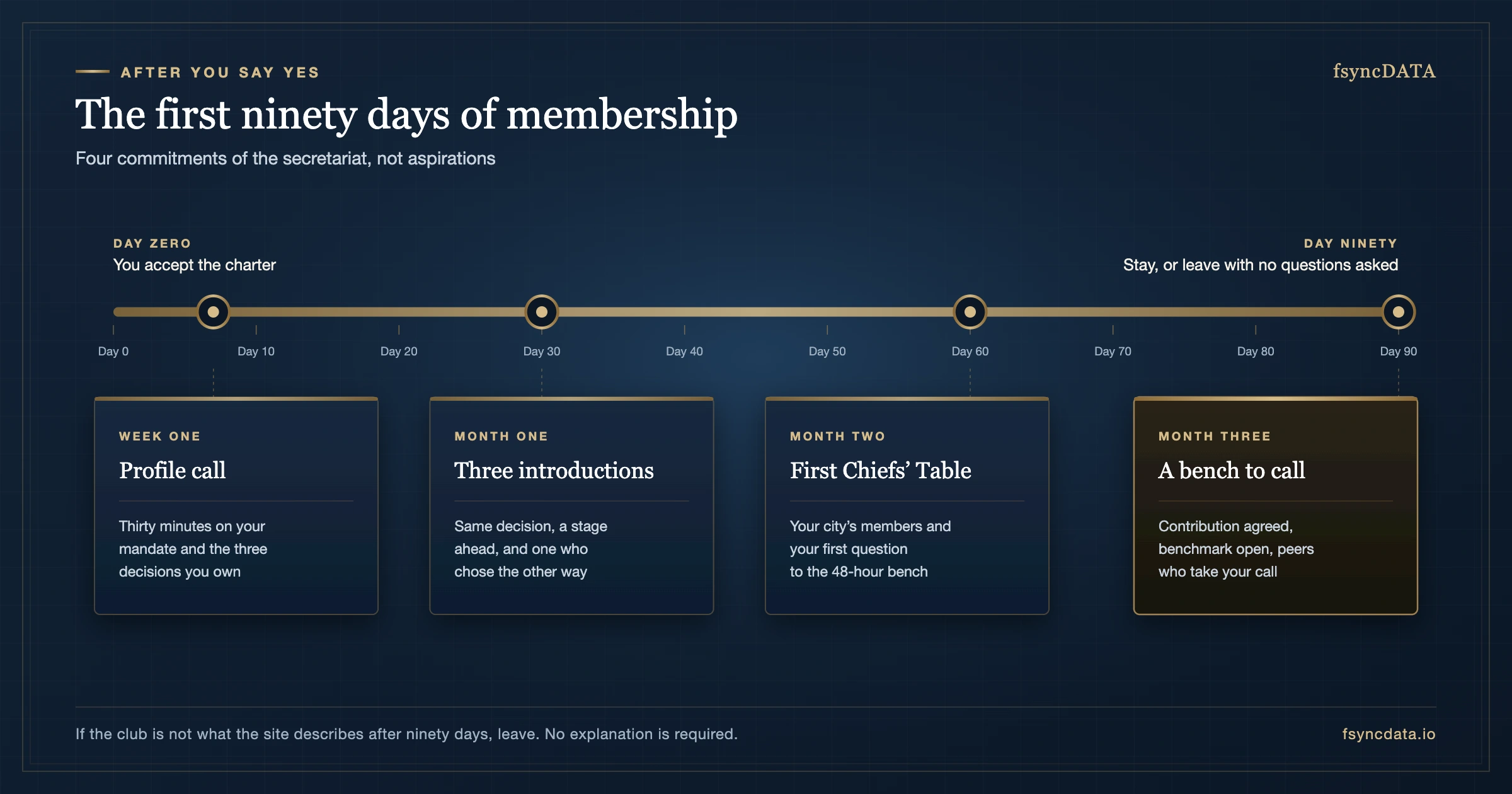
A thirty-minute profile call
Your mandate, your reporting line, and the three decisions you own this year. Nothing that identifies you or your center leaves the club.
Three introductions, each with a reason
A chief facing the same decision, one a stage ahead, and one who chose the other way.
Your first Chiefs’ Table
You sit at the table, meet members in your city, and put your first question to the bench.
A bench you can call
Your contribution for the year agreed, the benchmark open to you, and a directory of peers who have agreed to take your call.
What data and AI leaders should not expect from the club
A club that promises everything is a sales funnel. Here is what fsyncDATA deliberately does not offer.
Vendor introductions
Nobody in the club will introduce you to a supplier, and the secretariat will never pass your details to one. If you want a recommendation, ask the bench, and members will tell you what they use and why.
Certificates or training
The club is not a course. There are no certificates, no curriculum and no badges. Members learn from each other’s decisions, not from a syllabus.
Visibility or awards
There are no awards, no speaker slots to win and no rankings of members. What is said in the club stays in the club, which is the opposite of a platform for visibility.
Recruiting
Members may not recruit each other’s teams through the club. Data and AI leaders join to compare notes, not to lose their best people to the person across the table.
Answers on demand
The bench answers within 48 hours, but it is made of peers who have day jobs. It is not a help desk, and members who treat it like one are reminded of that.
A seat for your deputy
Seats are personal and never delegated. If you cannot attend, the summary in the reading room is there the next day.
Why data and AI leaders stay
Members describe the value of the club in different ways, but a few themes come up again and again. The first is time: data and AI leaders say the bench saves them from weeks of internal debate by putting a tested answer in front of them before they commit. The second is confidence: hearing that a peer made the same call, and what happened next, makes it easier to take a decision to the parent board.
The third is perspective. Several members say the most useful sessions were the ones outside their own industry, where a familiar problem looked different under a different regulator. And the fourth is relief at being in a room where nobody is selling. For data and AI leaders who spend much of their week being pitched to, that alone is worth the thirty hours.
We do not publish testimonials, and we will not put names to these themes. The club charter forbids attribution, and members would not stay if we broke it. The way to test whether the themes are true is to sit at one table as a guest.
A typical month looks like this. In the first week, a member posts a question to the bench about how peers structured the handover of a platform from a global team to the India center. Three answers arrive within two days, one of them from a member who did the same handover a year earlier and is willing to talk it through on a call.
In the second week, the secretariat sends the brief for the month’s Chiefs’ Table: a decision about whether to centralise analytics teams that currently sit inside business lines. The member bringing it shares the headcount, the cost and the parent’s expectations in advance, so the table can spend its time on questions rather than context.
In the third week, the table meets. In the fourth, the summary is in the reading room, the member who brought the decision has made it, and the secretariat has made two introductions that came out of the conversation. Nothing in that month involved a vendor, a slide or a sales call, and the hours it took were spent on decisions that members would have had to make anyway.
Questions data and AI leaders ask before joining
Is this a sales funnel with better manners?
No, and the club charter is written so that you can prove it. Rule I forbids any approach that references the club, by fsyncDATA, MinervaDB or ChistaDATA. A breach is published to every member by a council we do not sit on.
Will I be the only one from my industry?
Unlikely, and it would not matter if you were. The club mixes industries on purpose, because data and AI leaders learn most from peers who face the same decision under different rules.
I cannot share our numbers.
Then bring the decision without them and listen. Under the Chatham House Rule, what is said may be used and who said it may not; the one-strike rule protects the members who do share.
What if I miss a month?
Most members miss some tables. The summary reaches the reading room the next day, and the bench is there whenever you need it.
Does it cost anything later?
No. There is no fee and no premium tier coming. MinervaDB funds the club outright, and the charter forbids sponsors.
Can my organisation sponsor a session instead?
No. The club takes no sponsorship money from anyone, including members’ employers. Members may host a deep dive in their own office, but hosting buys nothing: no branding, no speaking slot and no say over the agenda.
Is there an online-only option?
Yes, in practice. The monthly table runs online, the bench is written, and the reading room is always open. Members outside the four cities take part fully and join the in-person deep dives when they travel. The annual assembly in October is the one gathering the secretariat asks every member to attend if they can, because that is where the council is elected and the charter reviewed.
How do I start?
Request an invitation or ask a member to nominate you. The council decides, and you may sit in on one table as a guest first.
Join the data and AI leaders who already compare notes here
Leaders request an invitation; invitees may sit in on one Chiefs’ Table as guests before they decide. Anyone may nominate a peer.
Every message to the secretariat is answered by a person within two working days.