Members run fsyncDATA, not us
Club governance at fsyncDATA is simple: an elected council of members owns the charter, approves every admission, audits the benchmark and can dissolve the club. Neither fsyncDATA nor MinervaDB has a seat or a veto. This page sets out who decides what, what the secretariat does, and what the convener explicitly does not get.
Three roles in club governance
The council decides, the secretariat serves, and the convener pays. Nobody holds more than one of these roles.
The members’ council
Seven members elected each October at the annual assembly, no two from the same company. It owns the charter, approves admissions, hears breaches, audits the benchmark, sets the pace of growth, and may dissolve the club.
The secretariat
fsyncDATA staff, none in a sales role. It routes bench questions, makes introductions, runs the calendar and answers every message within two working days. It holds the directory and shares it with no one.
The convener
MinervaDB Inc. funds the secretariat, platform, venues and hospitality outright. It gets no member list, no leads, no logo in sessions and no say in admissions.
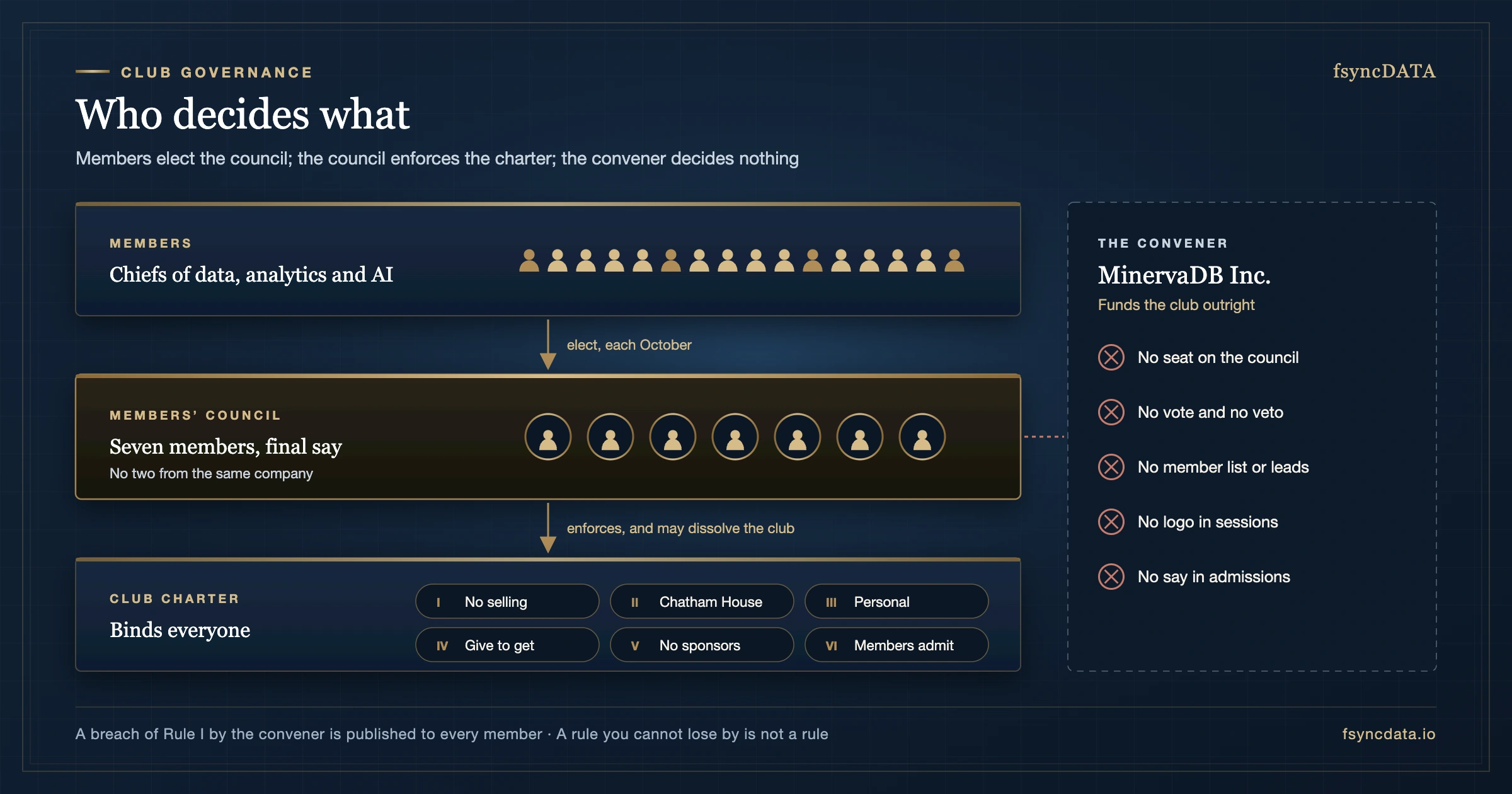
What the council does in club governance
The council is the only body that can change how the club works, and it answers to members.
- Owns the club charter and proposes amendments to the annual assembly
- Approves or declines every request and nomination for membership
- Hears complaints and decides on breaches; its decision is final
- Audits the leadership benchmark before results are released
- Sets the pace of growth and the themes for deep dives
- May dissolve the club, and take its member directory with it
Council members serve for one year and may stand again. They receive no payment and no privileges beyond the work. A council member who moves into a selling role leaves the council and the club on the same day, as any member would.
If a seat falls vacant during the year, the council may leave it empty until the next assembly or invite the candidate with the next highest vote at the last election to fill it. It may not appoint anyone who did not stand. Either way, members are told who sits on the council at any time, because a council that members cannot name is not one they can hold to account.
How the council is elected
Every October, at the annual assembly in Bengaluru, members elect the seven members of the council for the coming year.
Nominations
Any member may stand, or nominate another member who agrees to stand. The secretariat circulates the list of candidates to every member.
The vote
Members vote at the assembly, one vote per seat. The secretariat counts, and the outgoing council confirms the result.
No two from one company
If two candidates from the same company would both be elected, only the one with more votes takes a seat.
A one-year term
The new council takes office at the end of the assembly and serves until the next one.
The secretariat’s place in club governance
The secretariat runs the club day to day. It serves the council and the members; it does not govern.
The secretariat is a small team of fsyncDATA staff, none of them in a sales role at fsyncDATA, MinervaDB or ChistaDATA. It reads every request and nomination, holds the thirty-minute conversations, routes questions to the bench, makes introductions, organises tables and deep dives, and edits the anonymised summaries in the reading room.
It also holds the member directory, and that is where club governance is strictest. The directory is shared with no one: not the convener, not a sister company, not a sponsor (there are none). Contact details are never given to anyone acting for a vendor.
The secretariat answers every message within two working days, by a person. When it is unsure whether something is allowed under the club charter, it asks the council rather than deciding itself.
The secretariat is also the first point of contact for new members. In the first week it holds the thirty-minute profile call; in the first month it makes three introductions, each with a reason; and in the third month it agrees the member’s contribution for the year. Those commitments are written on the homepage, and the council checks each year that they were kept.
What club governance gives the convener, and what it does not
MinervaDB Inc. convenes and funds fsyncDATA. This is the full list of what that buys.
| Item | Convener | Note |
|---|---|---|
| Funds the secretariat, platform, venues and hospitality | Yes | Outright, with nothing taken back |
| A seat or vote on the council | No | Neither fsyncDATA nor MinervaDB |
| A veto over any decision | No | Including amendments to the charter |
| Access to the member list or directory | No | Held by the secretariat alone |
| Leads, introductions or referrals | No | Forbidden by Rule I |
| Logo or branding in sessions | No | No sponsor branding of any kind |
| A say in admissions | No | The council decides |
| Access to individual benchmark responses | No | Aggregated results only, like any member |
“The rooms I learned most in were the ones where nobody was selling. fsyncDATA is that room, and its rules bind me as tightly as they bind anyone in it.”
Shiv Iyer, Founder and CEO, MinervaDB Inc.
A rule you cannot lose by is not a rule
The hardest test of club governance is whether the convener can lose by it. Ours can.
MinervaDB Inc. and ChistaDATA provide database services. If any member receives a services approach from fsyncDATA, MinervaDB or ChistaDATA that references the club, a table or anything learned in one, the council publishes the breach to every member and may dissolve the club.
We wrote that rule so that members do not have to take our word for anything. If we ever used the club to sell, every member would know, and the club would end. That is the guarantee, and it is enforced by people we do not control.
Club governance starts at the door
Rule VI of the club charter puts admission in members’ hands, through the council.
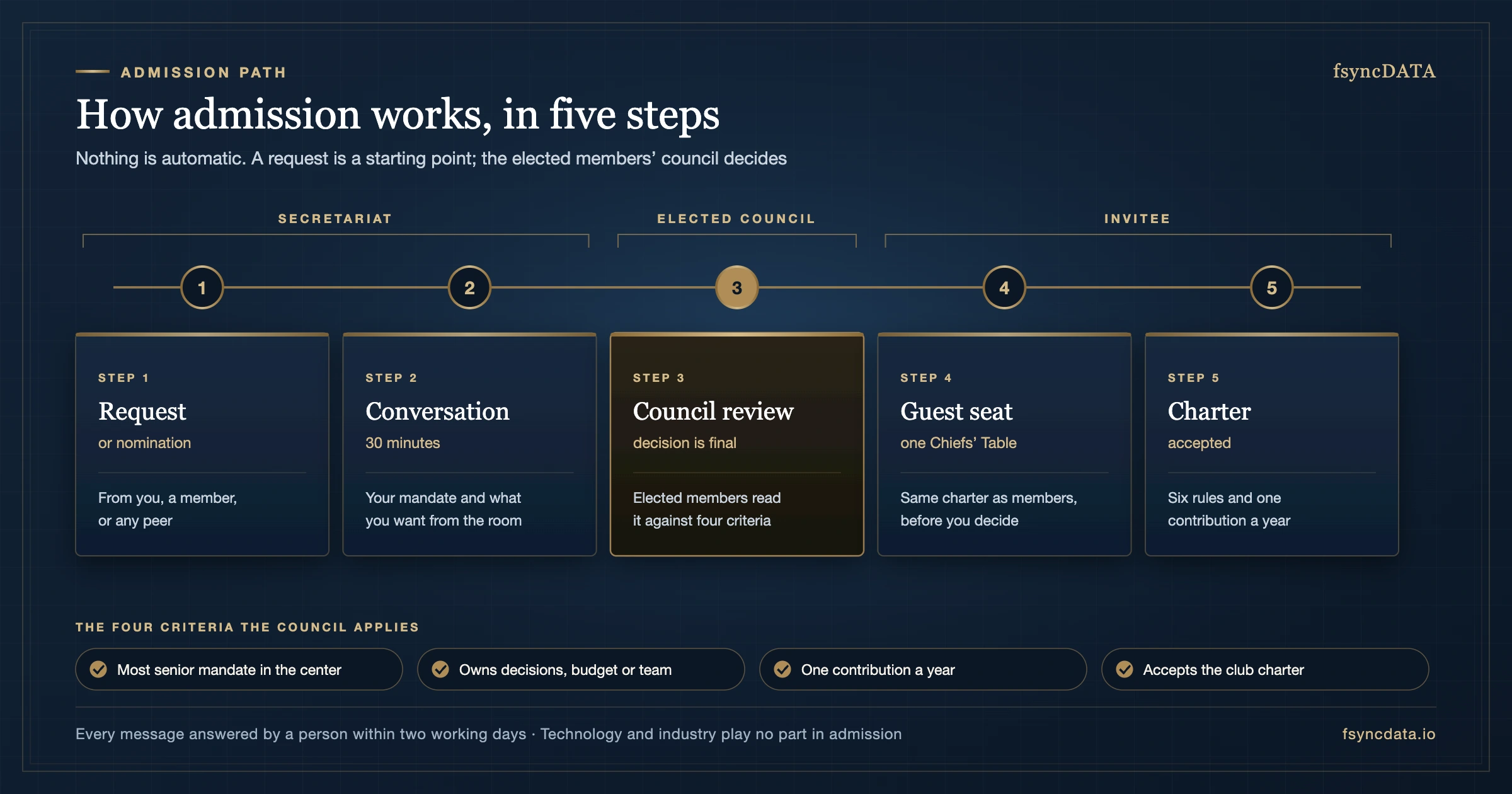
The council admits on mandate, not title: the most senior data, analytics or AI leader of a GCC in India, whatever the business card says. Technology and industry play no part. The secretariat prepares each request; the council reads it and decides. The full criteria are on who is invited.
How club governance covers the benchmark
The council audits the leadership benchmark every year before results reach members.
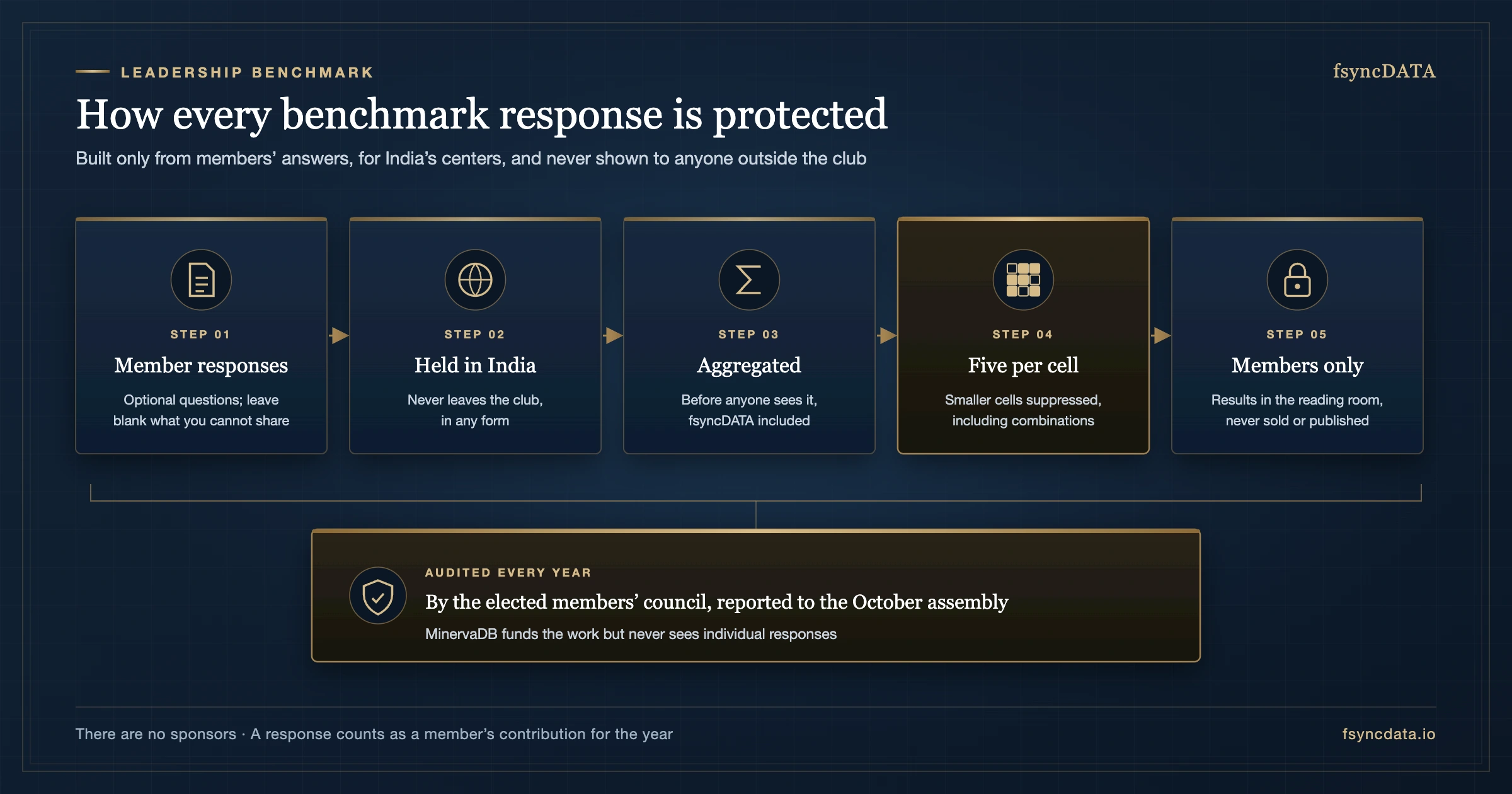
The audit checks that the method matches what members were told, that every published cell has at least five responses, and that nothing could identify a member or a center. The council reports its findings to the annual assembly. Read more about the leadership benchmark.
Where club governance happens in public
Once a year, in Bengaluru each October, every member can see and shape how the club is run.
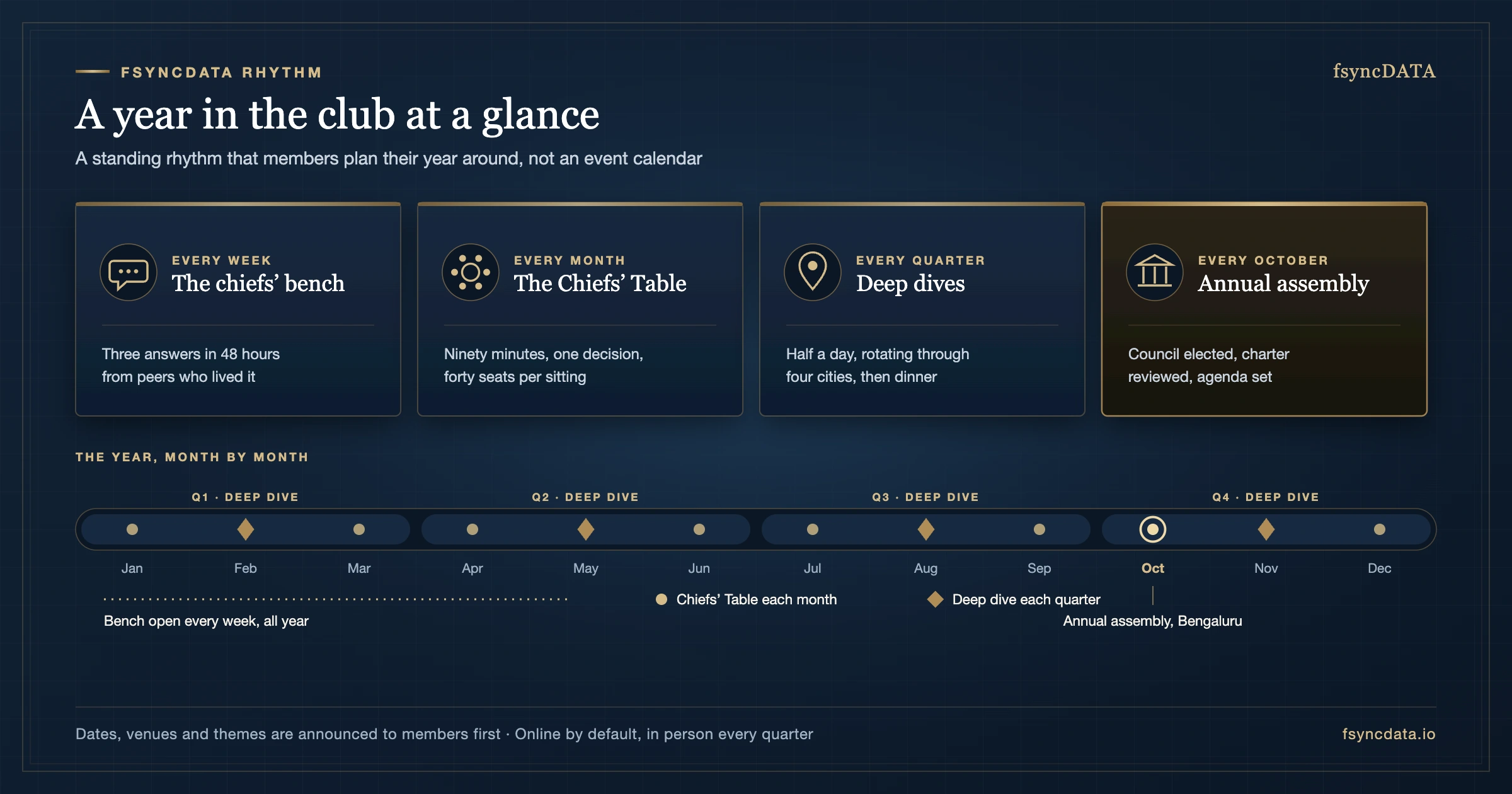
The assembly is where club governance is most visible. The outgoing council reports on its year: requests and nominations received and decided, breaches raised and how they were handled, and what the benchmark audit found. The convener reports what it spent and confirms that it received nothing back.
Members then vote on any proposed amendments to the club charter, elect the new council, and name the three decisions each of them expects to own in the coming year. Those decisions become the agenda. The day ends with dinner, which is usually where the next year’s best introductions begin.
What the council spends its time on
Most council work is quiet and routine. That is how it should be in a club that works.
Reading requests
The largest share of council time goes on admission. Each request and nomination is read against the four criteria, often with a short call to the secretariat to clarify how a center is organised. Most decisions are straightforward; the hard ones are usually about who holds the most senior mandate in a center where the role is split.
Answering questions
Members and the secretariat ask the council whether something is allowed under the club charter: whether a member may share a figure with their board, whether a host may invite a colleague, whether a change of role affects membership. The council answers in confidence and keeps a record so that the same question gets the same answer next time.
Setting themes
Between assemblies, the council turns members’ stated decisions into themes for deep dives and keeps the agenda tied to what members are actually facing. It also decides when the club is growing too fast for the bench to keep its 48-hour promise, and slows admissions if it is.
How club governance handles conflicts of interest
Council members
A council member steps out of any decision that involves their own company, a direct competitor, or a person they manage or report to. The remaining members decide.
The secretariat
Secretariat staff may not hold a sales or pre-sales role at fsyncDATA, MinervaDB or ChistaDATA, now or while they serve. If their role changes, they leave the secretariat.
Hosts
A member who hosts a deep dive gains no influence over its theme, its speakers or its summary. Hosting is a courtesy, not a sponsorship.
Members who host do so because they want peers to see how their center works, and because it is a pleasant way to give back. The secretariat covers hospitality so that hosting never becomes a cost that only larger centers can afford.
What we hold, and what we never do with it
Data handling is part of club governance, and it is audited the same way.
- We hold your name, role, contact details and the profile you agree to share. Company names appear in the directory only if you opt in.
- Table summaries are anonymised before they reach the reading room, and approved by the member who brought the decision.
- Benchmark responses are aggregated before anyone sees them, and held in India.
- Nothing is sold, licensed or shared with any vendor, including the convener. See the privacy policy.
Why club governance sits with members
Most clubs and communities for senior leaders are run by whoever pays for them. That is reasonable, but it creates a problem that members can sense even when nobody mentions it: the person who pays can always decide, in the end, what the room is for. In a club where the convener sells database services, that risk is obvious, and members are right to ask about it.
We could have answered with promises. Instead we put club governance where the convener cannot reach it. The council is elected by members, from members, and the convener has no seat, no vote and no veto. The rules that bind the convener are enforced by people it does not employ, and the penalty for breaking them is public and final.
The arrangement costs us something. We cannot decide who joins, we cannot use what we learn, and we cannot change the rules. That is the point. Members can trust the club because the people who fund it have given up the ability to use it.
It also makes the club more durable. A club that depends on one sponsor’s goodwill ends when the goodwill does. A club run by its members can outlast any of the people who started it, including us.
None of this makes the club perfect. Elected councils make mistakes, secretariats miss deadlines, and rules need amending as the club grows. What the structure guarantees is that when something goes wrong, the people who put it right are the members themselves, and they have the power to do it without asking anyone’s permission.
Questions about club governance
Can MinervaDB overrule the council?
No. MinervaDB has no seat, no vote and no veto. The council’s decisions are final, including decisions about MinervaDB.
What happens if MinervaDB stops funding the club?
The council decides what happens next, including whether to continue with other funding that meets the club charter or to wind the club down. The directory belongs to the club, not the convener. Whatever the council decides, members are told first, and nothing about them is handed to anyone else as part of any change.
Who can stand for the council?
Any member. Candidates are circulated before the annual assembly, and no two members from the same company may sit at once.
How do I raise a concern?
Write to any council member directly, or to the secretariat. Concerns about the convener should go to the council, not the secretariat.
Are council decisions published?
The council reports its decisions to members at the annual assembly. A breach of Rule I by the convener is published to every member when it is found.
How often does the council meet?
As often as the work needs, and at least once a quarter. Most admissions are decided between meetings by written agreement, so that nobody waits a quarter for an answer. Decisions on breaches are always taken at a meeting, with the member concerned given the chance to be heard first.
Is the council paid?
No. Council members serve without payment and receive no privileges beyond the work. Hospitality at council meetings is funded by the convener on the same terms as every other club event.
Can the council remove a member?
Yes, for a breach of the club charter, and only after hearing the member’s account. The council’s decision is final, and the member is told the reason in writing. Membership also lapses on its own when a member moves into a selling role.
Where are the rules written down?
In the club charter, which follows the Chatham House Rule with one difference: there is no warning stage.
Join a club whose governance belongs to its members
Leaders request an invitation; invitees may sit in on one Chiefs’ Table as guests before they decide. Anyone may nominate a peer.
Every message to the secretariat is answered by a person within two working days.