In October 2026 we will propose sixty founding members for the fsyncDATA Circle, an invitation-only club for the people who run India’s Global Capability Center data estates. This note sets out what the founding cohort is, how it is composed, what its members decide, and how to answer an invitation. Further notes will follow here as the cohort is seated.
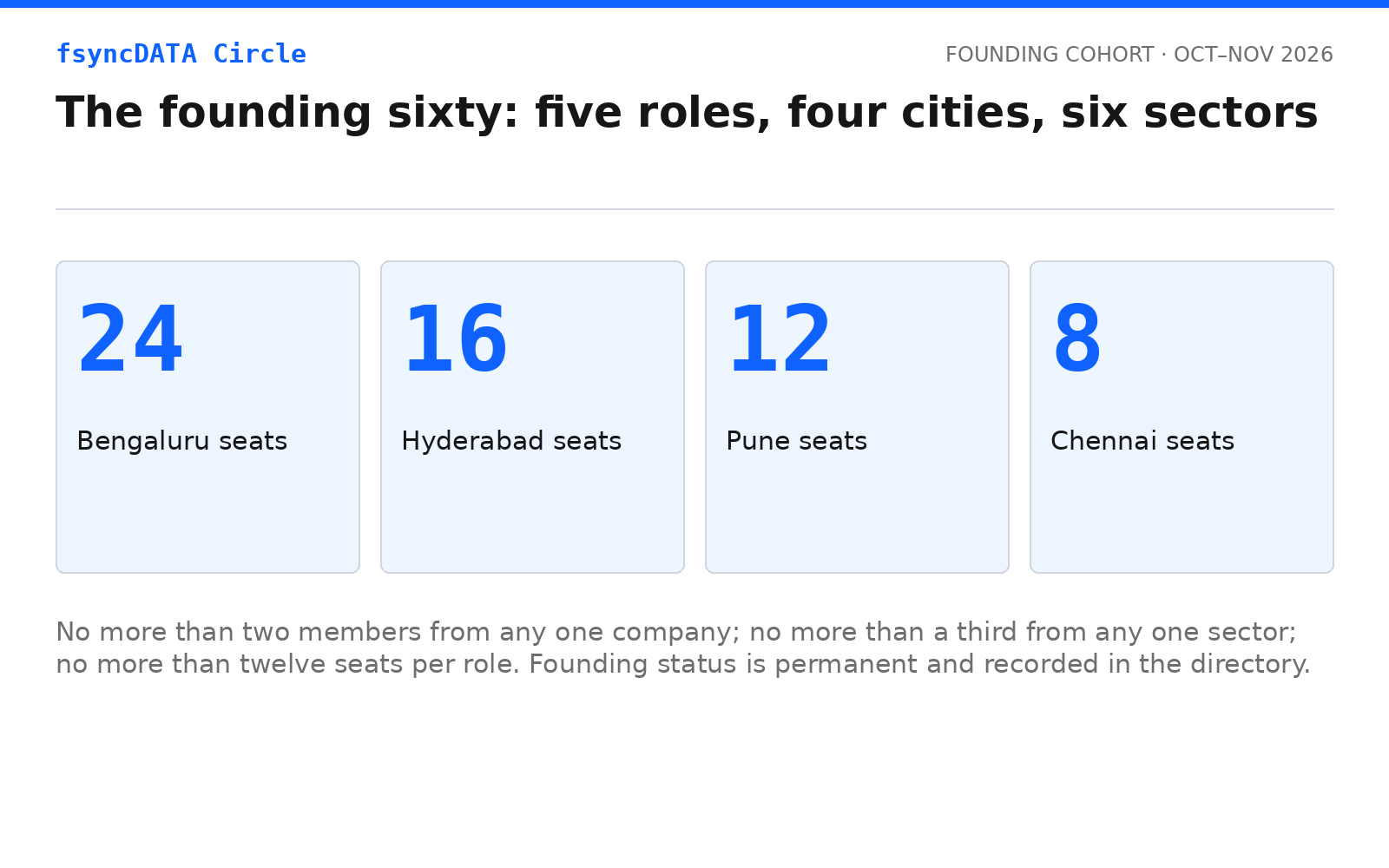
Table of Contents
What the founding cohort is
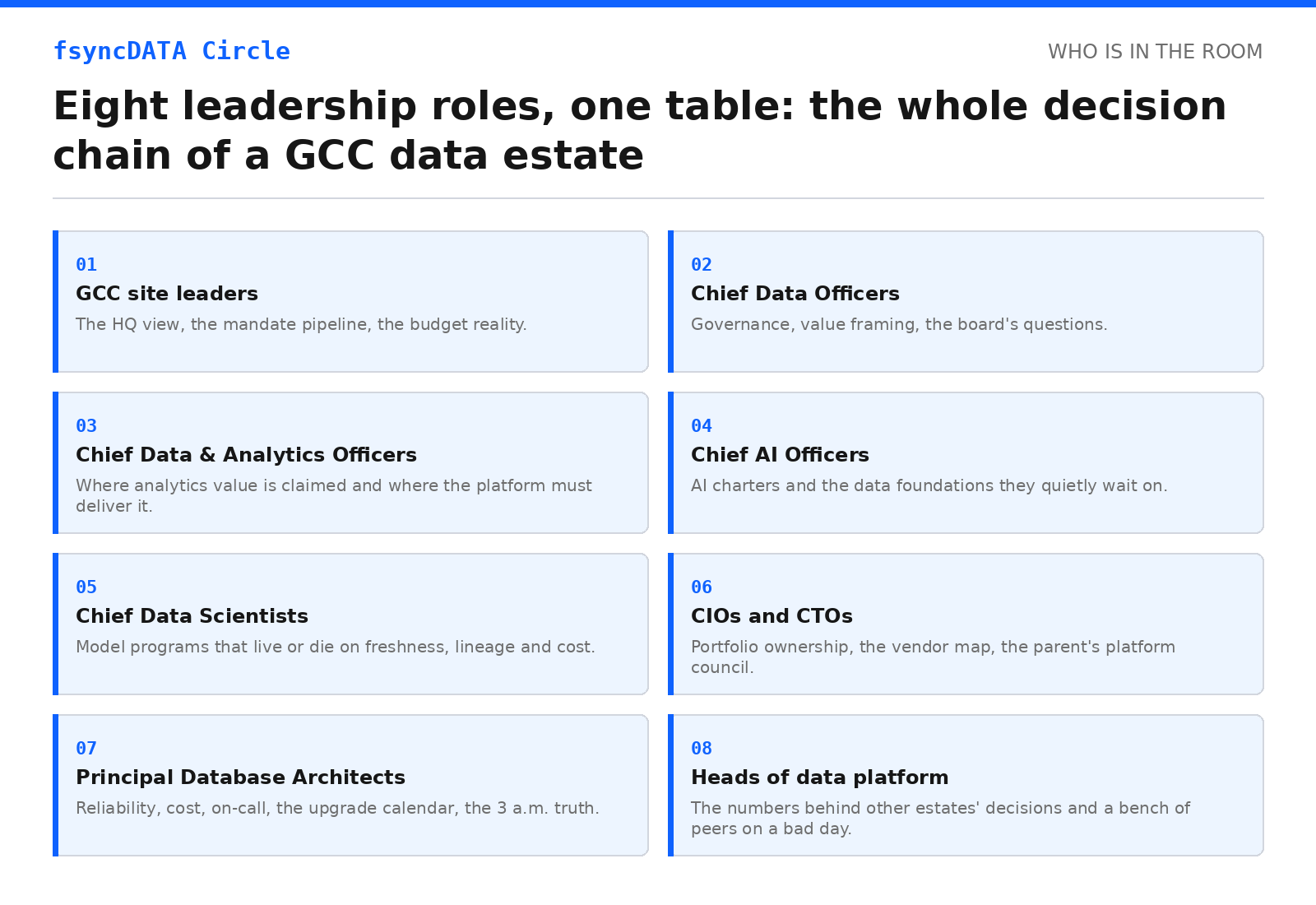
The founding cohort is the first sixty members of the Circle: site leaders, chief data officers, chief data and analytics officers, chief AI officers, chief data scientists, CIOs, CTOs, principal database architects and heads of data platform at capability centers in India, or at their parents’ data organisations. They are proposed by us, the convener, and they are the last members we will ever propose. After them, every seat is filled by a member’s nomination and the council’s approval.
That last sentence is the reason the founding cohort matters more than any cohort after it. Founding members adopt or amend the charter, elect the first council, set the size and pace of the second cohort, approve the benchmark’s questions and choose where the annual assembly is held. Everything the Circle becomes is decided by these sixty people in one evening in Bengaluru, and revisited by them once a year after that.
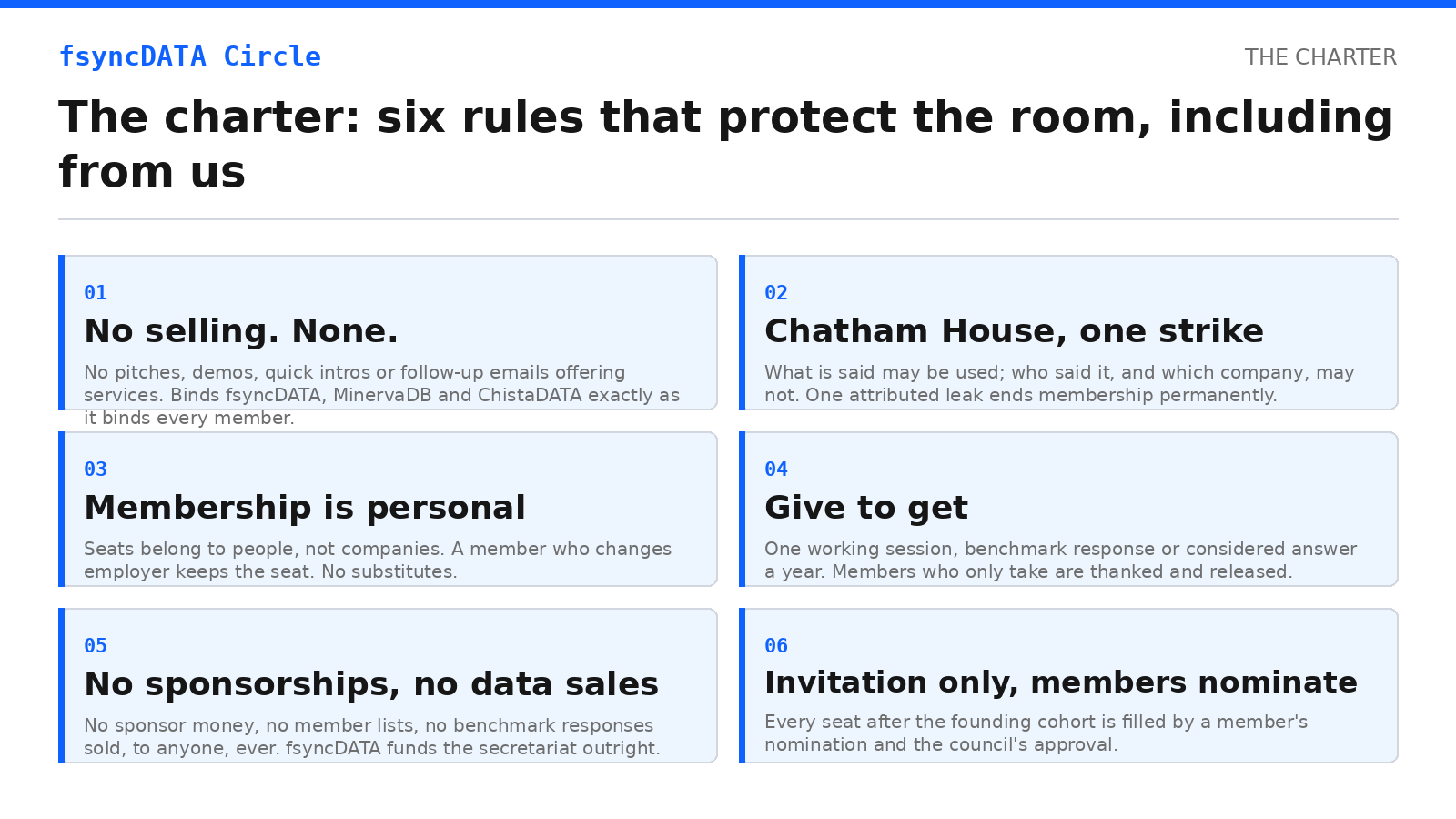
The rules they will be asked to adopt are published on the Circle charter page. The short version: no selling, by anyone, including us; Chatham House with one strike; seats belong to people, not companies; one contribution a year; no sponsors and no data sales; growth by nomination only.
Why sixty, and why now
Sixty is the number at which a room can still know itself. Below it, the sector and stage mix that makes the Circle useful cannot be filled; above it, a working session capped at forty starts to exclude, and the member directory becomes a list rather than a set of people who have met. The founding cohort is sixty so that the first benchmark clears the five-response minimum in most sector and stage cells, and so that the first council is elected by people who have sat with each other.
Why now is the calendar. Decisions that used to be made at a parent’s headquarters are now made in Bengaluru, Hyderabad, Pune and Chennai and ratified afterwards: platform ownership, cloud data spend, end-of-support programs, DPDP readiness, AI foundations. The 2027 end-of-support wave and the dated DPDP obligations both land inside the founding cohort’s first year. The Circle’s year-one curriculum is built around those dates, and a cohort seated in November 2026 works them in time.
India hosts roughly 2,117 capability centers across 3,728 units, according to the Nasscom–Zinnov India GCC Landscape 2026, and more than 1,200 of them carry embedded AI and ML mandates. The founding cohort is not a sample of that market. It is sixty people whose estates and decisions are close enough to each other’s to make the numbers they exchange useful.
Composition of the founding cohort
The founding cohort is composed by role, city and sector, with hard limits on concentration. No more than twelve seats go to any one role. No more than two members come from any one company. No more than a third come from any one sector. Cities are allocated by where India’s centers actually are: Bengaluru 24, Hyderabad 16, Pune 12, Chennai 8.
| Dimension | Target for the founding sixty |
|---|---|
| Site leaders | 10 |
| Chief data officers, chief data and analytics officers, heads of data | 10 |
| CIOs, CTOs, chief AI officers, chief data scientists | 14 |
| Principal database architects and data architects | 14 |
| Heads of data platform and senior data engineers | 12 |
| Bengaluru · Hyderabad · Pune · Chennai | 24 · 16 · 12 · 8 |
| Sectors | BFSI, retail and CPG, software and product, healthcare and pharma, industrial and engineering, PE-backed mid-market; no more than a third from any one |
| Stages | Day-1 centers, scaling centers and portfolio owners, mixed deliberately |
The role mix is the point of the founding cohort. Most rooms seat one role; the Circle seats the whole decision chain of a center’s data estate, so that the site leader hears what the principal architect knows about cost, and the architect hears what the site leader knows about the parent. The sector and stage mix is what lets a Day-1 center learn from a portfolio owner and a BFSI captive learn from a retail estate. The roles are described in full on the GCC leadership roles page.
What founding members decide
Five things, at the founding session. Whether the charter stands as written or is amended. Who sits on the first members’ council, five people, no two from the same company or role, elected by ballot. The size and pace of the second cohort. The benchmark’s questions, before the survey is issued in January 2027. Which city hosts the annual assembly in October 2027.
Two things the founding cohort cannot amend, because they are the conditions under which we convene the room: Rule 1, no selling, and the council’s power to find us in breach of it and dissolve the Circle. Everything else, including the one-strike sanction under Chatham House, the contribution expectation and the nomination mechanics, is theirs to shape.
Founding members also shape the Circle by what they bring. Each is asked to bring a real decision, with its numbers, to the room at least once; to answer the benchmark honestly; and to nominate one person a year who belongs there. The first year’s working sessions are told by founding members. The GCC data platform curriculum lists the eight themes they will work.
What the founding cohort will not be asked to do
Founding members will not be asked to recruit, to sponsor, to speak at anything we organise commercially, to lend their names or logos, or to appear in any marketing. The founding cohort exists to make the Circle real for its members, not to make it visible for us. The one public artefact the council may release is a three-paragraph benchmark summary with no numbers, and only if the council chooses. Founding members who prefer that even their membership is not mentioned outside the room may opt out of every directory field but role and city.
Nor will the founding cohort be asked to fund anything. We pay for the secretariat, the platform, the deep-dive venues, the dinners and the benchmark infrastructure outright. The price of a founding seat is the same as the price of any seat: one contribution a year, and the discipline to keep the charter.
What founding status carries
Permanent recognition in the directory and at every assembly. Priority nomination rights for the second cohort. A standing seat at the annual charter review, for as long as the member remains in the Circle. Nothing commercial, from anyone, ever.
Founding status follows the person, not the company. A founding member who moves to another center, or to the parent’s data organisation, keeps the seat and the status. A founding member who moves into a sales, pre-sales, partnerships or marketing role at a vendor, consultancy or analytics firm is thanked and released, like any other member, because the charter does not bend for founders. The one thing founding status does not carry is immunity from Rule 2.
The founding cohort timeline
| When | What happens |
|---|---|
| October 2026 | We propose sixty founding members across five roles, four cities and six sectors. Each receives the invitation prospectus and a personal note explaining why they were proposed. |
| October to November 2026 | Accepting members complete a thirty-minute profile call with the secretariat. Declined seats are re-offered from a reserve list. No seat is filled by a company’s substitute. |
| November 2026 | Founding session in Bengaluru. Charter adopted or amended, first council elected, first working session on portfolio ownership the same evening. |
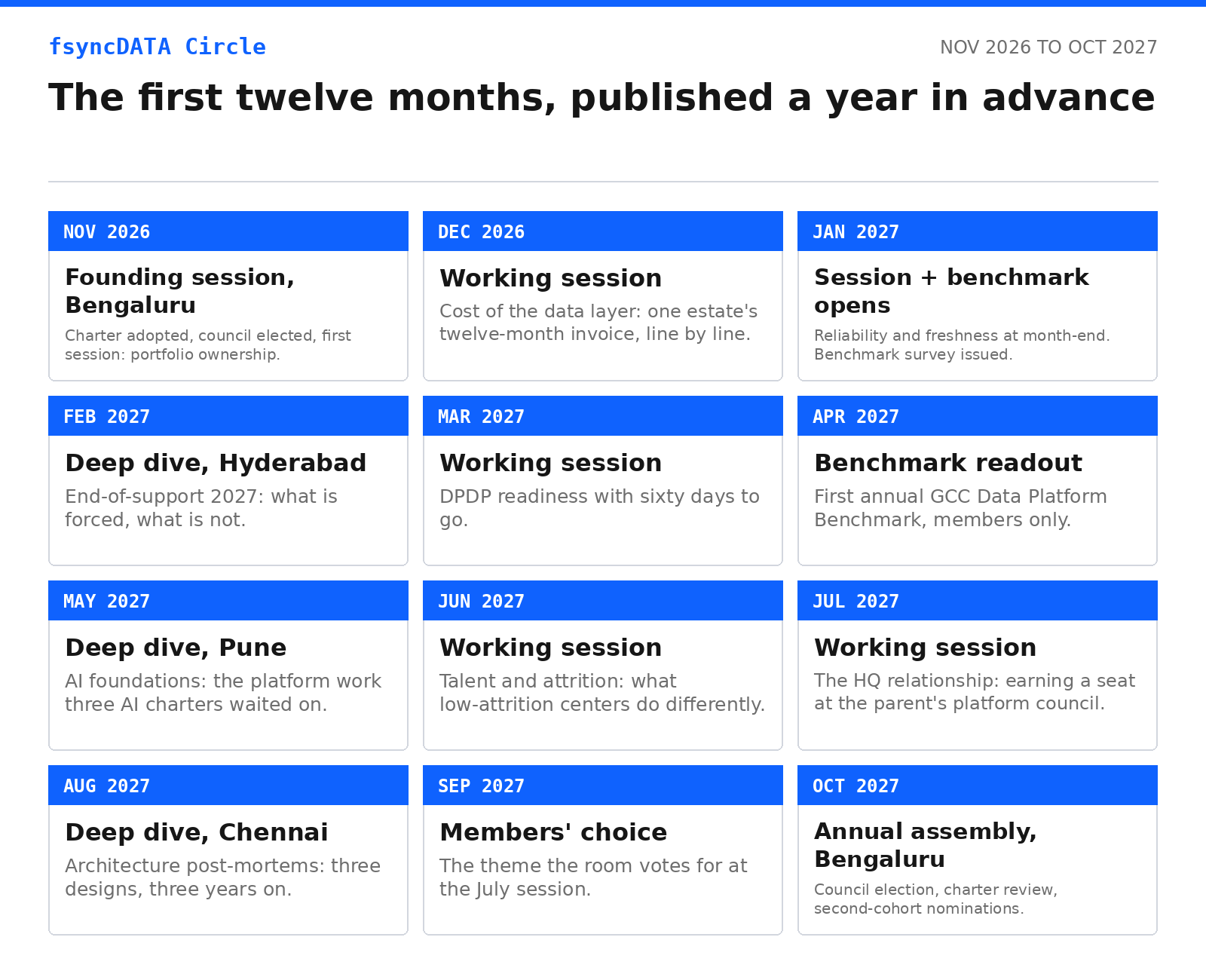
| December 2026 to March 2027 | Monthly working sessions; the first deep dive in Hyderabad in February; the benchmark survey issued in January. |
| April 2027 | First annual GCC Data Platform Benchmark readout, members only. From this point the founding cohort has something no other room in India has. |
| October 2027 | Annual assembly: council election, charter review, second-cohort nominations. Founding members hold a standing seat at the review. |
The full year is on the Circle calendar. Dates are published a year ahead so that founding members can hold them; the ask is six of twelve working sessions, the benchmark once, one contribution and one nomination.
Who we are proposing, and how
We are proposing people, not companies, and we are proposing them for what they run rather than for what their title says. The test for a founding seat is the test for any seat: you hold one of the leadership roles at a capability center in India or at its parent’s data organisation; you are accountable for a real production data estate, or you architect or run one day to day; you are willing to bring a real decision to the room, with its numbers, at least once.
What disqualifies: a sales, pre-sales, partnerships or marketing role at any vendor, consultancy or analytics firm, our own group included; attendance on behalf of a company rather than as yourself; a prior breach of a comparable confidentiality charter. We are not proposing analysts, consultants or advisors who would attend to prospect, and we are not proposing anyone who would rather present than learn.
How we choose is worth stating plainly, because a convener’s choice of founders is the one decision the council cannot yet check. We draw on the people we have worked alongside at the parents of India’s centers and in the centers themselves, and we weight toward the estate and the decision, not toward the relationship with us. Where we are unsure, we ask a person we trust in that sector to tell us who belongs. Where a proposed founder tells us a colleague belongs more than they do, we treat that as the strongest recommendation a seat can receive, and we say so in the prospectus.
If you have not received a personal note and believe you belong in the founding cohort, you may say so. Requests from outside the proposed sixty go to the reserve list, in the order that keeps the composition target intact, and declined seats are re-offered from it. The form is on the request an invitation page.
The founding session in Bengaluru
One evening in Bengaluru in November 2026, in person and online. The charter is read and adopted or amended by those present. The first council is elected by simple ballot, run by the secretariat and witnessed by two members who are not standing. The second cohort’s size and the assembly city are decided. Then the first working session runs: portfolio ownership, told by a center that won it, with twenty minutes of story, forty of questions and thirty of what the room would do.
Founding invitees who have not yet accepted may attend the founding session as guests before deciding. They hear the charter adopted, watch the council elected and sit through the first session under the same Chatham House rule as members. They do not vote and are not recorded. It is the only session, ever, at which guests are admitted, because it is the session at which people decide.
Bengaluru is the founding city because roughly 30% of India’s centers are there and 24 of the sixty founding seats are allocated to it. The deep dives rotate through the other three cities in the first year so that the founding cohort meets in each of them, and the assembly returns to Bengaluru unless the founders choose otherwise.
What a founding member’s first ninety days look like
Week one, a thirty-minute profile call with the secretariat. Weeks two to four, three introductions chosen for complementarity: one in your role at a different stage, one in a different role at your stage, one in your sector. Month two, the founding session itself for those seated in October, or the December working session for those seated later, and a first ask-the-network question. Month three, your contribution for the year chosen with the secretariat: a session, a benchmark response, or standing availability for peers’ questions.
Most of what the founding cohort gains arrives in that first quarter, before the benchmark and before the deep dives: three people in the room whose numbers you have seen and who have seen yours. The test the secretariat applies at twelve months is whether every member has three people in the Circle they would call before calling a vendor. For the founding cohort, the secretariat expects that test to be met by the April readout.
How to reply
Three ways. Accept, and a thirty-minute profile call is scheduled: your estate shape, the three topics you can be asked about, the three you want to learn, your directory preferences. Ask, and a person from the secretariat answers within two working days; if you would rather see a session first, say so, and attend as a guest. Nominate, and the council considers your colleague ahead of you.
Nothing in this process is a sale, and nothing that follows it will be. The Circle has no fee, no sponsors and no sales conversations, including by us. If any member ever receives a services approach from fsyncDATA, MinervaDB or ChistaDATA that references the Circle, the council publishes the breach to all members and may dissolve the Circle. We wrote that into the charter because a rule we cannot lose by is not a rule.
For the record, once: fsyncDATA is the India-domiciled data-platform operations business of MinervaDB Inc., serving Global Capability Centers, and a sister to ChistaDATA. That is who is holding the door for the founding cohort. Who walks through it, and what the room becomes, is up to the sixty.
The secretariat is reached at circle@fsyncdata.io from October 2026, and until then at shiv@minervadb.com with the subject line “fsyncDATA Circle”. Every message is answered by a person within two working days. fsyncDATA is a working name; entity and domain registrations are in progress, and the secretariat address will be confirmed in the founding invitations.
One caveat we apply to our own practice and repeat here: the end-of-support dates and market figures referenced above are version-pinned as of September 2026 and should be re-verified against current sources before any decision rests on them. The founding cohort will do exactly that, together, in February.